
 By
By How Luoyang Became a Central Hub for Chinese Buddhism
How did an ancient capital, Luoyang, emerge as a pivotal hub for the propagation and development of Buddhism in ancient China? The city’s unique confluence of political power, strategic geography, and dedicated religious infrastructure created an environment unparalleled for the growth of a foreign faith. Understanding this historical dynamic is crucial for appreciating the deep roots of Buddhism in Chinese culture and its enduring legacy.
The Early Seeds: Buddhism’s Arrival and Initial Growth in Luoyang
Buddhism first arrived in China during the Eastern Han dynasty, with Luoyang serving as the imperial capital. This early introduction was not a rapid conversion process but a gradual assimilation, heavily influenced by the city’s status and its role as a terminus for international exchange. The narrative often points to the establishment of the White Horse Temple (Baima Si) in Luoyang, traditionally regarded as the first Buddhist temple in China, as a foundational moment. While historical debates exist regarding its exact founding date, its symbolic significance is undeniable.
The city’s position at the eastern end of the Silk Road meant it was a natural point of entry for foreign merchants, envoys, and, critically, Buddhist monks from Central Asia and India. These early missionaries brought with them scriptures, statues, and new philosophical ideas that gradually began to permeate Chinese society, initially within court circles and among intellectuals. The early stages were characterized by the painstaking process of translating Buddhist sutras from Sanskrit into Chinese, a monumental task that began in Luoyang and laid the groundwork for future doctrinal development. This initial phase set the stage for Luoyang to become more than just a capital; it became a cultural crucible where foreign thought met indigenous traditions.
Pillars of Influence: Imperial Patronage, River Routes, and Monastic Institutions
The transformation of Luoyang into a definitive Buddhist center was not accidental but the result of specific, interacting factors. A causal analysis reveals how imperial support, strategic geographical advantages, and well-developed monastic structures collectively propelled Buddhism’s growth. Each element played a distinct role, and their synergy created an environment where the religion could flourish and adapt.
* **Imperial Patronage:**
* **What it affected:** Direct financial support for temple construction, land grants for monasteries, official recognition and protection for monks, and the promotion of Buddhist ceremonies at court. Emperors often saw Buddhism as a means to legitimize their rule, foster social harmony, or even secure spiritual merit. This top-down endorsement provided significant resources and prestige, allowing Buddhism to move beyond a fringe belief.
* **Consequences if absent:** Without imperial backing, Buddhism would have struggled for resources, faced greater persecution, and likely remained a minor, localized faith. The grand scale of temple complexes and the widespread acceptance of Buddhist doctrine would have been impossible. The ability to translate and disseminate texts widely depended heavily on state support.
* **Practical impact for Luoyang:** Led to monumental projects like the construction of numerous temples and stupas within and around Luoyang. It attracted eminent monks and scholars, turning the city into an intellectual nexus for Buddhist studies.
* **River Routes (and Silk Road Connectivity):**
* **What it affected:** Luoyang’s strategic location on the Luo River, which connected to the Yellow River, and its position as a key point on the Silk Road network, facilitated the physical movement of people, goods, and ideas. This allowed for the continuous influx of Buddhist texts, relics, and monks from India and Central Asia. The river systems provided efficient internal transportation, enabling the dissemination of translated texts and teachings from Luoyang to other regions of China.
* **Consequences if absent:** Without these crucial transport links, the flow of new scriptures and foreign practitioners would have been severely limited, isolating Chinese Buddhism from its Indian origins. This would have hampered the translation efforts, stalled doctrinal development, and prevented the rich cultural exchange that characterized early Chinese Buddhism.
* **Practical impact for Luoyang:** Ensured a steady supply of new knowledge and cultural influences, keeping Luoyang at the forefront of Buddhist intellectual activity. It made the city a natural gathering point for translators and scholars from diverse backgrounds.
* **Monastic Institutions:**
* **What it affected:** Monasteries served as centers for worship, education, translation, and community life. They housed libraries of scriptures, provided accommodation for monks and pilgrims, and offered a structured environment for spiritual practice and scholarly pursuits. These institutions were crucial for training new generations of monks and nuns, preserving texts, and developing a distinctively Chinese Buddhist identity.
* **Consequences if absent:** Without organized monastic institutions, Buddhism would have lacked the infrastructure for sustained growth, intellectual development, and community support. The preservation and systematic study of complex Buddhist doctrines would have been impossible, leading to fragmentation and eventual decline.
* **Practical impact for Luoyang:** The proliferation of monasteries in Luoyang, such as the White Horse Temple and later numerous others, established it as a hub for Buddhist learning and practice, attracting students and devotees from across the empire. These institutions became dynamic centers where diverse Buddhist traditions converged and evolved.
These three elements did not operate in isolation. Imperial patronage often funded the construction and maintenance of monastic institutions, while river routes ensured those institutions had access to new scriptures and foreign scholars. The presence of robust monastic centers, in turn, justified further imperial support and maximized the benefits of Luoyang’s geographical advantages.
Luoyang’s Legacy in Buddhist Art and Philosophy
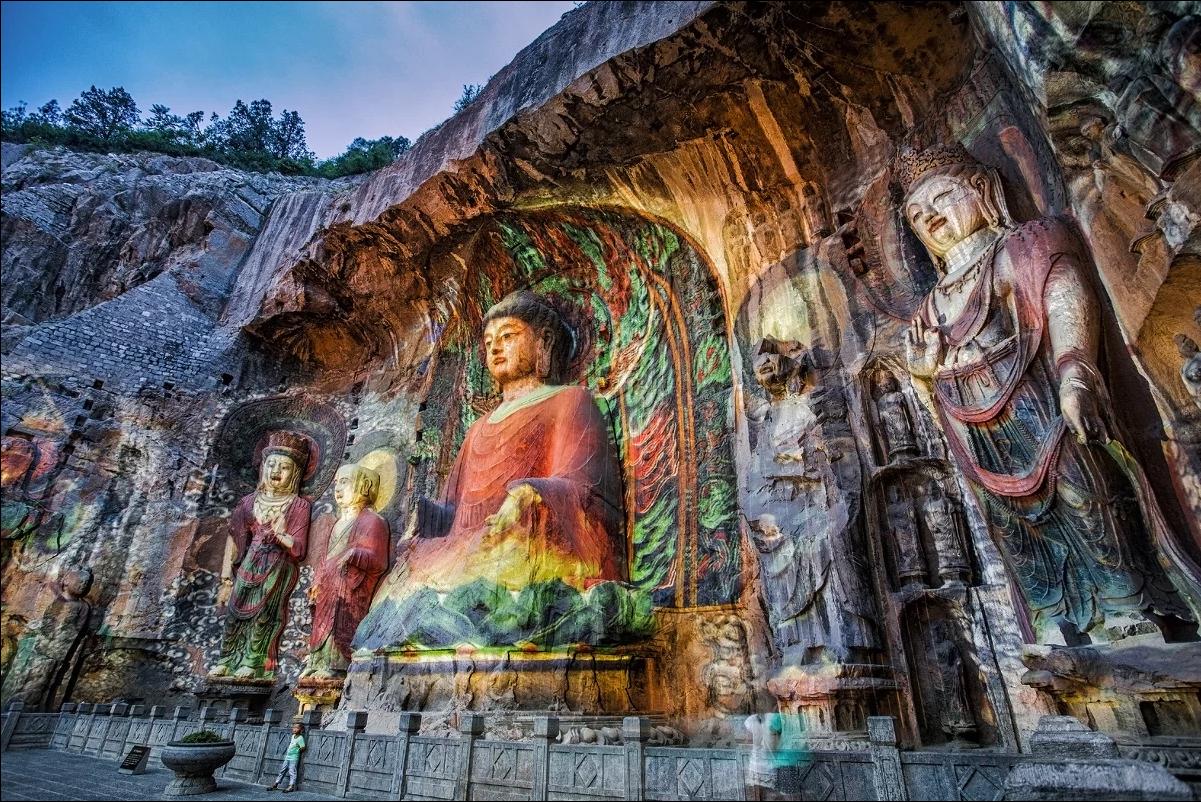
The intense activity in Luoyang during its peak as a Buddhist center left an indelible mark on Chinese art, literature, and philosophy. The city became a crucible for the sinicization of Buddhism, where foreign concepts were adapted to Chinese cultural contexts. This period witnessed a remarkable flourishing of Buddhist art, particularly during the Northern Wei dynasty, which made Luoyang its capital.
The Longmen Grottoes, carved into the limestone cliffs along the Yi River near Luoyang, stand as a monumental testament to this artistic and spiritual fervor. While specific details about their creation are beyond the scope of this discussion, their sheer scale and the intricate artistry reflect the profound influence of Buddhism and imperial patronage. These cave temples showcase a blend of Indian, Central Asian, and Chinese artistic styles, evolving over centuries to define a unique Chinese Buddhist aesthetic.
Philosophically, Luoyang was a hub for the translation of an immense body of Mahayana Buddhist scriptures. Monks like Kumarajiva, though primarily active elsewhere, had their influence spread through the translation schools that flourished in cities like Luoyang. These efforts led to the development of various indigenous Chinese Buddhist schools of thought, interpreting the vast canonical texts through a Chinese lens. The intellectual debates and syntheses occurring in Luoyang contributed directly to the rich diversity of Chinese Buddhism we recognize today.
Key Aspects of Luoyang’s Buddhist Heritage for Modern Understanding
- Cultural Synthesis: Luoyang demonstrates how a foreign religion can be deeply integrated and transformed by indigenous culture, creating unique artistic and philosophical traditions.
- Translational Hub: The city’s role in translating scriptures was fundamental, making complex Buddhist doctrines accessible to Chinese speakers and shaping their interpretation.
- Architectural Innovation: The scale of Buddhist construction, from grand temples to cave grottoes, showcases remarkable architectural and sculptural achievements.
- Imperial Influence: It highlights the critical role of state support in the propagation and institutionalization of a religion, for better or worse.
- Silk Road’s Impact: Luoyang exemplifies how trade routes were not just economic arteries but vital channels for profound cultural and spiritual exchange.
Enduring Echoes: The Historical Significance of Luoyang Today
The historical significance of Luoyang in shaping Chinese Buddhism extends far beyond the ancient dynasties. Its legacy continues to resonate in the religious practices, artistic expressions, and philosophical underpinnings of Chinese culture. The city’s historical sites, even in their current states, offer tangible connections to a period of intense intellectual and spiritual dynamism.
For anyone seeking to understand the trajectory of Buddhism in China, from its initial introduction to its widespread adoption and subsequent transformation, Luoyang remains an indispensable case study. It is a testament to the power of cultural exchange, the impact of political will, and the enduring human quest for spiritual meaning. The early foundations laid in Luoyang ensured that Buddhism would not merely exist in China but would become an intrinsic part of its national identity.
Explore the enduring legacy of Luoyang’s profound Buddhist heritage.
