
Blog
Decoding Longmen China: Cave Placement and Scale

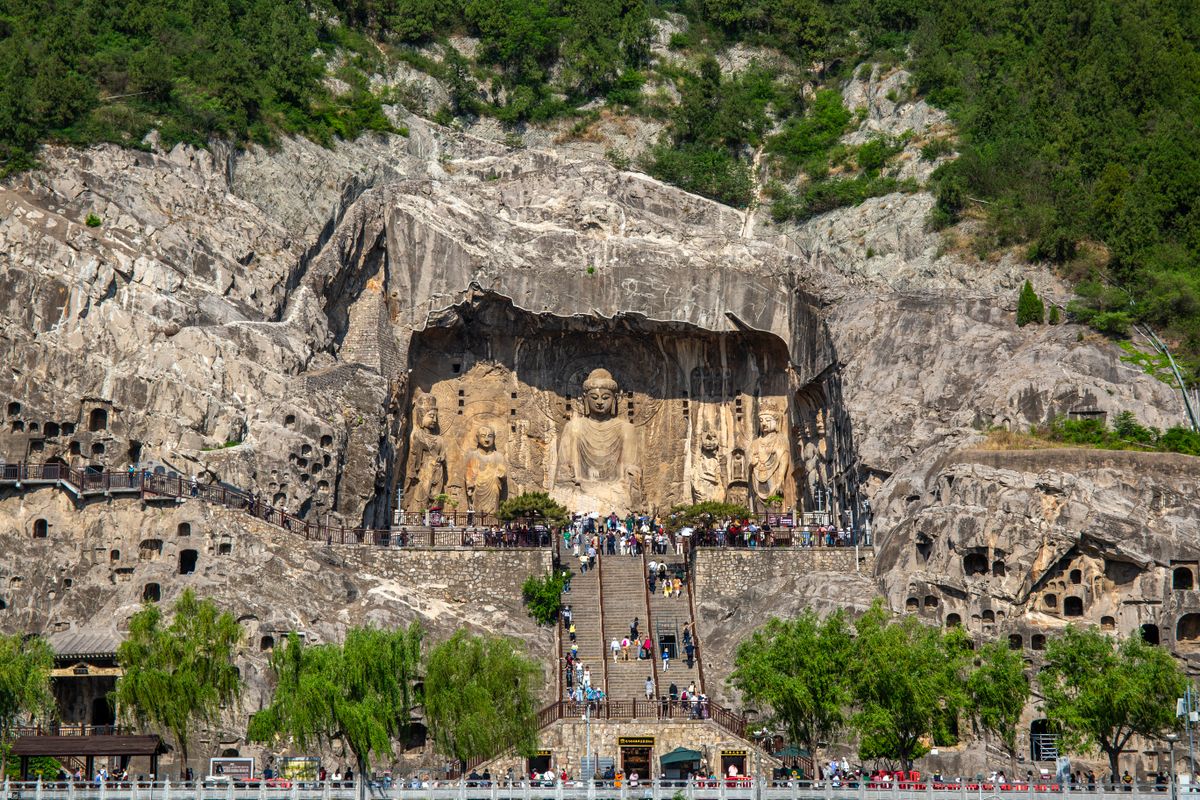
Decoding Longmen China: How Cave Placement and Scale Communicate Ancient Messages
For many, the Longmen Grottoes in China represent an awe-inspiring collection of Buddhist sculptures carved into limestone cliffs. However, to truly understand the site’s profound significance, one must move beyond merely admiring individual statues. The position of each cave, the scale of its figures, and its relationship to the surrounding landscape of the Yi River were all deliberately orchestrated to communicate complex messages about power, piety, and the cosmic order. This article explains how these architectural and artistic choices in Longmen China served as a sophisticated visual language for ancient dynasties.
The Historical Tapestry of Longmen China: Imperial Ambition and Devotion
The Longmen Grottoes, situated south of Luoyang in Henan province, represent one of the most significant and extensive collections of Chinese Buddhist art. Carving began in the late 5th century during the Northern Wei Dynasty and continued for over four centuries, reaching its zenith during the Tang Dynasty. Each era left its distinct imprint, reflecting changing artistic styles, religious interpretations, and political motivations. The grottoes became a monumental testament to imperial patronage, where successive emperors and empresses commissioned grand carvings to express their devotion, legitimize their rule, and ensure blessings for their reigns and ancestors.
The shift from the Northern Wei’s delicate, elongated figures to the Tang’s more robust and lifelike sculptures, particularly the famous Vairocana Buddha at Fengxian Temple, illustrates a dynamic evolution. This artistic progression is not merely aesthetic; it mirrors the expanding influence and confidence of the empires. The sheer scale of the undertaking at Longmen China, involving countless artisans and immense resources, underscores its profound importance as a spiritual and political center. It was a place where earthly power sought to align itself with divine authority, visible in every chiselled rock face.
Unlocking the Symbolic Language of Longmen China: Elevation, Sightlines, and Scale
Interpreting the Longmen Grottoes requires understanding a deliberate system of communication embedded within its design. The placement of caves, the orientation of statues, their relative sizes, and the natural environment of the Yi River were all carefully chosen elements that conveyed rank, religious importance, and imperial prestige.
Here is how these elements worked in concert:
| Element | Mechanism of Communication | Meaning Conveyed |
|---|---|---|
| Cave Elevation | Higher caves often reserved for major shrines or imperial commissions; lower caves for smaller, private devotions. | Indicates hierarchy and significance. Higher placement denotes greater importance, imperial backing, and accessibility to the divine. The most prominent caves, like Fengxian Temple, command elevated positions. |
| Statue Scale | The size of the main Buddha figure relative to surrounding bodhisattvas, arhats, or guardians; overall size of the cave’s central figure. | Reinforces the hierarchy of deities and the power of the patron. The colossal Vairocana Buddha symbolizes universal enlightenment and Empress Wu Zetian’s imperial authority. Larger figures invariably represent more significant cosmic or earthly power. |
| Sightlines & Orientation | How statues face the Yi River, interact with opposing cliff faces, or are positioned within their own grotto. | Creates a visual dialogue with the landscape and other devotional sites. Statues facing the river symbolize sending blessings downstream or receiving auspicious energy. Certain arrangements might create a processional path for pilgrims, guiding their spiritual journey. |
| Yi River Setting | The river’s role as a natural boundary, a source of reflection, and a conduit for spiritual energy. | Integrates the grottoes into a larger cosmic and geographical framework. The river provides a reflective surface, enhancing the visual impact of the opposite cliff. Its flow could symbolize the ceaseless cycle of life and the flow of Buddhist teachings, influencing the perception of the sacred space. |
This intricate interplay demonstrates that the creators of Longmen China were not just sculptors but master planners, using the natural environment and monumental art to craft a powerful spiritual and political statement. For more detailed insights into ancient art forms, exploring resources on ancient Buddhist art can provide further context.

Beyond Aesthetics: Practical Considerations in Longmen China’s Construction
While the artistic and symbolic aspects of Longmen China are paramount, the practical challenges of its creation are equally compelling. Carving thousands of statues, some colossal, into a sheer limestone cliff face demanded immense engineering prowess, resource management, and labor coordination. This was no small feat, especially with the tools available centuries ago.
Consider these practical dimensions:
- Material Sourcing and Stability: The limestone itself had to be suitable for carving – not too soft to erode quickly, not too hard to resist chisels. Geologists and master carvers had to assess the rock’s stability to prevent collapses, especially for deep caves and large overhangs. The choice of location along the Yi River also provided a steady supply of water for carving and daily needs.
- Scaffolding and Access: Constructing scaffolding to reach heights up to 100 meters would have been an monumental undertaking. Timber had to be cut, transported, and erected, often against steep, irregular rock faces. Access paths for workers, materials, and even imperial patrons required careful planning and construction.
- Logistics and Labor Management: Thousands of laborers, artisans, and monks were involved over centuries. Organizing food, housing, tools, and payment for such a large workforce demanded sophisticated logistical systems. The scale of the project suggests a highly organized administrative structure, likely managed by imperial officials.
- Drainage and Preservation: Preventing water damage and erosion was a constant battle. Carvers had to consider natural drainage patterns to divert rainwater away from the sculptures, using channels and overhangs. Despite these efforts, centuries of exposure have taken their toll, necessitating ongoing preservation efforts.
Understanding these practicalities adds another layer of appreciation to the ingenuity and sheer human effort behind the artistic and spiritual achievements of Longmen China.
Interpreting Longmen China: A Visitor’s Checklist for Deeper Understanding
To gain a richer experience when visiting the Longmen Grottoes, or when studying images of them, consider these points beyond the immediate visual impact. This checklist helps shift focus from simple observation to meaningful interpretation, revealing the hidden narratives within the stone.
- Identify the Patronage: Look for inscriptions or stylistic clues that indicate who commissioned a cave or statue. Imperial patronage (e.g., Northern Wei emperors, Empress Wu Zetian) often results in larger, more prominent, and centrally located works. Private donations are typically smaller and less conspicuous. This provides insight into the social and political landscape of the time.
- Assess the Scale and Composition: Pay attention to the relative sizes of the main Buddha and surrounding figures. Is the Buddha colossal, dominating the space, or is it part of a more intimate tableau? The number and type of accompanying figures (bodhisattvas, guardians, donors, apsaras) often reflect specific Buddhist doctrines or the patron’s spiritual aspirations.
- Examine the Cave’s Position and Orientation: Note whether a cave is high on the cliff face or closer to the river. Does it face directly across the Yi River, or is it oriented differently? Consider what views it commands and what it overlooks. This strategic placement reveals intentional communication about its importance and symbolic relationship with the environment.
- Observe Artistic Style and Iconography: Distinguish between the slender, elongated forms of the Northern Wei and the more naturalistic, robust figures of the Tang Dynasty. Look for specific mudras (hand gestures), poses, and attributes of the Buddhas and bodhisattvas, as these convey specific teachings and identities. Resources on Buddhist art can be helpful here.
- Consider the Narrative Context: Many caves depict scenes from Buddha’s life or jataka tales (stories of his previous lives). Try to identify these narratives. Even without specific knowledge, appreciating that a story is being told adds depth.
- Reflect on the River’s Role: Imagine the grottoes from the perspective of someone approaching by boat on the Yi River. How would the reflections and the sheer scale of the carvings impact them? Consider the river not just as a geographical feature, but as an integral part of the spiritual landscape.
By applying these interpretive lenses, one can move beyond a superficial viewing of Longmen China and engage with it as a complex historical document, rich with cultural and religious meaning. For further exploration of cultural heritage sites, our team offers insights into cultural heritage insights.

The Enduring Legacy of Longmen China
The Longmen Grottoes stand as a profound testament to human endeavor, artistic expression, and spiritual devotion. They are more than just beautiful relics; they are a sophisticated record of imperial power, religious belief, and artistic innovation over centuries. Every carved niche, every towering Buddha, and every subtle detail contributes to a grand narrative that can be “read” by those who understand its unique language. The interplay of cave elevation, statue scale, sightlines, and the majestic Yi River setting continues to offer unparalleled insights into the minds and motivations of ancient Chinese civilizations.
We encourage you to delve deeper into these historical and cultural narratives. Contact our team for further discussions or to explore how historical context informs broader understanding.
About LyWOW Tours
LyWOW is a locally based travel agency in Luoyang, specializing in private tours for international travelers across Luoyang, Shaolin, Xi’an and Central China. English-speaking guides, flexible itineraries and door-to-door service.
Learn more about us or browse all our tours.
