
Blog
How Luoyang Longmen Grottoes Gained UNESCO Status

How Luoyang Longmen Grottoes Gained UNESCO Status
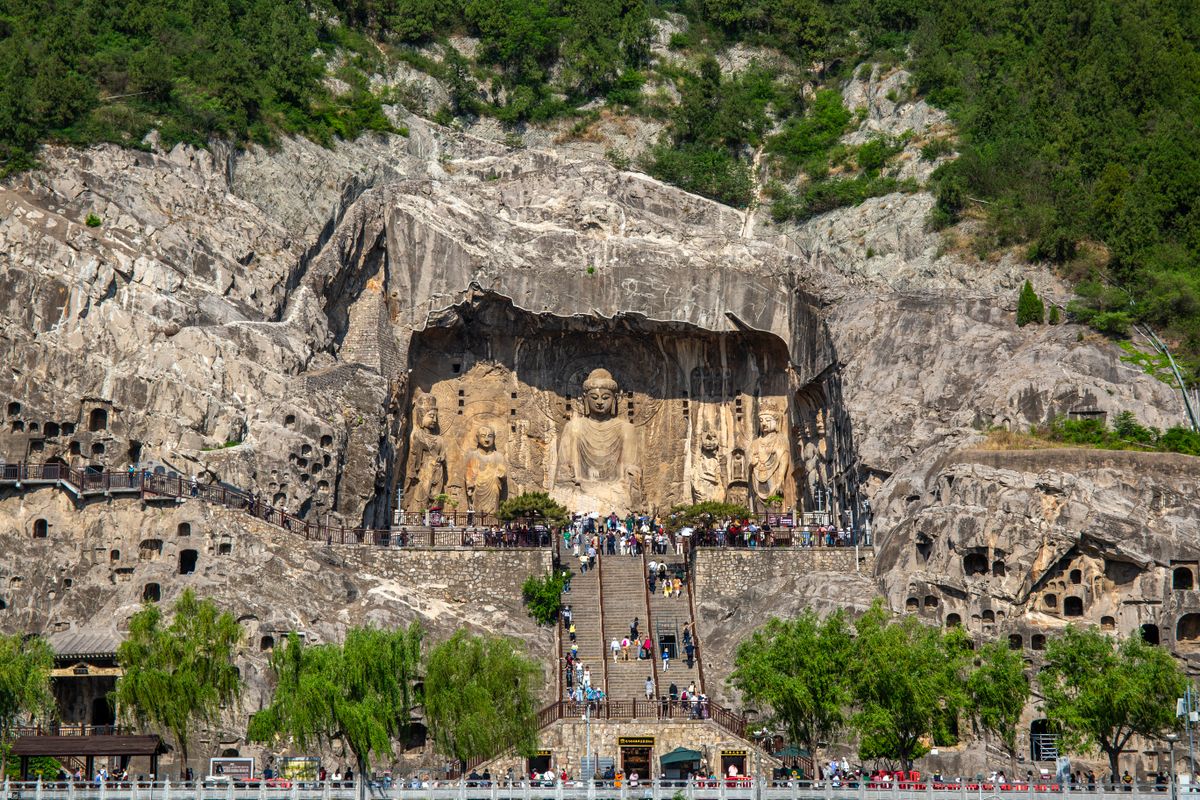
What made a riverbank complex of Buddhist caves important enough for global recognition? The answer is not simply its age, size, or visual impact. The luoyang longmen grottoes gained UNESCO status because the site demonstrates exceptional artistic achievement, records major historical change in China, and requires conservation that protects both carved monuments and their landscape setting.
Inscribed on the UNESCO World Heritage List in 2000, the luoyang longmen grottoes were recognised under cultural criteria (i), (ii), and (iii). These criteria assess whether a place represents outstanding creative achievement, illustrates cultural interchange, and provides exceptional evidence of a living or past civilisation.
For travellers and students, that distinction matters. Visiting the luoyang longmen grottoes as a collection of statues alone can lead to a shallow reading of the site. A stronger visit asks how individual carvings, patron inscriptions, changing styles, and the surrounding landscape work together to explain the site’s international importance.

UNESCO recognition depended on artistic, historical, and conservation evidence
The UNESCO inscription was based on a combined case rather than a single object or monument. The luoyang longmen grottoes were not recognised merely because they contain Buddhist imagery. Their value lies in how the carvings show the development of religious art, political patronage, social life, and stone-carving practice across successive periods.
The practical conclusion is clear: assess the site as a connected cultural landscape, not as a list of separate caves. This approach is especially useful for students preparing research notes and travellers deciding which areas deserve the most time. It is less useful if the goal is only a short photographic stop, because the UNESCO rationale requires comparison and context that cannot be understood from one viewpoint alone.
| UNESCO assessment element | What it evaluates in practice | Why it mattered at Longmen | What visitors may misunderstand |
|---|---|---|---|
| Criterion (i) | Exceptional human creative achievement | The sculpture and cave design demonstrate a high level of artistic control in stone carving. | Large figures alone do not explain the criterion; composition, expression, carving detail, and spatial arrangement are part of the achievement. |
| Criterion (ii) | Important interchange of human values | The site reflects the adaptation of Buddhist visual traditions within Chinese artistic and cultural settings. | It is inaccurate to treat the art as unchanged foreign religious imagery; the value includes transformation and local interpretation. |
| Criterion (iii) | Exceptional testimony to a cultural tradition or civilisation | Carvings, inscriptions, donors, and religious commissions preserve evidence of imperial, elite, and devotional culture. | A statue without its inscription, patronage context, or historical period gives only part of the evidence. |
| Integrity and authenticity | Whether the property retains the attributes needed to express its value | The caves, sculptures, inscriptions, cliff setting, and broader cultural context must remain legible together. | Conservation is not cosmetic cleaning; poorly judged intervention can weaken historical evidence. |
The luoyang longmen grottoes therefore gained status through a layered argument. UNESCO did not separate artistic excellence from historical evidence or preservation needs. Each element supports the others.
Artistic achievement explains why the carvings are more than religious decoration
Criterion (i) concerns masterful creative achievement. At Longmen, this can be seen in the deliberate relationship between sculpture, cave architecture, relief work, inscriptions, and the natural cliff face. Buddhist figures were carved as part of designed visual environments rather than placed as isolated artworks.
The key lesson for a visitor is to look beyond the central figure in each space. Observe how attendant figures, halos, drapery, facial treatment, smaller devotional images, and the cave opening establish hierarchy. This is the most useful method for readers who want to understand why the luoyang longmen grottoes are studied as art history rather than simply admired as ancient sculpture.
- Look for visual hierarchy: The main figure often anchors the composition, while surrounding figures guide attention and communicate religious rank. This helps when comparing caves, but it does not mean every cave uses the same design logic.
- Compare carving styles: Differences in body proportions, clothing folds, and facial expression can indicate changing artistic preferences. This is useful for study, although visual style alone should not be used as a substitute for formal archaeological dating.
- Read the cave as a setting: Sculpture, wall surface, niche shape, and light all affect how images were experienced. A close-up photograph can hide that relationship.
- Notice unfinished or weathered areas: These areas can reveal the material reality of stone carving and later exposure. They should not automatically be treated as artistic failure or poor conservation.
The luoyang longmen grottoes also demonstrate that artistic value does not depend on uniformity. The site contains evidence of changing aesthetic choices over time. That variation is precisely why comparing different groups of carvings is more informative than selecting only the most famous image.

Historical continuity turned the site into evidence of cultural change
Criterion (ii) and criterion (iii) address history as well as art. The luoyang longmen grottoes show how Buddhist belief and visual culture were reshaped through Chinese political, social, and artistic life. Their importance comes from adaptation, not from a simple transfer of religious ideas from one place to another.
This is where inscriptions and patronage become essential. Donor records and commissioned carvings can connect an image to the people and institutions that supported its creation. For students, the best conclusion is that the site should be read as documentary evidence as well as visual art. That interpretation fits coursework on religion, political authority, social history, and material culture. It does not permit broad assumptions about every visitor, donor, or artisan, because individual caves may have different contexts.
| Research question | Useful evidence at the site | What a careful answer can show | Limit of the evidence |
|---|---|---|---|
| How did Buddhist imagery change in China? | Figure styles, robes, cave layouts, and iconographic choices | How artistic forms were adapted within local traditions | Style comparison should be supported by reliable historical interpretation. |
| Who supported the carvings? | Inscriptions and donor references | The role of imperial, elite, religious, and private patronage | Not every carving has equally complete surviving documentation. |
| Why does the setting matter? | Cliffs, caves, river corridor, and monument placement | How the physical environment shaped viewing and religious experience | Modern access routes may not reproduce historical movement through the landscape. |
A common mistake is to describe the luoyang longmen grottoes as a frozen monument from one era. The complex developed across changing historical conditions. Recognising that sequence makes the UNESCO status easier to understand because the property records continuity and transformation together.
Conservation protects meaning, not only stone surfaces
Conservation was central to the World Heritage case because the site’s significance depends on preserving more than surviving statues. The luoyang longmen grottoes need their carved surfaces, inscriptions, cave spaces, cliff context, and relationship to the surrounding landscape to remain understandable.
For heritage management, the conclusion is that intervention must protect evidence rather than make every surface appear new. A repair that obscures tool marks, changes carved edges, removes historical traces, or disrupts the relationship between sculpture and cave could reduce the ability of researchers to interpret the monument. This principle applies when assessing fragile cultural heritage, but it does not mean that all intervention is inappropriate; stabilisation and preventive care may be necessary to prevent further loss.
- Weathering changes interpretation: Surface loss can affect facial details, inscriptions, and decorative patterns. Visitors should avoid assuming that a damaged feature was originally plain.
- Water and environmental exposure matter: Cliff-carved heritage remains vulnerable to natural processes. Respecting barriers and designated routes helps reduce avoidable pressure on sensitive areas.
- Visitor behaviour is part of conservation: Touching, climbing, or using prohibited access points can harm surfaces and weaken site protection measures.
- Documentation supports future decisions: Photographs, records, surveys, and scholarly study help conservators distinguish original material from later change.
The conservation value of the luoyang longmen grottoes is therefore inseparable from their artistic and historical value. If inscriptions become unreadable or the relationship between caves and landscape is lost, the evidence behind criteria (i), (ii), and (iii) becomes harder to interpret.
Use a focused visit plan to connect the UNESCO criteria to what you see
A practical visit does not require trying to examine every carving. Instead, use a sequence that links observation to the inscription criteria. This approach suits culture-focused travellers and students with limited time. It is not a replacement for professional site interpretation or specialist academic guidance.
- Start with the landscape: Before focusing on individual carvings, consider how the cliffs, caves, and river corridor create a setting for the monuments.
- Select contrasting caves or carving groups: Compare figure scale, composition, drapery, and cave layout rather than looking at only one celebrated work.
- Identify evidence of patronage: Look for interpretive material explaining donors, inscriptions, religious commissions, or historical context.
- Connect art to cultural exchange: Ask which features reflect Buddhist traditions and which reveal Chinese artistic adaptation.
- Observe conservation choices: Notice protected areas, viewing distances, controlled circulation, and explanation of vulnerable surfaces.
- Record one evidence-based takeaway: State which UNESCO criterion your observation supports and why.
Using this method turns the luoyang longmen grottoes from a scenic destination into a case study in artistic innovation, cultural exchange, historical testimony, and conservation responsibility. For students, it also creates a stronger basis for field notes because every observation can be linked to a recognised heritage criterion.
For a more focused study visit, prepare your research questions before finalising your itinerary.
About LyWOW Tours
LyWOW is a locally based travel agency in Luoyang, specializing in private tours for international travelers across Luoyang, Shaolin, Xi’an and Central China. English-speaking guides, flexible itineraries and door-to-door service.
Learn more about us or browse all our tours.
