 By
By How Were Sancai Ceramics Used in Tang Dynasty Tombs?
Most people see the flowing green, amber, and cream glazes of sancai ceramics and assume they were luxury goods for the living. The historical record tells a different story. These objects were overwhelmingly manufactured for the dead. Understanding their placement, typology, and ritual function inside a tomb is the key to distinguishing a genuine burial piece from a later decorative reproduction.
The term sancai ceramics translates literally to “three colors.” While the palette sometimes includes blue or black, the core combination of straw-glaze, amber, and green defines the category. They emerged during the high Tang period (roughly late 7th to mid-8th century) and served a specific purpose: they were mingqi, or spirit objects, designed to accompany the deceased into the afterlife.
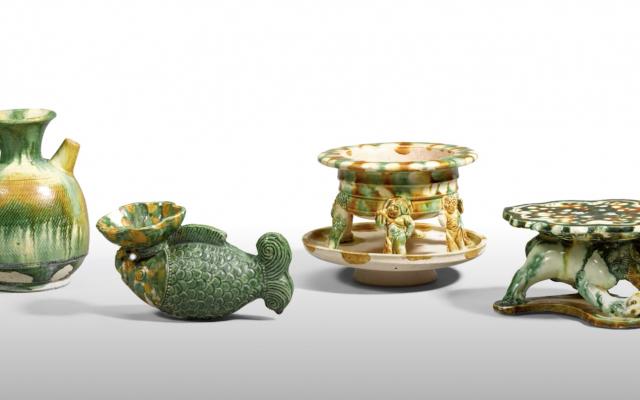
The Funerary Role of Sancai Figures and Vessels
To understand sancai ceramics, you must first abandon the modern concept of “art for art’s sake.” In Tang China, these objects were functional equipment for the soul. The tomb was not a museum; it was a residence. The logic was simple: whatever the deceased needed in life, they would need in death.
This funerary role dictates the form of nearly every sancai piece you will encounter. The repertoire is narrow and repetitive because it follows ritual necessity, not aesthetic whim.
How Tomb Context Changes Interpretation
A sancai camel standing alone on a shelf is a beautiful sculpture. The same camel found in a tomb corridor tells you something else entirely. Context transforms the object from decoration into evidence.
Here is how placement changes meaning:
| Object Type | Common Tomb Location | Interpretation Shift |
|---|---|---|
| Guardian figures (Lokapala, earth spirits) | Entrance corridor or front chamber | Protective function; meant to ward off evil influences from entering the burial space. |
| Camels and horses | Side niches or near the coffin platform | Transport and status; not merely “animals” but provisions for travel and trade in the afterlife. |
| Female musicians and dancers | Inner chamber, often arranged in groups | Entertainment retinue; recreating the domestic pleasures of the elite household. |
| Bowls, jars, and ewers | Near the head or feet of the deceased | Food and drink offerings; the vessels were likely filled with real or symbolic provisions at burial. |
| Small guardian beasts | Placed at specific compass points | Cosmological protection; aligning the tomb with directional beliefs. |
The same logic applies to vessel types. A sancai bowl found in a tomb is not tableware. It is a ritual container. Archaeologists rarely find heavy use-wear on the interiors of tomb sancai. The glazes are often intact, the bases unworn. This suggests the objects were made specifically for burial, fired, and immediately placed underground without ever serving a domestic purpose.
Collectors should note this distinction. A sancai dish with significant abrasion on the foot ring or interior suggests either post-excavation handling or — more rarely — a piece that was used above ground before being buried. The latter is uncommon but not impossible. The vast majority of surviving sancai ceramics came out of the ground, not out of a Tang dynasty kitchen.
What the Tomb Inventories Tell Us
Tang sumptuary laws regulated how many figures a person could be buried with. The number of sancai ceramics in a tomb was not random. It reflected official rank.
An imperial or high-ranking official’s tomb might contain dozens of figures: a full procession of horses, camels, grooms, officials, and musicians. A lower-ranking official might be permitted only a handful. A merchant — even a wealthy one — could not legally commission the same scale of burial goods as a prince. This legal framework is why the finest, largest sancai figures almost always come from high-status contexts.
Here is a practical breakdown of what tomb inventories reveal:
- Quantity equals rank. More figures generally means higher official status, not merely more wealth.
- Size matters. Oversized guardian figures (over 80 cm) are almost exclusively from elite or imperial tombs.
- Blue glaze signals exceptional status. Cobalt blue sancai required imported pigment. It appears rarely and almost always in high-ranking burials.
- Sets are more valuable than singles. A matched set of musicians or a full horse-and-groom pairing tells a more complete story than an isolated figure.
For a museum visitor or student, this means you should always ask: “What else was found with this piece?” A single sancai horse is beautiful. A sancai horse documented alongside its groom, saddle fittings, and a second horse becomes a historical document.
Common Misinterpretations to Avoid
The research stage is where most collectors and students go wrong. They see a sancai piece and immediately ask, “Is it authentic?” That is the wrong first question. The better question is, “What was this for, and where did it sit?”
Here are the most frequent mistakes:
- Assuming all sancai are figures. Vessels — amphorae, tripod dishes, covered boxes — make up a substantial portion of tomb assemblages. They are often undervalued because they are less dramatic than horses or camels.
- Treating all green-glazed Tang pottery as sancai. True sancai requires the deliberate combination of at least two glaze colors, typically amber and green, with the cream slip showing through. A monochrome green glaze is related but not the same category.
- Ignoring the firing process. Sancai glazes are low-fired lead glazes. They are soft and prone to flaking. Heavy, intact glaze with no degradation is not automatically a sign of a fake — but it is a sign you should examine the piece more carefully.
- Forgetting the burial context. A sancai figure with soil encrustation in the crevices is normal. A piece that looks freshly washed and uniformly clean may have been aggressively cleaned — or may be a modern reproduction with artificial dirt applied.
A Step-by-Step Approach to Researching a Sancai Piece
If you are standing in front of a sancai object in a museum or considering one in a catalog, use this sequence to evaluate what you are seeing:
- Identify the form. Is it a guardian, a beast of burden, a human figure, or a vessel? The form tells you the ritual function.
- Note the glaze colors. Count them. Two or more distinct colors (green, amber, cream, blue) qualifies as sancai. One color does not.
- Look for burial evidence. Check the crevices, the underside, the interior of vessels. Is there soil residue? Are there areas where the glaze has naturally degraded from contact with damp earth?
- Ask about provenance. Where was it excavated? What else was found with it? A piece without documented tomb context loses significant interpretive value — and market value.
- Compare the scale. Measure it against known examples from published tomb excavations. Oversized pieces without a high-status provenance are a red flag.
This sequence forces you to treat sancai ceramics as archaeological evidence first and art objects second. That is the correct order for research-stage evaluation.
Why the Funerary Context Matters for Collectors
Here is the uncomfortable truth: nearly every authentic sancai piece on the market was removed from a tomb. There is no way around this. Tang dynasty sancai was not produced for the export trade or for domestic decoration in any significant quantity. The kilns at Gongyi, Huangye, and other sites fired these pieces specifically for burial.
This has three practical implications:
- Provenance is everything. A piece with documented excavation from a known site carries more scholarly and financial weight than an identical piece with no history.
- Condition expectations differ. Tomb conditions vary. Some pieces emerge with brilliant, intact glazes. Others show the expected flaking and degradation of low-fired lead glaze exposed to moisture for over a millennium. Do not expect uniformity.
- Restoration is common. Tomb ceramics frequently break under the weight of collapsed ceilings or shifting earth. Professional restoration is accepted in the field — provided it is disclosed. Undisclosed restoration is the single most common problem in the sancai market.
For museum visitors and students, none of this should dampen the appeal of sancai ceramics. It should sharpen it. The moment you understand that every horse, camel, and vessel was packed into a dark chamber to serve a specific soul, the object stops being a pretty glaze sample. It becomes a functional piece of Tang belief.
The next time you see a sancai camel with its head tilted back, braying, loaded with saddlebags, picture it placed in a niche beside a tomb corridor. That camel was not a souvenir. It was a provision. The person who commissioned it expected that camel to carry goods across the afterlife. That is the meaning the glaze was meant to preserve.
If you are researching sancai ceramics for a collection or an exhibition and need help evaluating form, glaze, or burial context, send us the details of the piece you are studying. We can help you ask the right questions before you commit to an acquisition or a display label.