
Blog
Reading Longmen China Cave Layout by Dynasty

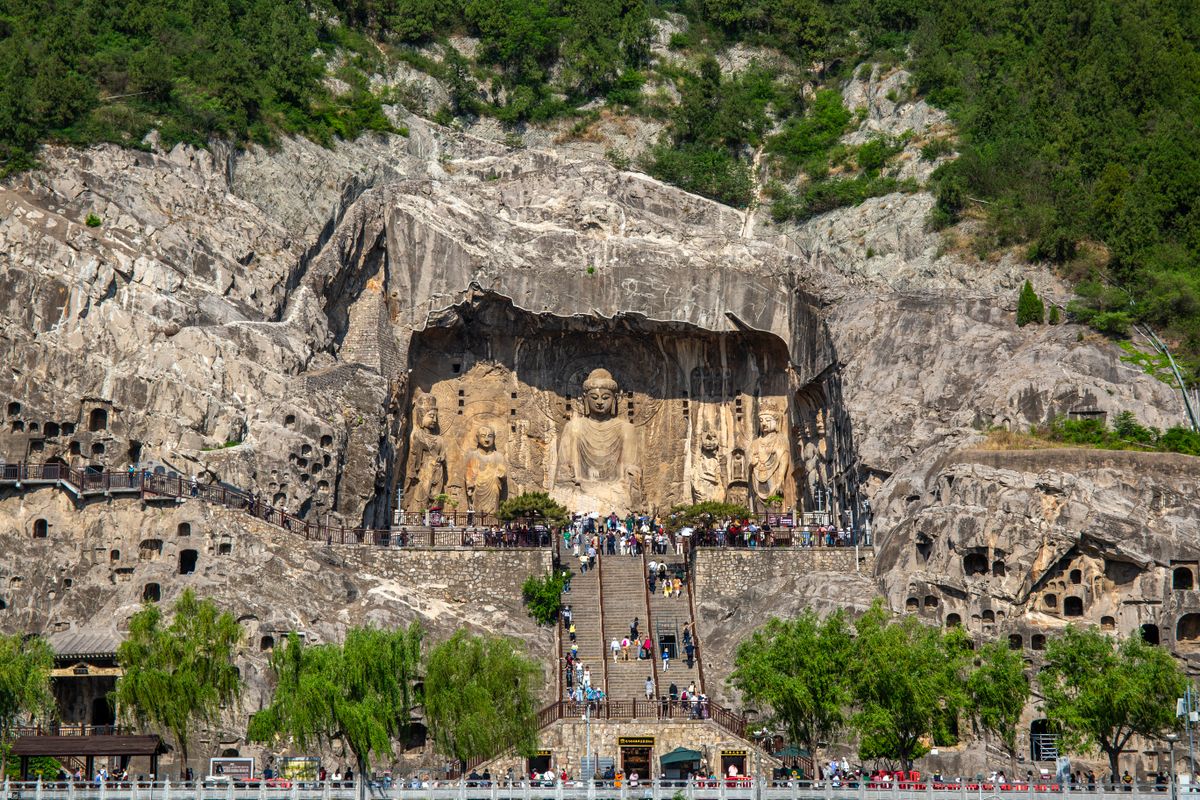
Reading Longmen China Cave Layout by Dynasty
Most visitors to Longmen China walk the main path once and leave. They see impressive stone, but they miss the chronological logic that makes the site legible. The key question is not “which caves are biggest” but how are Longmen caves arranged by dynasty? The answer shapes where you start, where you linger, and what you can safely skip if time is short.
The grottoes stretch for roughly one kilometer along the Yi River. The layout follows a south-to-north progression that loosely mirrors historical development. Northern Wei work clusters in the middle section. Sui and early Tang work pushes north. High Tang work dominates the northern end around the Fengxian Temple. Understanding this sequence turns a crowded walkway into a readable timeline.
This guide gives you a route-based method for linking cave locations to their dynastic periods. It is built for independent visitors planning a visit without a private guide. No invented statistics, no promotional claims — just a practical way to read the stone.
A Route-Based Method for Connecting Cave Locations to Northern Wei, Sui, and Tang Periods
You need a working method before you enter the site. The goal is to see dynastic change as a physical sequence, not as abstract dates in a guidebook. Here is a how-to framework that works whether you have two hours or five.
Step 1: Anchor Yourself at the River
Enter from the main visitor gate and walk toward the river. Face the cliff on the west bank. The river runs north. Your route will move from the middle section toward the north end. This orientation matters because the dynastic sequence does not run south to north in a clean line. It clusters.
Checkpoint: Identify the central stairway leading up to the Binyang caves. That stairway is your baseline. Northern Wei work is immediately around you.
Common failure: Visitors rush north toward the giant Buddha first. That breaks the sequence. You will see the climax before the setup, and the earlier caves will feel underwhelming by comparison.
Step 2: Read the Middle Section as Northern Wei
The middle section contains the densest concentration of Northern Wei carving. Look for three features that distinguish this period. First, figures tend to be slender with elongated proportions. Second, drapery lines are sharp and linear rather than soft. Third, niches often have pointed or flame-shaped mandorlas behind the central figure.
The Binyang caves sit here. So do the Guyang and Lianhua caves. These are not the largest caves at Longmen, but they carry the earliest sustained imperial patronage. If you study the stylistic details in this section first, you will recognize the contrast later when Tang work appears.
Checkpoint: Stand before the central Binyang cave and look at the robe folds. Note the angular, repetitive pattern. Now mentally file that as “Northern Wei line.” You will use it as a comparison baseline.
Common failure: Treating all caves as generically “old.” Without a visual anchor, the dynastic shift becomes invisible. Pick one detail — robe folds, face shape, or mandorla form — and track it northward.
Step 3: Move North Through the Transitional Zone
Between the middle section and the northern end lies a transitional band. This zone contains work from the late Northern Wei, the brief Sui period, and early Tang. The Sui caves are fewer and often smaller. They show a stylistic bridge: figures begin to fill out, drapery softens, and compositions become more three-dimensional.
Do not expect a dramatic Sui showcase. The Sui dynasty lasted less than forty years. At Longmen, its footprint is modest. The value of this zone is comparative. You see stone carving shifting from linear elegance toward volumetric weight.
Checkpoint: Find a Sui-period niche with a seated figure. Compare its torso to the Northern Wei example you noted earlier. The Sui torso reads as more solid, less flattened.
Common failure: Skipping this zone because it lacks a monumental highlight. If you skip it, the jump from Northern Wei to High Tang feels jarring rather than evolutionary.
Step 4: Arrive at the Northern End for High Tang
The northern end delivers the climax. The Fengxian Temple dominates this section. The central Vairocana Buddha and its attendant figures represent the mature Tang style at its most confident. Figures are massive, full-bodied, and spatially assertive. Drapery falls in broad, simplified planes rather than fine linear ridges.
This is the payoff for following the route. When you stand before the Fengxian group after walking from the middle section, you feel the stylistic distance. The Tang sculptors did not merely carve larger figures; they changed the relationship between stone and space.
Checkpoint: Stand at the base of the Fengxian platform and look back south along the cliff. The route you just walked is the dynastic arc. The visual contrast between the distant middle section and the immediate Tang scale is the whole point.
Common failure: Arriving here first, taking photos, and leaving. That sequence flattens the historical narrative into a single impressive stop.
When This Route Does Not Apply
This method assumes you have at least ninety minutes and can walk the full length of the west bank. It does not apply if you have mobility constraints that limit you to the northern end. In that case, prioritize the Fengxian Temple and the nearby Tang caves, and accept that the Northern Wei context will be missing. It also does not apply if you are visiting primarily for photography rather than historical sequence. The best light for the Fengxian group may not match the chronological route.
Which Longmen Caves Are from the Tang Dynasty?
Tang dynasty work at Longmen is not evenly distributed. It concentrates heavily at the northern end, with additional Tang niches carved into earlier sections as later patrons added dedications. The most important Tang caves include the Fengxian Temple complex, the Wanfo Cave, and the Kanjing Temple area.
The Wanfo Cave is notable for its dense field of small carved Buddhas. The name translates roughly to “Ten Thousand Buddhas,” and while the actual count is lower, the visual effect is one of overwhelming repetition. This is a distinctly Tang approach: using multiplication and scale to create awe. Northern Wei caves at Longmen rarely pursue this effect.
The Kanjing Temple area contains a series of Tang-period figures with a more human, less hieratic quality. The arhats and bodhisattvas here show the Tang interest in naturalistic posture and individualized expression. If you have time, compare a Tang arhat from this area with a Northern Wei figure from the middle section. The Tang figure will appear more physically present, more anchored in bodily weight.
Tang work also appears in the form of added inscriptions and smaller niches cut into earlier caves. This is a common pattern at Chinese Buddhist sites: later patrons reused earlier sacred space. When you see a Tang-style niche carved beside a Northern Wei niche in the same cave, you are seeing a layered history, not a single construction event.
Where Should Visitors Start at Longmen Grottoes?
Start in the middle section. Specifically, begin at the Binyang caves and the adjacent Northern Wei cluster. This recommendation is based on the route logic described above, not on crowd avoidance or ticketing convenience.
The practical advantage is visual calibration. If you start at the northern end with the Fengxian Temple, your eye adjusts to Tang scale and Tang modeling. When you later walk south to the Northern Wei caves, those earlier figures will read as smaller, flatter, and less impressive. You will have inverted the historical sequence and lost the sense of development.
Starting in the middle section does require some patience. The entry path from the visitor center naturally pulls people north. You may need to walk against the flow. But the payoff is a coherent narrative. You see the earliest sustained imperial work first, then the transitional Sui material, then the Tang climax.
If you arrive late in the day or during peak season, adjust. The middle section can be crowded in the morning. In that case, start with the less-visited caves south of the Binyang group, then move north. The key principle is to avoid seeing the Fengxian Temple before you have spent time with earlier material.
Using a Longmen Grottoes Map to Plan Your Sequence
A good Longmen Grottoes map labels caves by number and often by period. Use it to mark three anchor points before you arrive. First, mark the Binyang caves in the middle section. Second, mark the transitional zone north of that cluster. Third, mark the Fengxian Temple at the northern end.
Most printed and digital maps follow the same orientation: west bank cliff facing east, river running north. The numbered caves generally increase from south to north, though the numbering does not perfectly track chronology. Do not assume that cave number equals date. Northern Wei caves appear throughout the middle and even into the northern numbering range, because later Tang patrons carved near earlier work.
The map is most useful for locating the three anchor points and for identifying secondary caves you might otherwise miss. The Guyang Cave, for example, is easy to overlook if you are focused on the main path. It contains some of the earliest dated inscriptions at Longmen. A map with period labels helps you decide whether to detour.
One practical note: the east bank also contains caves, but they are fewer and generally later. If your time is limited, focus on the west bank. The dynastic sequence described here lives almost entirely on the west side. The east bank offers views of the cliff and a quieter walk, but it does not add much to the chronological story.
Common Mistakes When Reading Longmen History by Location
Several errors recur among independent visitors. Most are avoidable with a little pre-visit planning.
- Starting at the Fengxian Temple. This is the single most common mistake. It inverts the historical sequence and flattens the experience.
- Assuming cave number equals date. Cave numbering reflects modern survey order, not chronological sequence. Use period labels, not numbers, for dynastic reading.
- Ignoring the transitional zone. The Sui and early Tang material is less monumental but essential for understanding the stylistic shift. Skipping it makes the Tang climax feel abrupt.
- Rushing the middle section. Northern Wei work rewards slow looking. The detail is in the drapery lines and niche forms, not in sheer scale.
- Treating the site as a single period. Longmen spans multiple dynasties and centuries. Reading it as one undifferentiated “ancient” place erases the most interesting layer of meaning.
A Worked Example: Walking the Dynastic Sequence in Two Hours
Imagine you arrive at 9:00 AM with two hours before you must leave. Here is a realistic sequence.
9:00–9:20: Walk from the visitor center to the middle section. Enter the Binyang cave area. Spend twenty minutes examining the Northern Wei figures. Note the linear robe folds and slender proportions.
9:20–9:40: Move north through the transitional zone. Stop at one or two Sui-period niches. Compare the torso modeling with the Northern Wei examples you just saw. This is your bridge.
9:40–10:20: Continue north to the Wanfo Cave and the Kanjing Temple area. Spend time with the Tang arhats and the dense field of small Buddhas. Note the shift toward volume and naturalism.
10:20–11:00: Arrive at the Fengxian Temple. Spend the final forty minutes here. By now, the scale and modeling should feel like a culmination, not an isolated wonder. Take your photos last.
This sequence requires no special access and no guide. It works with a standard ticket and a basic Longmen Grottoes map. The only requirement is the discipline to delay the northern end until you have read the earlier material.
Limits of the Dynastic Reading
This route-based method has limits. It does not account for every cave at Longmen, many of which are small, eroded, or poorly documented in English. It also simplifies a complex history. Dynastic periods overlapped, patrons reused older caves, and stylistic change was uneven. The Northern Wei-to-Tang arc is a useful framework, not a rigid law.
The method also assumes you can access the full west bank path. Construction, restoration, or crowd control sometimes closes sections. Check current conditions before you commit to the sequence. If the middle section is closed, the comparative method breaks down, and you should simply visit what is open without trying to force a chronological narrative.
Finally, this approach prioritizes historical sequence over aesthetic encounter. Some visitors prefer to experience the Fengxian Temple without prior context, letting the scale hit directly. That is a valid choice. The route method is for those who want the dynastic logic to structure their visit.
Pre-Visit Planning Checklist
Use this checklist before you arrive. It turns the method above into a concrete plan.
- Download or print a Longmen Grottoes map with period labels.
- Mark three anchor points: Binyang caves, transitional zone, Fengxian Temple.
- Decide your total time. The route method needs at least ninety minutes on the west bank.
- Check current access conditions for the middle section.
- Choose one visual detail to track across dynasties — robe folds, face shape, or figure proportion.
- Plan to delay the Fengxian Temple until the second half of your visit.
- Bring water and sun protection. The west bank path is exposed.
The Longmen history embedded in the cliff becomes legible only when you read it in sequence. The stone does not announce its own chronology. You have to bring the framework with you.
If you are planning independent travel to heritage sites and want a route-based historical guide tailored to your itinerary, send us your planned dates and interests. We can help you structure a visit that prioritizes sequence over crowds.
About LyWOW Tours
LyWOW is a locally based travel agency in Luoyang, specializing in private tours for international travelers across Luoyang, Shaolin, Xi’an and Central China. English-speaking guides, flexible itineraries and door-to-door service.
Learn more about us or browse all our tours.