
Blog
What Evidence Dates the Oldest Temple in China to 68 CE

What Evidence Dates the Oldest Temple in China to 68 CE?
Can we actually prove that the oldest temple in China was founded in 68 CE? The short answer is no—not in the way modern archaeology proves the age of a kiln or a city wall. The claim rests on textual tradition, not physical remains. For researchers and history-focused travelers, that distinction matters more than the date itself. White Horse Temple (Baima Si) in Luoyang carries the title of China’s first Buddhist temple. But the buildings standing today are not from the Eastern Han Dynasty. Understanding what “68 CE” actually means requires separating three layers of evidence: the traditional narrative, the historical record, and the physical site.
The traditional founding story is well known. Emperor Ming of the Eastern Han dreamed of a golden figure flying through his palace. He sent envoys westward. They returned with two monks, Buddhist scriptures carried on white horses, and the emperor ordered a temple built. That story appears in later sources—not in contemporary Han documents. The earliest surviving version comes from a preface to the Sutra of Forty-two Sections, a text likely compiled centuries after the event. So when someone asks whether the oldest temple in China really dates to 68 CE, the honest answer is: the tradition says so, but the evidence is layered and contested.
Separating the 68 CE Tradition from Rebuilding Phases and Surviving Structures
The distinction between the traditional founding date, documented rebuilding phases, and what visitors actually see today is essential. These are three different things, and conflating them leads to a false understanding of the site’s age. The table below breaks down the evidence types.
| Evidence Layer | What It Claims | What It Actually Proves | Where to See It |
|---|---|---|---|
| Traditional founding date (68 CE) | Emperor Ming ordered the temple built after envoys returned with scriptures and monks. | No contemporary Han inscription, stele, or archaeological layer confirms this. The date comes from later textual tradition. | Commemorative steles within the temple compound—but these date from later dynasties. |
| Historical rebuilding phases | The temple was repaired, expanded, and rebuilt under successive dynasties—Tang, Song, Yuan, Ming, Qing. | Well documented in local gazetteers and imperial records. Major reconstructions occurred after wars and fires. | Architectural style of the halls: Ming and Qing timber framing dominates. |
| Surviving physical structures | Visitors assume the current halls are the original Han buildings. | No standing building at White Horse Temple predates the Ming dynasty (14th–17th century). The oldest structures are a few stone carvings and steles. | The Qiyun Pagoda, stone sculptures, and inscribed steles—not the wooden halls. |
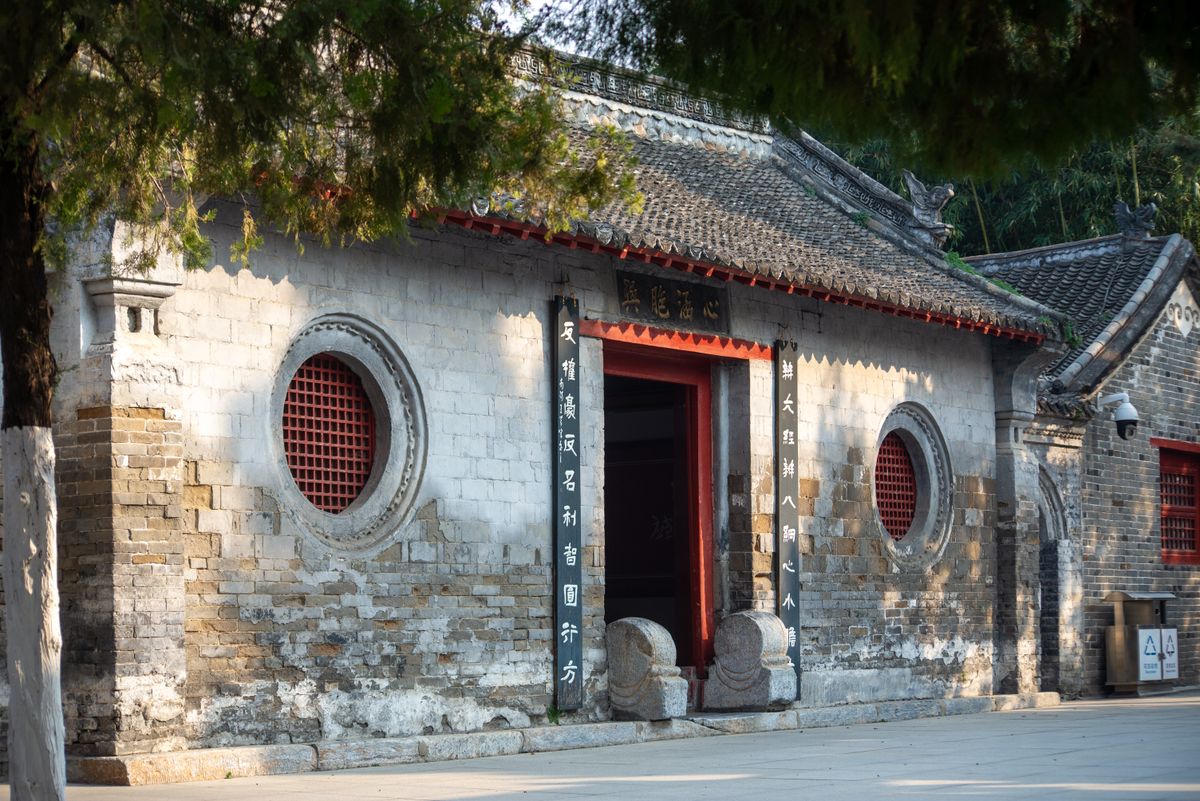
What does this mean in practice? If you visit the oldest temple in China expecting to touch a wall built in 68 CE, you will be disappointed. The timber halls you see were rebuilt after the original complex suffered repeated destruction. Wooden architecture in China rarely survives more than a few centuries without major reconstruction. The humid climate, fires, and warfare all take their toll. So the physical site is a palimpsest—a document written over many times. The 68 CE date exists in memory and text, not in the beams and tiles.
What the Textual Record Actually Shows
The earliest textual reference to White Horse Temple as a specific location appears in the Wei Shu (Book of Wei), compiled in the 6th century. The Luoyang Qielan Ji (Record of Buddhist Monasteries of Luoyang), written around 547 CE, describes the temple as already ancient by that time. But “ancient” in the 6th century means it existed before memory—not necessarily that it was founded in 68 CE. No Han dynasty source mentions the temple by name. That absence is significant. The Eastern Han court kept detailed records. If an emperor had founded a major religious institution, we would expect some trace in official histories like the Hou Han Shu (Book of the Later Han). The silence is conspicuous.
Scholars generally agree on this much: Buddhism did enter China during the Eastern Han, likely through Central Asian trade routes. The arrival of Buddhist texts and monks in the Luoyang region around the 1st century CE is plausible. Whether a specific temple was founded in a specific year—68 CE—is a later attribution. The date was probably fixed retrospectively to give the story precision. Round numbers and auspicious dates in Chinese historiography often signal symbolic rather than documentary accuracy.
Why the 68 CE Date Persists in Popular and Scholarly Writing
The 68 CE date persists because it serves a function. For Chinese Buddhist institutions, having the first temple carries enormous prestige. For Luoyang, the claim anchors the city’s identity as a cradle of Chinese Buddhism. For visitors, a precise date makes the story memorable. But the persistence of a date is not evidence for it. The historical process works the other way: the story became important, and the date was attached to it.
Several factors reinforce the 68 CE claim in popular writing. First, guidebooks and tourist signage repeat the traditional narrative without qualification. Second, the temple itself promotes the founding story through its own museums and displays. Third, the academic debate—which is nuanced and often skeptical—rarely reaches general audiences. The result is a feedback loop: visitors read the claim, repeat it, and it becomes “fact” through repetition.
For a researcher or serious traveler, the key skill is source triangulation. When you see a date on a sign, ask: what is the earliest source for this? Is it contemporary? Is it corroborated by archaeology? The answers for White Horse Temple are: later texts, no, and no. That does not make the temple unimportant. It makes it a different kind of important—a site where tradition, memory, and later architectural history converge.
What Physical Evidence Exists on the Ground Today
Visitors to the oldest temple in China often miss the most interesting physical evidence because they focus on the large halls. The halls are impressive but relatively recent. The genuinely old objects are smaller and easier to overlook. Here is what to look for:
- Stone steles with inscriptions: Several steles in the compound record repairs and imperial patronage. The oldest date from the Northern Wei and Tang periods. These are primary documents—they tell you what people in those eras believed about the temple’s history.
- The Qiyun Pagoda: Often described as the oldest structure on the site. While its current form is heavily restored, its base may preserve earlier masonry. Dating is uncertain, but it is the closest thing to pre-Ming physical fabric.
- Stone sculptures and reliefs: Some Buddhist images show stylistic features from the Northern Wei and Tang. They are not Han dynasty artifacts, but they demonstrate the temple’s long continuous use as a religious site.
- The “horse” statues: The two stone horses near the entrance are commonly associated with the temple’s founding story. They are Song or later in date. They are symbolic, not archaeological evidence.
None of these items proves a 68 CE founding. What they prove is that by the Northern Wei period (386–534 CE), the site was already established and important enough to receive imperial patronage and monumental inscriptions. That is a meaningful finding. It tells us the temple was old by the 5th century—but not how old.
A Researcher’s Decision Checklist for Assessing the Age Claim
If you are evaluating the 68 CE claim for a research project, a travel article, or a cultural heritage assessment, use this checklist. It helps separate what is known from what is asserted.
- Identify the earliest source. Does any text from the Eastern Han or Three Kingdoms period mention the temple? If not, the founding date is later tradition.
- Check for contemporary inscriptions. Are there steles or bronze inscriptions dated to the claimed founding era? For White Horse Temple, the earliest inscriptions postdate the founding by centuries.
- Assess the archaeological record. Have excavations revealed Han-dynasty foundations, roof tiles, or ritual deposits beneath the current structures? No systematic excavation has confirmed a 1st-century temple layer.
- Distinguish building phases. What is the date of the oldest standing structure? For most Chinese timber temples, this is Ming or Qing. Older sites exist only as foundations or scattered stone elements.
- Evaluate the motivation for the claim. Who benefits from the 68 CE date? Religious institutions, local governments, and tourism authorities all have incentives to promote the earliest possible founding.
This checklist does not debunk the site’s significance. It places that significance on a firmer foundation. The oldest temple in China is not old in the way a Roman ruin is old. Its age is a matter of continuous religious identity rather than surviving physical fabric. For many visitors, that is the more interesting story.
What Gets Lost When the Date Is Taken at Face Value
Taking the 68 CE date at face value obscures the most important historical process at White Horse Temple: the transformation of an oral tradition into institutional authority. The temple did not become China’s first Buddhist site by being first. It became first by being remembered as first. That process took centuries. The monks, patrons, and local officials who rebuilt the temple in later dynasties were not preserving a Han original—they were constructing a lineage. Each rebuilding phase added a layer of authority to the founding story.
This matters for anyone studying how religious institutions create legitimacy. The 68 CE date is not a fact about the past. It is a claim about identity, made in the present, using the past as material. The same pattern appears in many ancient sites worldwide. A temple, a church, or a shrine gains authority through its claimed antiquity. The claim works whether or not the antiquity is verifiable.
For travelers, this reframing changes the experience. Instead of asking “Is this really 68 CE?” you can ask “How did this site become China’s oldest temple in the collective memory?” The second question leads to the steles, the pagoda, the later inscriptions—the actual evidence on the ground. The first question leads to a yes-or-no answer that misses the texture of the place.
Practical Guidance for Visiting or Researching the Site
If you plan to visit White Horse Temple or use it in a research project, approach the site with a simple rule: date every object separately. Do not transfer the founding date to the buildings. Do not assume the oldest inscription proves the founding. Treat the site as a layered archive, not a single event.
For visitors, allocate time to the less prominent areas—the stele courtyard, the pagoda base, the museum displays. These hold the evidence for the temple’s long history. The grand halls are worth seeing for their Ming and Qing architecture, but they will not answer your questions about 68 CE. For researchers, consult the Luoyang Qielan Ji and the Wei Shu before relying on modern guidebooks. The primary sources are more cautious than the tourist literature.
The evidence for the oldest temple in China’s 68 CE founding is a tradition, not a fact. It rests on later texts, symbolic dates, and institutional memory. The physical site tells a different story: a Buddhist center rebuilt across centuries, each generation adding its own layer to the claim of primacy. Both stories are real. They just answer different questions.
If you are planning a research itinerary or cultural heritage project focused on early Chinese Buddhist sites, we can help you identify the primary sources and site-level evidence worth prioritizing. Contact our technical team with your specific research questions or itinerary goals, and we will point you toward the most useful materials and on-the-ground contacts.
About LyWOW Tours
LyWOW is a locally based travel agency in Luoyang, specializing in private tours for international travelers across Luoyang, Shaolin, Xi’an and Central China. English-speaking guides, flexible itineraries and door-to-door service.
Learn more about us or browse all our tours.
