 By
By What Fengxian’s Vairocana Buddha Means in Longmen Caves AP Art History
Students staring at a photograph of a colossal stone Buddha at Longmen often ask the same question: what is this figure actually saying, and how much of that meaning can you defend on an exam? This is the central problem in longmen caves ap art history study — the site is visually stunning, but AP graders reward argument grounded in visible evidence, not just enthusiasm for a famous monument. This article works through what the Fengxian Cave’s Vairocana Buddha communicates, what remains speculative, and how to build a response that survives scrutiny.
Why the Fengxian Cave Matters in Longmen Caves AP Art History Questions
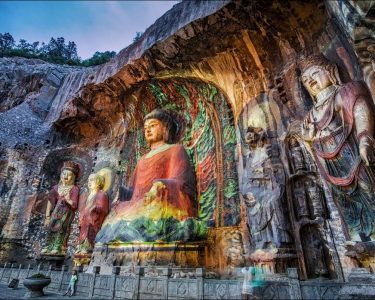
The Longmen Grottoes, carved into limestone cliffs near Luoyang, contain thousands of niches produced across several centuries of Chinese Buddhist patronage. Fengxian Cave, one of the largest open-air shrines at the site, is usually the single image AP Art History students are expected to recognize and analyze. Its central figure — a seated Vairocana Buddha flanked by bodhisattvas, guardian kings, and heavenly generals — appears repeatedly in released exam materials because it condenses several testable ideas into one composition: scale as political statement, Buddhist cosmology, and Tang dynasty imperial ambition.
Any question framed around longmen caves ap art history content will typically ask you to connect form to function — why is the figure this large, why is it positioned this way, and what does its calm, idealized face communicate to a viewer standing at the base of the cliff.
What Vairocana Symbolizes in Buddhist Cosmology
Vairocana is not simply “a Buddha” — the name identifies a specific cosmic principle within Mahayana Buddhist thought. Vairocana is understood as the Buddha of illumination, often interpreted as the source from which all other Buddhas and truths radiate, comparable to the sun as the source of light. This matters for exam writing because it explains formal choices:
- Serene, symmetrical facial expression — conveys enlightened stillness rather than individual emotion, consistent with how cosmic Buddhas are typically rendered across Buddhist sculpture broadly.
- Frontal, hierarchical pose — reinforces Vairocana’s role as a central, unifying figure rather than a narrative character in motion.
- Monumental scale relative to surrounding figures — visually establishes cosmic and, by extension, imperial authority.
An answer that only says “the statue looks peaceful” earns partial credit at best. An answer that ties serenity to Vairocana’s cosmological role earns more.
Imperial Patronage and the Tang Dynasty Context
Fengxian Cave was produced during the Tang dynasty, a period when Buddhist monastic institutions and the imperial court were closely intertwined. Court-sponsored Buddhist projects of this scale were rarely spiritual gestures alone — they doubled as public demonstrations of the ruling house’s legitimacy and reach. This is the reasoning AP graders want to see: connect the sheer size and central placement of the Buddha to the political value of visible, monumental religious patronage, rather than treating the carving as devotional art detached from state interests.
The limitation here is important. Associating specific patrons — including the frequently cited link to Empress Wu Zetian — with exact motivations requires outside historical sources beyond what the carving itself shows. The stone tells you scale, position, and iconography. It does not, by itself, narrate court politics.
Boundary: What the Fengxian Vairocana’s Iconography Can and Cannot Prove
This is the section students skip and then lose points on. Not every claim about Fengxian Cave is equally defensible from the object alone. Some readings are supported directly by what you can see; others require documentary or historical evidence outside the sculpture itself.
| Claim | Supported by visual/iconographic evidence? | Notes for exam writing |
|---|---|---|
| Vairocana represents a cosmic, unifying Buddha principle | Yes | Directly tied to established Buddhist iconographic convention for this figure type. |
| Scale and central placement project authority to viewers | Yes | Visible compositional evidence — size, elevation, frontal orientation. |
| Flanking bodhisattvas and guardian figures reinforce hierarchy | Yes | Supported by relative scale and positioning within the niche. |
| The carving reflects imperial-era Buddhist patronage practices | Yes, generally | Consistent with known Tang-period court involvement in major Buddhist projects. |
| The Buddha’s face is a portrait of a specific empress | Requires caution | A popular claim in some accounts, but not something the carving itself confirms without outside textual or historical sourcing. |
| Exact patron intent or inscription meaning | Requires outside evidence | Needs documentary or epigraphic sources beyond visual analysis. |
The safest AP strategy: build your thesis on the left-hand column, and only mention the caution-column claims as “traditionally associated with” rather than fact.
Common Mistakes Students Make on This Question
- Describing without analyzing — listing what’s in the image instead of explaining why the choice matters.
- Treating a debated attribution as settled fact — stating the empress-portrait theory as confirmed history rather than a contested interpretation.
- Ignoring surrounding figures — the guardian kings and bodhisattvas are part of the argument about hierarchy, not just decoration.
- Skipping the political dimension entirely — treating the carving only as religious art misses half the credit available.
- Overgeneralizing from one monument — assuming every Buddhist cave carving anywhere follows identical political logic.
A Step-by-Step Approach for Writing About Fengxian Cave
- Identify the figure precisely: Vairocana Buddha, not a generic seated Buddha.
- State the cosmological role Vairocana occupies within Mahayana Buddhist thought.
- Connect scale and placement to imperial-era patronage patterns of the Tang dynasty.
- Describe at least one supporting figure (guardian king or bodhisattva) and its compositional function.
- Flag any patron-specific claim as traditional or contested, rather than confirmed.
- Close with the combined function: the carving works simultaneously as religious devotion and political display.
Quick Decision Checklist Before You Submit an Essay Response
- Have you named the figure correctly as Vairocana, not a generic Buddha?
- Did you explain a formal choice (scale, pose, expression) rather than just describe it?
- Did you separate “visually supported” claims from “requires outside evidence” claims?
- Did you mention the Tang dynasty court context, not just religious meaning alone?
- Did you avoid presenting the empress-portrait theory as settled fact?
How Fengxian Cave Compares to Other Buddhist Rock-Carved Sites
Placing Fengxian Cave alongside other well-known Buddhist rock-cut sites helps clarify what is distinctive versus what is a shared regional practice within Buddhist art broadly.
| Site | Region/Period | Notable feature relevant to exam comparison |
|---|---|---|
| Fengxian Cave, Longmen | China, Tang dynasty | Colossal Vairocana as centerpiece of an open-air court-associated shrine. |
| Yungang Grottoes | China, earlier Northern Wei period | Often compared for evolving imperial-Buddhist sculptural style over time. |
| Ajanta Caves | India, various periods | Useful comparison point for rock-cut Buddhist devotional space more broadly, though artistic tradition and context differ substantially. |
Use this kind of comparison only when a prompt explicitly asks for cross-cultural or cross-period analysis — forcing an unrelated comparison into a Fengxian-specific question weakens focus rather than strengthening it.
Building a Defensible Thesis Statement
A strong thesis for this monument does two things at once: it names the specific religious meaning of Vairocana, and it ties that meaning to a concrete visual choice tied to imperial patronage. For example: “The colossal scale and central frontal placement of the Fengxian Vairocana project both cosmic authority within Buddhist cosmology and the political legitimacy of its Tang-era imperial sponsors.” That single sentence covers iconography, form, and historical context — the three pillars graders look for in longmen caves ap art history free-response answers.
Where students lose points is pushing that thesis further than the object supports — claiming, for instance, definitive patron identity or exact inscriptional meaning without citing outside sources. Keep the thesis anchored to what the carving visibly demonstrates, and treat contested attributions as secondary, clearly flagged claims.
If you’re preparing study materials, practice essays, or visual references on this monument and want a second check on how the argument holds together, feel free to request a review or sample outline before your next practice test.