 By
By Understanding the Spiritual Significance of Small Buddha Images in the Longmen Grottoes
When visitors first encounter the majestic **Longmen Grottoes** near Luoyang, China, their eyes are often drawn to the colossal statues that dominate the cave temples. Yet, an equally compelling and pervasive feature is the multitude of smaller Buddha figures, often repeated in dense arrays across walls and ceilings. What do these countless miniature carvings represent? This article delves into the profound religious and artistic intentions behind these often-overlooked yet critically important elements of the Longmen Grottoes. We will explore their devotional purpose, their role in ritual practice, and their broader symbolic meaning within the context of Buddhist art and faith.
Decoding the Devotional and Symbolic Roles of Small Buddha Carvings
The presence of repeated small Buddha images across the **Longmen Grottoes** is not merely decorative. It embodies a complex interplay of religious devotion, ritual practice, and profound symbolism central to Mahayana Buddhism, which flourished during the periods of their creation, particularly the Northern Wei and Tang Dynasties. Understanding these roles clarifies the intent of their creators and the spiritual experience they offered to adherents.
Here are the key religious roles embodied by these small Buddha images:
- Accumulation of Devotional Merit (Punya): In Buddhist belief, sponsoring or creating images of the Buddha, no matter their size, is an act that generates positive karma or “merit” for the donor. The more images created, the greater the merit. This was a primary motivation for individuals, families, and even imperial patrons. Each small Buddha represented a tangible contribution to one’s spiritual well-being and future rebirths.
- Ritual Repetition and Aspiration: The repetitive nature of the carvings mirrors the repetitive aspects of Buddhist practice, such as chanting mantras or prostrating. Each carving can be seen as a visual mantra, a continuous prayer etched into stone. This ritual repetition in art reinforced the practitioner’s commitment and aspiration towards enlightenment, creating a sacred space imbued with constant devotional energy.
- Symbolism of Thousand-Buddha Programs (Qianfo dong): Many grottoes across Asia feature “Thousand-Buddha” iconography, and the small Buddhas at **Longmen Grottoes** are a prime example. This concept is rooted in the belief that countless Buddhas have appeared and will appear throughout cosmic history across different kalpas (eons) and directions. The multitude of small Buddhas visually represents this vastness, symbolizing the universality of Buddhahood and the endless potential for enlightenment for all beings. It creates a sense of an omnipresent divine presence.
- Dedications and Vows: Many small Buddha carvings include inscriptions detailing the donor, the purpose of the carving, and the specific vows or prayers offered. These dedications often called for blessings for deceased ancestors, living family members, the emperor, or the entire nation, linking personal piety with broader societal and political aspirations.
- Teaching and Propagation of Dharma: While not as detailed as larger narrative scenes, the sheer presence of so many Buddha figures served as a constant visual reminder of the Dharma (Buddhist teachings). They transformed the caves into sacred instructional environments, reinforcing faith and understanding for pilgrims and monks alike.
These multifaceted roles underscore that the small Buddhas are far more than mere ornamentation; they are fundamental expressions of Buddhist faith and practice embedded in the very fabric of the **Longmen Grottoes**.
Historical Context and Artistic Evolution of Small Buddha Carvings
The practice of carving multiple small Buddha images at the **Longmen Grottoes** evolved significantly over centuries, reflecting changes in patronage, artistic styles, and spiritual emphasis. Early examples from the Northern Wei Dynasty (386–534 CE) often feature more stylized, elongated figures with serene expressions, deeply influenced by Gandharan and Central Asian artistic traditions. As the Tang Dynasty (618–907 CE) progressed, the figures became more naturalistic, fuller, and often depicted with greater individual detail, even in their smaller forms.
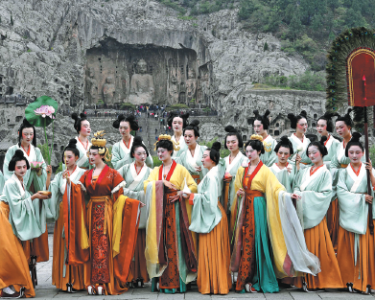
Initially, Buddhist figures and iconography arrived in China via the Silk Road, influencing the earliest cave temples. The establishment of the **Longmen Grottoes** as a major imperial project, particularly under Empress Wu Zetian, solidified the trend of extensive carving. The imperial family often sponsored grand projects, but the proliferation of small Buddhas also points to widespread popular devotion. Wealthy individuals, monastic communities, and even commoners contributed to the carving of these smaller figures, often as acts of piety or to fulfill specific vows. This democratic aspect of merit-making allowed a broader segment of society to participate in the artistic and spiritual endeavor of the grottoes. The scale of the **Longmen Grottoes** themselves, with thousands of niches and tens of thousands of statues, is a testament to the enduring power of these devotional practices. For further context on the broader history of such sites, one can consult resources like Wikipedia on the topic of Buddhist cave temples.
Common Misconceptions About the Small Buddha Images
The sheer volume and repetitive nature of the small Buddha images at the **Longmen Grottoes** can sometimes lead to misunderstandings for first-time observers. Clarifying these common misconceptions can enhance appreciation for their true significance.
- Misconception: They are simply filler or decorative elements.
- Clarification: While they contribute to the overall aesthetic, their primary purpose is profoundly spiritual. Each carving is an intentional act of devotion, not merely an artistic embellishment to fill empty space. Their repetition itself carries deep religious meaning, as discussed in the “Thousand-Buddha Programs.”
- Misconception: All small Buddhas represent the same specific Buddha.
- Clarification: While many might depict Shakyamuni Buddha (the historical Buddha) or Amitabha Buddha (the Buddha of Infinite Light, popular in Pure Land Buddhism), the collective often represents the concept of countless Buddhas across different times and realms. Specific iconic attributes, hand gestures (mudras), or accompanying bodhisattvas might differentiate them, but often their small scale makes precise identification challenging without inscriptions.
- Misconception: They were carved by a single, massive team in a short period.
- Clarification: The **Longmen Grottoes** were carved over a period of approximately 400 years, from the late 5th to the 9th century. While major projects had large teams, the smaller Buddhas were often commissioned individually or in small groups over this long span by various patrons. This piecemeal but continuous effort explains the stylistic variations seen across different caves and time periods.
- Misconception: Their small size implies lesser importance than the large statues.
- Clarification: Importance in Buddhist art is not solely determined by physical size. While grand statues like the Vairocana Buddha at Fengxian Temple certainly hold immense significance, the small Buddhas contribute collectively to the spiritual power of the site. Their cumulative merit and symbolic representation of universality are crucial, demonstrating that even a small act of devotion can contribute to a grand spiritual landscape.
Understanding these nuances allows for a deeper engagement with the religious artistry and historical context of the **Longmen Grottoes**. The small Buddhas are an integral part of the spiritual narrative, reflecting the devotional intensity and artistic mastery of ancient China.
Appreciating the Enduring Legacy of the Longmen Grottoes
The **Longmen Grottoes** stand as an unparalleled testament to the enduring power of Buddhist faith and artistic expression in China. The myriad small Buddha images, often overlooked in favor of their larger counterparts, are in fact central to understanding the spiritual landscape of this UNESCO World Heritage site. They embody the hopes, prayers, and devotional practices of countless individuals across centuries, creating a sacred environment where the pursuit of merit and enlightenment was etched directly into the stone. Their presence transforms the caves into dynamic spaces of ritual and contemplation, reflecting a profound belief in the universality of Buddhahood and the continuous cycle of spiritual aspiration. The legacy of the Longmen Grottoes, observed through these intricate details, continues to inspire and inform our understanding of ancient Chinese religious art and history.
To learn more about the specific carving techniques or the broader historical significance of these remarkable sites, we encourage you to explore detailed historical accounts and academic resources.