Build a Longmen Caves AP Art History Comparison That Uses Real Visual Evidence
Most study materials on Longmen tell you where the site is, who sponsored it, and why it matters. That is useful background, but it is not what a comparison essay asks you to do. A strong longmen caves ap art history response puts two works side by side, names what you can actually see, and explains why the differences matter. This guide gives you a repeatable process for doing exactly that, assuming you already know the basic timeline of the site.
Start with a Comparison Question, Not a Summary
The most common weakness in student answers is retelling the site’s history instead of answering a question. Before you pick any artwork, write one sentence that frames the comparison. Good framing questions for Longmen include:
- How did sculptural style change between the earlier and later phases of carving at the site?
- How do patrons shape the way a Buddha is presented to viewers?
- How does the cave setting change the way a figure is experienced compared with a freestanding sculpture?
Each question gives you a reason to choose evidence. If you cannot explain in one sentence what your two works will help you argue, keep narrowing until you can. The sections below, especially choosing your pairs and the visual evidence checklist, help you move from question to proof.
Choose Pairs That Create Real Contrast
A comparison only works if the two subjects are similar enough to compare and different enough to teach you something. At Longmen, three pairings tend to give students the most to work with.
Earlier cave sculpture versus later monumental sculpture
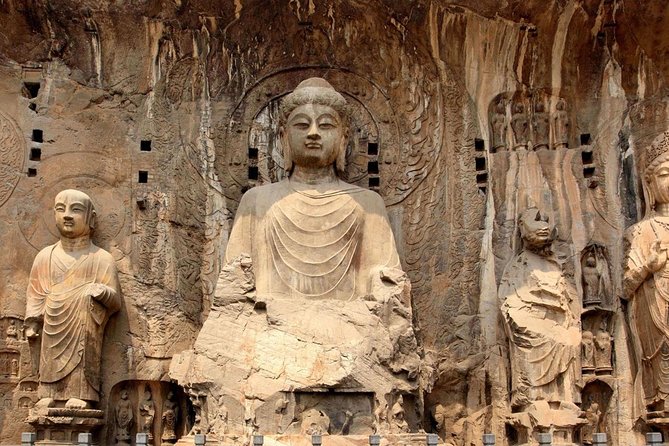
Pair a work from the earlier Northern Wei phase, such as the Guyang Cave, with the great Vairocana from the Fengxian Temple complex, a Tang dynasty project. Both are Buddhist and both are carved from the same rock, so the contrasts come from period, patronage, and scale rather than from different materials or religions.
Devotional figure versus donor imagery
Compare a principal Buddha with relief carvings that show donors or processions, such as the imperial donor reliefs once found in the Binyang Caves. Many fragments of these reliefs are now in museum collections outside China. This pairing lets you discuss who is being honored, who is paying for the honor, and how a sacred space can carry political meaning.
Cave interior versus open-air carving
Contrast a relatively enclosed cave setting with a figure carved in an open niche facing the river valley. This lets you write about viewer experience, lighting, and ritual movement, which are often overlooked.
Whichever pairing you choose, limit yourself to two primary works. Adding a third usually thins out your analysis rather than strengthening it.
Use a Visual Evidence Checklist
Once your works are chosen, collect observations before you write a single claim. Looking first prevents you from forcing a memorized story onto the images. The table below gives you categories to examine for each work.
| Category | What to look for | Why it matters |
|---|---|---|
| Face and expression | Shape of the face, treatment of the eyes and mouth, degree of remoteness or warmth | Shows changing ideals of the sacred and how approachable the figure feels |
| Body and proportion | Slender or full torso, visibility of the body beneath the robes | Signals shifts in style and influence over time |
| Drapery | Linear folds, layered patterns, or softer and more volumetric treatment | Helps you describe stylistic change without relying on vague words like “better” |
| Pose and gesture | Seated or standing, hand positions, symmetry | Connects form to meaning and to the figure’s identity |
| Scale and placement | Size relative to the viewer, position within the cave or niche | Explains how the work commands attention and shapes ritual behavior |
| Attendant figures | Bodhisattvas, disciples, guardians around the main Buddha | Reveals the hierarchy and narrative the patron wanted to present |
Write at least one precise observation in each row for both works. Precision is the difference between “the figure looks calm” and “the narrow, downward-looking eyes and closed mouth create a distant, contemplative presence.”
Layer Context on Top of What You See
After the visual work comes context. This is where background knowledge earns its place, but only if it explains something you have already observed. Use three kinds of context sparingly.
- Patronage: Who commissioned the work, and what might they have wanted viewers to believe about them? Imperial and aristocratic sponsorship shaped the scale and placement of major figures.
- Religious meaning: Which Buddha or figure is depicted, and how does that identity affect pose, setting, and attendants?
- Cultural exchange: How do local Chinese traditions and ideas that arrived along trade routes appear in the carving?
A useful rule is to attach every contextual fact to a visible feature. If you mention imperial patronage, point to the monumental scale or the processional arrangement. If you mention shifts in taste, point to the drapery or proportions.
A Worked Example: Guyang Cave and the Fengxian Vairocana
Here is how the process looks in practice, using general observations rather than measurements.
Observation. The earlier Guyang Cave sculptures present figures with an elongated, linear quality, and the drapery tends to be rendered with crisp, rhythmic folds. The Fengxian Vairocana, by contrast, has a fuller face and a calmer, more balanced presence. The Tang figure seems to look gently down toward the viewer.
Interpretation. The earlier style emphasizes spiritual abstraction and an otherworldly ideal. The later style balances that ideal with a more grounded, human-seeming presence, which suits a figure intended to be seen by large numbers of visitors and to project imperial authority.
Context. Tradition links the Fengxian project to Tang court sponsorship and, in popular accounts, to Empress Wu Zetian. Whether you cite that tradition or not, the scale and open placement support the idea of a work meant to communicate state-backed devotion.
Conclusion. The two works show Buddhist imagery adapting to different patrons, audiences, and settings while remaining anchored in the same sacred site.
Mistakes That Weaken a Longmen Comparison
- Listing facts without evidence. A date or sponsor name does nothing unless you connect it to something visible.
- Treating “later” as “better.” Describe change, not progress. Each style served its own moment.
- Ignoring the setting. A cave, a niche, and a museum display each frame a work differently. Remember that some Longmen reliefs now sit far from their original context.
- Comparing too many works. Depth beats breadth. Two well-analyzed examples outperform four superficial ones.
- Using vague adjectives. Words like “beautiful” or “powerful” need to be replaced with specific descriptions of line, volume, and gesture.
A Simple Paragraph Template for Essays and Presentations
When you need to write quickly, use this four-part sequence for each comparison point:
- State the shared feature or question, such as the treatment of drapery.
- Describe the first work with one specific observation.
- Describe the second work with a contrasting observation.
- Explain the reason for the difference using patronage, religion, or setting.
For a presentation, put the two images next to each other and annotate only the details you plan to discuss. Audiences remember a pointed observation far better than a crowded slide.
Practice Before You Write
Build a one-page comparison sheet for each pairing you might use. Include the checklist observations, one or two contextual facts tied to those observations, and a single sentence of argument. Reviewing three such sheets is more effective than rereading a long chronology, because you are rehearsing the skill the essay actually tests.
Finally, keep your claims proportionate. If you are unsure about a specific date, attribution, or patron detail, describe it in general terms and check it against your course materials. Careful, accurate language reads as more confident than a precise-sounding claim you cannot support.
Bringing the Method Together
A good longmen caves ap art history comparison is built in a clear order: frame a question, choose two works with meaningful contrast, gather visual evidence, add targeted context, and explain what the differences reveal. Follow that sequence and your writing will move beyond summary into real analysis, whether you are drafting an essay or preparing a classroom presentation.