 By
By China Longmen Grottoes: Imperial Art Through the Ages
The China Longmen Grottoes, carved into limestone cliffs that stretch for roughly one kilometer along the Yi River, hold over 2,300 caves and niches. They contain more than 100,000 Buddhist statues, some towering 17 meters high, others no larger than a thumb. It’s a staggering concentration of imperial ambition. The site didn’t evolve in isolation—emperors, empresses, and noble clans poured resources into these cliffs for more than four centuries. The result is a stone chronicle of dynastic power and religious fervor.
Tracing Longmen Grottoes History Through the Dynasties
Longmen Grottoes history kicks off in 493 AD, when the Northern Wei emperor Xiaowen shifted his capital from Datong to Luoyang. That move dragged the center of cave-making south. The imperial family already had a deep connection to Buddhist rock-cut temples—the Yungang Grottoes near the old capital proved that. Now they wanted something more refined, something that could mirror the cosmopolitan tastes of a new capital. Within a decade, the first chisels struck limestone at Longmen. The early work drew directly from Indian and Central Asian prototypes, but local carvers quickly reshaped those forms into a leaner, more sinuous style. By the time the Northern Wei collapsed in 534, the site already boasted central pillars, colossal Buddhas, and processional friezes that told stories of the Buddha’s past lives. That momentum carried through short-lived successor states before the Tang dynasty ignited a second, even grander wave of construction.
Northern Wei Cave Temples: The Foundation of Imperial Devotion
The Northern Wei cave temples at Longmen are not just the oldest—they’re the most revealing about how state and faith fused. Take the Guyang Cave, started around 493. A niche there bears a dedicatory inscription from Emperor Xiaowen himself. It’s a rare direct link between throne and stone. Nearby, the Binyang Central Cave consumed 800,000 man-days of labor, drained over two decades, and was financed by Emperor Xuanwu for his parents. Walking through it, you see a rigid symmetry in the seated Buddha, flanked by two disciples and two bodhisattvas. That orderly composition wasn’t accidental. It echoed the court’s own hierarchy, projecting cosmic order onto the cliff face. In our experience, visitors often overlook the smaller donor niches, but those panels list noble titles and clan names—essentially a census of Northern Wei elites who wanted their karma secured. The craftsmanship shifted too. Robes that once fell in heavy, linear pleats began to ripple with a lightness that foreshadows Tang naturalism. By 523, when the Binyang work halted amid political turmoil, the northern Wei temple style had set the template: monumental, stiffly graceful, unmistakably imperial.
Artistic Evolution Under the Tang Dynasty
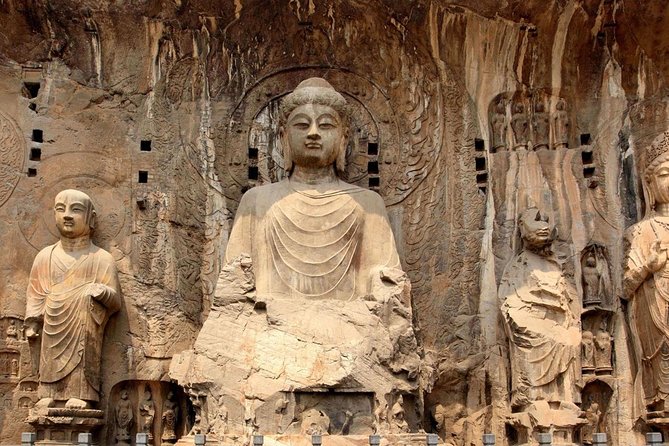
If Northern Wei built the skeleton, the Tang dynasty draped it in flesh and motion. Tang dynasty Buddhist art at Longmen hits you with its scale and sensuality. The Fengxian Temple, completed in 676, is the high-water mark. Emperor Gaozong and Empress Wu Zetian claimed direct patronage. Wu Zetian, who would later become China’s only female emperor, reportedly contributed 20,000 strings of her own cosmetic budget to the project. The main Vairocana Buddha—17.14 meters tall—dominates the alcove. His face is full, calm, almost smiling; his robe clings softly to a full body, no longer the abstract drapery of earlier centuries. Flanking him, a muscular guardian glares, veins bulging on his neck, while a disciple looks drained with age. That contrast is pure Tang confidence. They didn’t need to flatten everything into a single mood. They could show compassion and ferocity in the same grouping. Smaller Tang caves from the late 7th and early 8th centuries multiply this realism. Miniature Bodhisattvas twist at the waist, jewels carved deep enough to cast real shadows. We’ve seen how even a 30-centimeter figure from the Wanfo Grotto exhibits a hip-shot pose that earlier sculptors wouldn’t have attempted. The skill was extraordinary. By the time the An Lushan rebellion shattered Tang power in 755, imperial funding had dried up. Caves from the later Tang period revert to formulaic stiffness, as if the spirit had leaked away. The arc from the Guyang Cave to Fengxian echoes the arc of the dynasty itself—tightening, exploding, then fading.
Chinese Imperial Heritage Embedded in Stone
The site isn’t just a gallery of faith. It’s Chinese imperial heritage in three-dimensional form. More than a third of the caves carry dated inscriptions that mention emperors, princes, or court officials. That epigraphic record is invaluable. One inscription from 641 notes that a prince commissioned a niche to secure blessings for his father, Emperor Taizong. Another, from 722, records a palace eunuch’s donation during Xuanzong’s reign. These aren’t dry names—they map the shifting power networks around the throne. The choice of which Buddha to portray, which sutra to illustrate, often mirrored political alignments. The proliferation of Vairocana imagery during Wu Zetian’s ascendancy is no coincidence. Buddhist texts identified Vairocana as the universal, all-encompassing Buddha, a fitting symbol for a woman maneuvering to occupy the dragon throne. In the same period, carvers added 10,000 tiny Buddha figures to a single cave, an act of devotional bulk that also signaled the empire’s immense material reach. The Wei emperors had prioritized filial piety. Tang rulers broadcast universal sovereignty. The stonework captured that ideological pivot. After the Tang, later dynasties—Song, Ming—added a handful of statues, but never matched the imperial investment. The Longmen Grottoes thus freeze a specific mode of rule: a fusion of Buddhist merit-making and political theater that flourished only while the imperial center held firm.
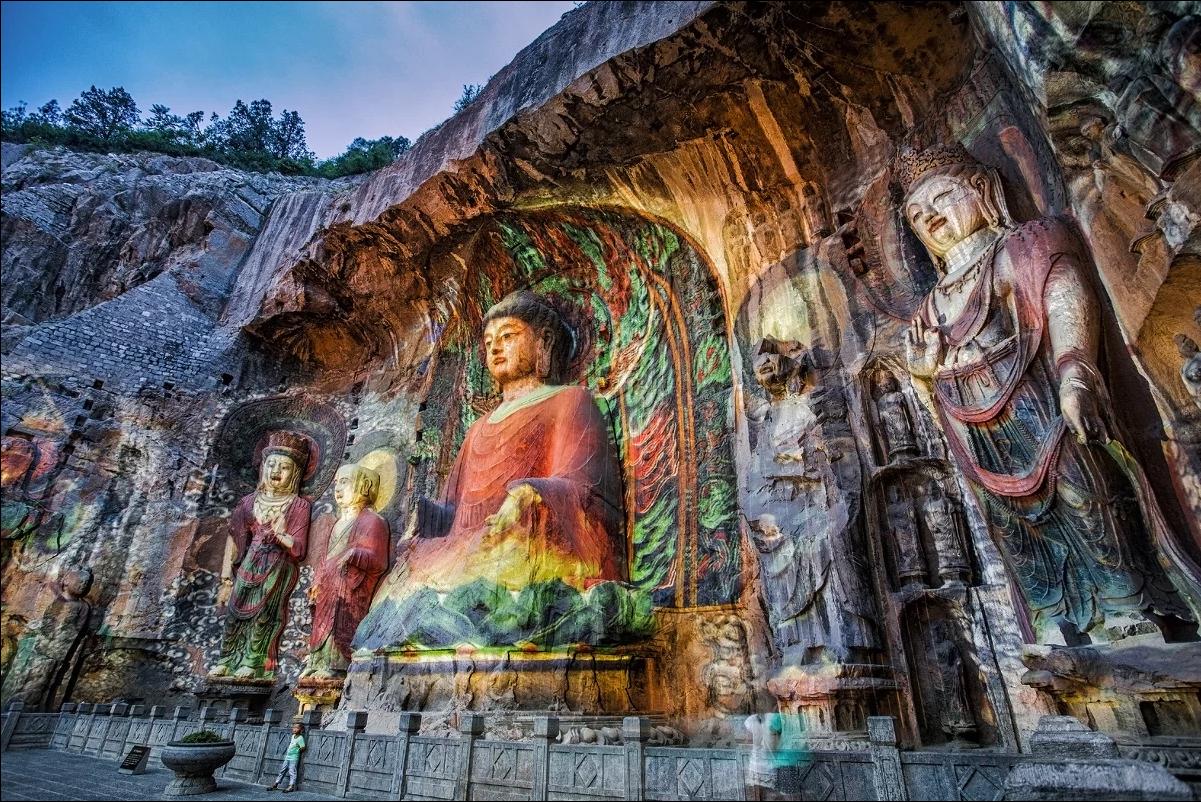
How Imperial Patronage Shaped the China Longmen Grottoes
A common question is how did imperial patronage shape the China Longmen Grottoes? The answer lies in the scale, speed, and stylistic unity of the works. An imperial decree could marshal thousands of craftsmen almost overnight. That compressed what would have been a generational folk effort into a decade-long project. The Binyang cave complex is a case study. The central cave’s seamless symmetry—the lotus ceiling, the mirrored apsaras, the regulated spacing of the niches—came from centralized planning, not organic village piety. When the court withdrew support after 523, work on the planned north and south Binyang caves lurched to a halt. They were left unfinished, an abrupt scar on the cliff that tells you everything about who was really driving the creativity. State sponsorship also controlled iconography. Empress Dowager Hu, regent for the Northern Wei, promoted a new, more rounded Buddha type that scholars call the “Longmen style.” She used it to reinforce her authority as a pious mother-ruler. Later, Tang patron Zhang Xiaoxiang, a military governor, funded an entire cliff of Amitabha figures in the late 7th century. Each statue follows the same formula, mass-produced but masterly—imperial branding long before the term existed. Remove the emperors and empresses, and Longmen would be a provincial shrine, not a world monument.
What Dynasties Contributed to the Longmen Grottoes?
People also ask what dynasties contributed to the Longmen Grottoes. The Northern Wei (386–534) laid the foundation, carving the earliest core from about 493 until their collapse. The Eastern Wei and Western Wei, short-lived successor states, added small caves but nothing monumental. The Sui dynasty (581–618) reunified China and sponsored a modest recovery, mainly in the form of finely carved Bodhisattvas that bridged Wei stiffness and Tang grace. But the Tang dynasty (618–907) was the powerhouse. The vast majority of the site’s 100,000 statues come from the Tang period, particularly between 650 and 755. That golden century accounts for the Fengxian Temple, the Wanfo Cave, the Huijian Cave, and dozens of lesser but exquisite shrines. After the Tang, sporadic patronage flickered. Song dynasty visitors left poetic inscriptions, not major carvings. Ming artisans restored some statues and added protective rooftops, but never started new cave projects on an imperial scale. So in essence, two dynasties—Northern Wei and Tang—define the site. The others are footnotes.
FAQ: China Longmen Grottoes
How did imperial patronage shape the China Longmen Grottoes?
Imperial patronage provided the massive funding, labor, and centralized design that turned Longmen into a coherent monumental ensemble. Emperors and empresses dictated the scale of projects—like the Fengxian Temple—and used specific Buddhist imagery to reinforce their legitimacy, leaving an art record directly tied to court politics.
What dynasties contributed to the Longmen Grottoes?
The Northern Wei dynasty initiated the grottoes in the 490s, carving the first large caves. The Sui dynasty contributed a few refined works. The Tang dynasty (7th–8th centuries) created the largest and most artistically accomplished caves, including the colossal Vairocana Buddha. Later Song, Ming, and Qing additions were minor repairs or inscriptions, not new cave-making.
Why are the Longmen Grottoes considered a UNESCO World Heritage site?
UNESCO recognizes the China Longmen Grottoes as an “outstanding manifestation of human artistic creativity” that fuses religion, politics, and art across four centuries. The site’s tens of thousands of statues and inscriptions document the high points of Chinese Buddhist sculpture and the evolution of imperial patronage, making it irreplaceable for cultural history.
Conclusion
The China Longmen Grottoes are not a frozen relic. They are a timeline you can walk through—from Northern Wei sacrifice to Tang dynamism and beyond. Every cliff surface records a moment when faith met imperial will, and the rock surrendered to the chisel. For businesses seeking culturally rooted products, motifs drawn from these caves—whether scaled-down replicas, fine art prints, or decorative elements—carry an authenticity that modern design rarely captures. We help partners source and export art pieces inspired by China’s most iconic heritage sites. Contact our team to discuss how we can bring this imperial legacy to your market.