
Blog
How Imperial Patronage Shaped the Luoyang Longmen Grottoes

How Imperial Patronage Shaped the Luoyang Longmen Grottoes
The staggering scale and artistic brilliance of the statues carved into the limestone cliffs raise a crucial question for any observer: who funded the Luoyang Longmen Grottoes? The answer is not a single person or entity. Instead, it reveals a complex and fascinating story of faith, political ambition, and social hierarchy woven directly into the stone. Understanding this patronage network is essential to deciphering the meaning behind one of the world’s most significant examples of Chinese Buddhist art.
From powerful emperors and empresses solidifying their rule to humble monks dedicating merit for their families, the grottoes served as a public ledger of devotion and power. The size of a statue, its location within the complex, and the specific deities depicted were all influenced by the patron’s status and intent. This guide breaks down how to read these visual and textual clues, focusing on the pinnacle of imperial sponsorship: the magnificent Fengxian Temple.
Reading the Stone: How Inscriptions Reveal a Diverse Patronage Network
While the imperial commissions are the most famous, they represent only one part of the story. The Longmen Grottoes were a project spanning several centuries, funded by a wide cross-section of society. The primary evidence for this diverse support comes from the thousands of dedicatory inscriptions found alongside the carvings. These inscriptions act as historical records, naming the donors and stating their motivations for commissioning the work.
Analyzing these texts reveals a clear hierarchy of patronage. The motivations ranged from the deeply personal desire for a better afterlife to the highly political act of legitimizing imperial power. We can group these patrons into several distinct categories, each with different goals and resources that directly impacted the resulting art.
Key Patron Groups at the Longmen Grottoes
- Imperial and Royal Family: This group includes emperors, empresses, princes, and high-ranking court officials. Their commissions are the largest in scale, occupy the most prominent locations, and often feature complex iconography directly tying the rulers to Buddhist deities. Their primary motivation was to display piety, legitimize their rule, and secure spiritual merit for the state and the dynasty. The sponsorship of the Fengxian Temple by Empress Wu Zetian is the ultimate example.
- Aristocratic Clans and Gentry: Wealthy and influential families who were not part of the immediate imperial circle also commissioned significant works. These niches are smaller than imperial projects but still display high-quality craftsmanship. Their inscriptions often express wishes for the health and prosperity of their family members, success in official careers, and favorable rebirths for deceased ancestors.
- Monastic Communities: Groups of monks and nuns, as well as prominent abbots, pooled resources to fund carvings. These works were often intended to accumulate merit for their monastery, honor their teachers, or serve as aids for meditation and teaching. The iconography in these caves can be more doctrinally specific than that in lay-sponsored caves.
- Commoners and Lay Associations: Perhaps the most numerous, these patrons were ordinary people, soldiers, merchants, and artisans. They often formed devotional societies (yiyi) to pool their modest funds to commission a small statue or niche. Their inscriptions are typically simpler, expressing earnest prayers for personal well-being, recovery from illness, or a peaceful afterlife for loved ones.
Imperial Ambition in Buddhist Form: Patronage, Scale, and Iconography
The connection between Buddhist devotion and Tang-era imperial patronage is most clearly understood by examining three key factors: the content of donor inscriptions, the physical scale of the statues, and the specific iconography chosen. Each element was a deliberate choice that communicated a powerful message about the patron’s status and intent. Getting any of these wrong—for example, a low-ranking official commissioning a statue on an imperial scale—would have been a serious political misstep.
The table below breaks down how these elements functioned as signals of power, particularly during the high Tang dynasty when imperial sponsorship of the Longmen Buddhist art reached its zenith.
| Patronage Element | Imperial Patronage (e.g., Wu Zetian) | Aristocratic / Gentry Patronage | Commoner Patronage |
|---|---|---|---|
| Donor Inscriptions | Formal, grandiloquent language. Links the ruler’s merit to the prosperity of the entire empire. Often names the emperor/empress as the primary benefactor, solidifying their divine-right-to-rule. | Formal but focused on the family or clan. Prays for sons, promotions in the bureaucracy, and honor for ancestors. Names the head of the household or clan. | Simple, direct language. Expresses personal prayers for health, safety, or a better rebirth. Often names a devotional society or multiple individuals who pooled funds. |
| Statue Scale | Colossal, often exceeding 15 meters in height. Designed to dominate the landscape and inspire awe, reflecting the immense power and resources of the state. Occupies prime, central locations. | Life-sized or slightly larger. Impressive but clearly subordinate to imperial commissions. Located in well-positioned but secondary caves or niches. | Small, often less than a meter tall. Tightly packed into smaller, less prominent caves or carved into the spaces between larger works. The scale reflects limited personal resources. |
| Iconography | Features deities like the cosmic Buddha Vairocana, whose all-encompassing nature mirrors the emperor’s universal rule. The main figure is often said to be a portrait of the ruler (e.g., Vairocana as Wu Zetian). | Focuses on popular figures like Amitabha Buddha (promising rebirth in the Pure Land) or Guanyin (the bodhisattva of compassion), reflecting concerns with salvation and worldly assistance. | Similar to aristocratic choices, often focusing on saviors like Amitabha and Guanyin who could offer direct help and comfort for the struggles of daily life. |
Why the Fengxian Temple is the Pinnacle of Imperial Sponsorship
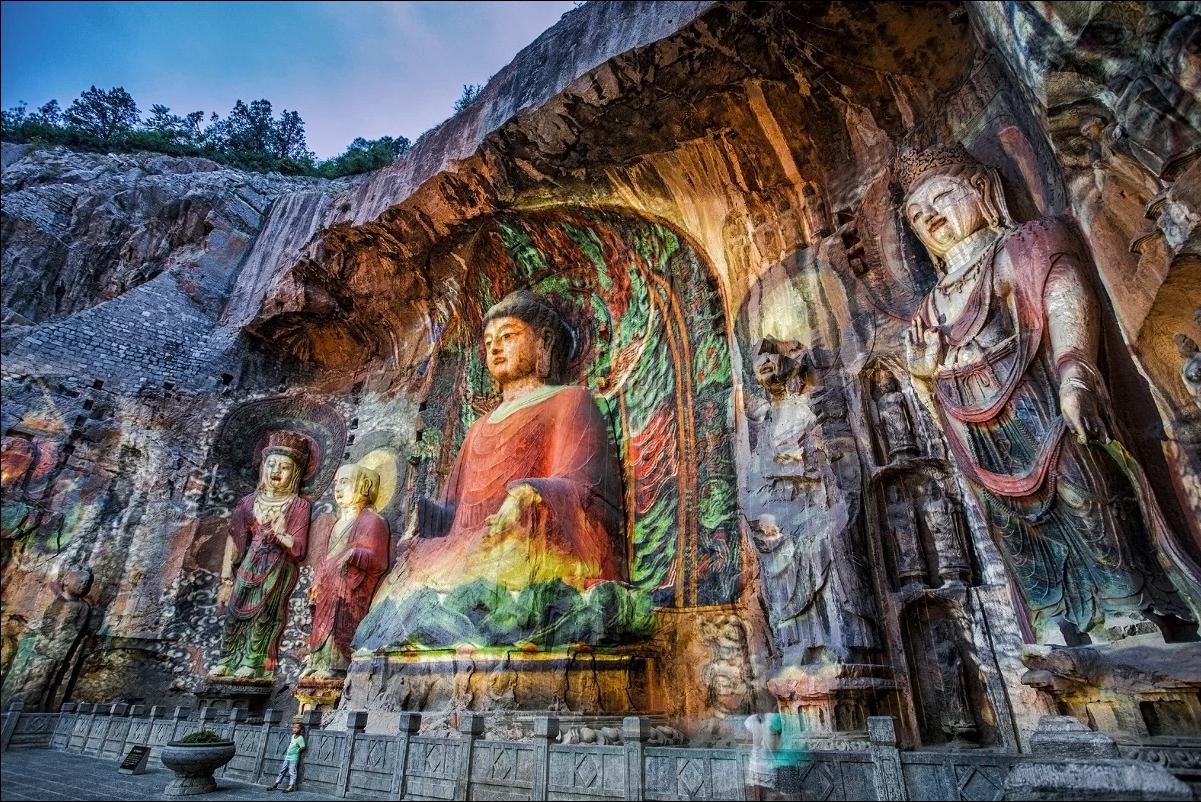
No discussion of patronage at the luoyang longmen grottoes is complete without focusing on the Fengxian Temple (Ancestor Worshipping Temple). Completed around 675 CE, this massive outdoor shrine represents the apex of imperial power, artistic achievement, and religious devotion during the Tang dynasty. Its creation was directly overseen and largely funded by Empress Wu Zetian, a pivotal and controversial figure in Chinese history.
The importance of Fengxian Temple stems from its powerful political messaging. The central figure is a monumental, 17-meter-tall statue of Vairocana Buddha. In Buddhist doctrine, Vairocana is the cosmic, universal Buddha from whom all other Buddhas emanate. By commissioning this specific deity on such a grand scale, Wu Zetian was creating a powerful political allegory. She was positioning herself not just as a pious ruler, but as the earthly counterpart to the universal Buddha—a sovereign whose power was absolute and divinely sanctioned. Legend holds that the serene, powerful face of the Vairocana statue was carved in her own likeness.
Common Misinterpretations of Fengxian Temple’s Art
When analyzing complex sites like these Chinese cave temples, it’s easy to make assumptions. Here are a few common mistakes to avoid:
- Mistake 1: Assuming all large statues are imperial. While the largest are indeed imperial, many substantial, life-sized statues were funded by powerful aristocratic families or monastic groups. Always look for an accompanying inscription to verify the patron’s identity.
- Mistake 2: Viewing it only as a religious site. Fengxian Temple was as much a political statement as a place of worship. Ignoring the political context of Wu Zetian’s rise to power means missing the primary motivation behind its creation. It was a strategic move to build legitimacy for a female ruler in a deeply patriarchal society.
- Mistake 3: Believing it was built by a single artist. A project of this magnitude involved a massive state-funded workshop with hundreds, if not thousands, of artisans, sculptors, and laborers working under the direction of master craftsmen and court officials. It was an industrial-scale undertaking.
The funding itself was a public display of power. It is recorded that Wu Zetian donated a significant sum of her own “cosmetics money” to help complete the project, a gesture that was both a display of personal piety and a demonstration of her immense personal wealth and influence even before she officially took the title of Empress Regnant.
The surrounding figures—disciples, bodhisattvas, and celestial guardians—are all rendered with a naturalism and dynamism that was characteristic of the high Tang period, reinforcing the idea that the imperial court could command the finest artistic talent in the empire. Fengxian Temple is not just a collection of statues; it is a carefully constructed tableau of the Buddhist cosmos, with the imperial patron at its center.
Our team provides in-depth analysis and documentation for cultural heritage sites. For assistance with your research or project needs, please contact our specialists.
About LyWOW Tours
LyWOW is a locally based travel agency in Luoyang, specializing in private tours for international travelers across Luoyang, Shaolin, Xi’an and Central China. English-speaking guides, flexible itineraries and door-to-door service.
Learn more about us or browse all our tours.