
Blog
How the White Horse Temple Became the Cradle of Chinese Buddhism

How the White Horse Temple Became the Cradle of Chinese Buddhism
Why is a temple in Luoyang, China, named after a horse, and how did it become recognized as the very first Buddhist temple in the country? The answer lies in a remarkable story of an imperial dream, a perilous journey, and the arrival of two Indian monks who would change the spiritual landscape of China forever. The White Horse Temple isn’t just a historic site; it’s the physical starting point for the story of Buddhism in China, a legacy that began with a quest for knowledge initiated by a Han Dynasty emperor.
This legendary origin, centered around 68 AD, establishes the horse temple as the foundational site for translation, teaching, and worship that shaped Chinese culture for millennia. Understanding its founding narrative is key to appreciating its immense historical and spiritual significance. The name itself is a direct tribute to the animals that carried the first sacred texts and missionaries across the continent.

The Imperial Dream That Sparked a 3,000-Mile Journey
The story begins not with a decree or a conquest, but with a dream. According to historical accounts like the Book of the Later Han, Emperor Ming of the Eastern Han Dynasty had a vision one night around 64 AD. In his dream, he saw a tall, golden deity with a halo of light flying around his palace. Unsure of the being’s identity, he consulted his ministers the next morning.
One of his advisors, Fu Yi, identified the figure as the Buddha from India, a sage from the West. Intrigued by this account, Emperor Ming dispatched an official delegation to seek out this religion. This was no small undertaking. The envoys, led by officials Cai Yin and Qin Jing, were tasked with traveling west from the capital of Luoyang into what was then considered remote and dangerous territory—modern-day Afghanistan and Central Asia—to learn more about Buddhism.
Their mission was clear: find the source of this “golden deity” and bring back its teachings, texts, and practitioners to the imperial court. This imperial patronage was the critical catalyst. Without Emperor Ming’s curiosity and resources, the introduction of Buddhism into China’s heartland might have occurred much differently, or been delayed significantly.
From Envoy Mission to Buddhist Foundation: Connecting the Key Events
The journey of Emperor Ming’s envoys culminated in the establishment of the White Horse Temple. Each element of the story—the envoys, the monks, the sutras, and the horses—plays a direct and interconnected role in the temple’s identity. Here is a breakdown of how these pieces fit together to mark the official arrival of Buddhism in China.
- The Imperial Mandate: Emperor Ming’s dream and subsequent order provided the political will and resources for the mission. It transformed a potential cultural exchange into a state-sponsored initiative, giving it legitimacy and importance.
- The Envoys’ Journey: The officials Cai Yin and Qin Jing traveled west along the burgeoning Silk Road. Their journey was successful; in Central Asia, they encountered two Indian Buddhist monks who had the knowledge and texts the emperor sought.
- The Indian Monks: The monks, named Kasyapa Matanga and Dharmaratna, agreed to travel back to China with the Han envoys. Their willingness to leave their homeland and undertake a difficult journey was the essential human element that made the transfer of knowledge possible. They weren’t just carrying books; they were carrying the living tradition.
- The White Horses and Sacred Texts: The monks transported their sacred cargo—Buddhist scriptures (sutras), relics, and statues—on the backs of two white horses. These animals became symbolic of the entire endeavor, representing the physical means by which the dharma, or Buddhist teaching, arrived in China.
- The Temple’s Founding and Name: Upon their arrival in the capital Luoyang in 67 AD, the emperor was pleased. He provided the monks with official lodging at a government ministry building. The following year, he commissioned a dedicated monastery to be built outside the city walls for them to live and work. In honor of the faithful animals that carried the precious texts, he named it the White Horse Temple.
This sequence of events directly explains why this specific horse temple is so revered. It wasn’t just a place of worship; it was China’s first government-sponsored center for Buddhist study and translation, established specifically to house the first monks and the first sutras to officially arrive in the country.

What Was Actually Brought Back? The First Sutras and Their Impact
The value of the monks’ arrival was not just symbolic. Kasyapa Matanga and Dharmaratna began the monumental task of translating the Buddhist scriptures from Sanskrit into Chinese. This was the critical step that allowed the philosophy to spread beyond a small circle of foreign monks and court officials. Their most famous translation is the Sutra of Forty-two Chapters (四十二章經).
This text was not a single, long discourse but rather a curated collection of foundational Buddhist aphorisms and teachings. It was designed as a concise introduction to core concepts like karma, monastic discipline, and the path to enlightenment. Its format made it accessible and was instrumental in providing the Chinese aristocracy and scholars their first structured look into Buddhist thought. The White Horse Temple thus became the first official translation center, setting a precedent for centuries of scholastic work that would follow in other temples across China.
However, with a story this ancient, several misconceptions can arise. It’s important to clarify what the founding of the temple represented.
Common Misconceptions About the Temple’s Founding
| Misconception | Historical Reality |
|---|---|
| Buddhism did not exist in China before the White Horse Temple. | There is evidence of Buddhist ideas and perhaps even small communities existing in China before 68 AD, likely arriving piecemeal through merchants on the Silk Road. However, the temple’s founding marks the first official, imperially-sponsored introduction and establishment of a Buddhist institution. |
| The temple has remained unchanged since the Han Dynasty. | The current structures are not the originals from 68 AD. The temple has been destroyed, rebuilt, and renovated many times throughout its nearly 2,000-year history, most notably during the Tang, Ming, and Qing dynasties. The present-day complex reflects centuries of architectural evolution. |
| The Sutra of Forty-two Chapters was a major, original scripture. | It is considered a compilation or anthology of excerpts from various Indian sources, rather than a single, verbatim sutra. Its genius was in its curation, providing a perfect “starter kit” for a Chinese audience unfamiliar with the religion’s vast literary tradition. |
Architectural and Historical Significance Beyond the Founding Story
While its origin story is paramount, the White Horse Temple’s importance extends far beyond the Han Dynasty. For centuries, it remained a vital center for Buddhism in China. It was a place where influential monks from across Asia came to study and translate, helping to build the vast canon of Chinese Buddhist literature.
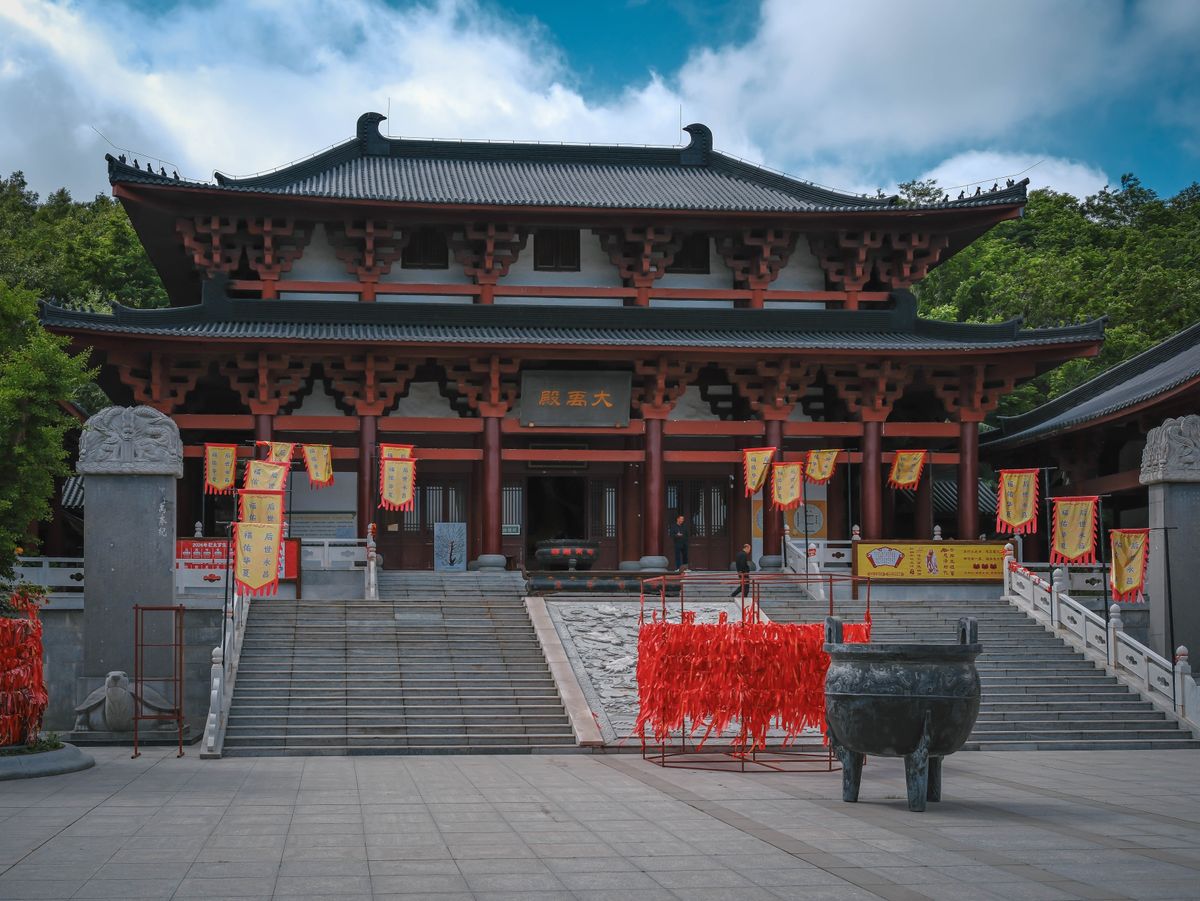
The temple complex today is a testament to this long history. While the core is of a classical Chinese monastery design, a unique feature is the “International Zone” or “World Buddhist Zones.” This area includes replicas of famous Buddhist temples from countries like India, Thailand, and Myanmar, built with the support of those nations. This modern addition reinforces the temple’s ancient role as a point of international cultural and spiritual exchange, connecting Chinese Buddhism back to its global roots.
Understanding the temple’s progression helps place its founding in a broader context. Here is a simplified timeline of key moments in its history.
Key Milestones in the Temple’s History
- circa 68 AD: Emperor Ming establishes the White Horse Temple in Luoyang to house Indian monks Kasyapa Matanga and Dharmaratna. Translation of the Sutra of Forty-two Chapters begins.
- Tang Dynasty (618-907 AD): The temple flourishes, enjoying significant imperial patronage. Famous monks like Xuanzang (of Journey to the West fame) are associated with the temple before or after their travels.
- An Lushan Rebellion (755-763 AD): The temple suffers significant damage during the widespread conflict that destabilized the Tang Dynasty.
- Ming (1368-1644) & Qing (1644-1912) Dynasties: Major reconstructions and renovations take place, forming the basis of the architectural layout seen today.
- 20th Century: The temple undergoes modern preservation efforts. The establishment of the International Zone begins, re-emphasizing its role in global Buddhism.
The White Horse Temple is more than just an ancient building; it is a living monument to a pivotal moment in world history. Its name is a permanent reminder of the two white horses that completed a historic journey, carrying not just scriptures, but the seeds of a philosophy that would profoundly influence Chinese civilization.
For those planning projects in regions with deep cultural significance, understanding these foundational stories is crucial. It informs everything from logistical planning to stakeholder engagement. Our team has extensive experience navigating the complexities of culturally sensitive environments.
To ensure your projects respect and align with local heritage, contact our team for expert guidance and support.
About LyWOW Tours
LyWOW is a locally based travel agency in Luoyang, specializing in private tours for international travelers across Luoyang, Shaolin, Xi’an and Central China. English-speaking guides, flexible itineraries and door-to-door service.
Learn more about us or browse all our tours.