 By
By Longmen Caves AP Art History Visual Analysis Guide
You need a thesis that moves beyond “these are Buddhist caves.” You need to connect specific visual details to the spiritual and political power carved into the limestone cliffs. When you face a longmen caves ap art history question on the exam, the difference between a passing score and a top score rests on your ability to transform observation into argument. We see students struggle with this transition every year. They describe what they see but fail to explain why it matters. This guide gives you a direct method for building that argument, using a visual evidence chart that links what you see to what you can claim.
Why the Longmen Caves Matter for Your AP Score
The College Board includes the Longmen Grottoes in the AP Art History curriculum for a reason that goes deeper than their age. These caves represent a convergence point where religious devotion, imperial ambition, and artistic technique merge into a single, analyzable site. When you answer what makes Longmen Caves important in AP Art History, you are really answering a question about how art functions as a tool of state and faith simultaneously.
Emperor Xiaowen moved the Northern Wei capital to Luoyang in 494 CE. Soon after, the cliffs along the Yi River became the focus of intense patronage. The site contains over 2,300 caves and niches housing more than 100,000 Buddhist statues. But numbers alone do not build your argument. What matters is the shift in style from the earlier Yungang caves to the Longmen figures. The earlier figures at Yungang display a more static, frontal, and blocky treatment of the body. At Longmen, you see an evolution toward elongated proportions, deeper linear drapery folds, and a more ethereal quality that reflects the growing influence of Han Chinese aesthetics over the previous Tuoba patronage models. This stylistic shift is your first major analytical hook.
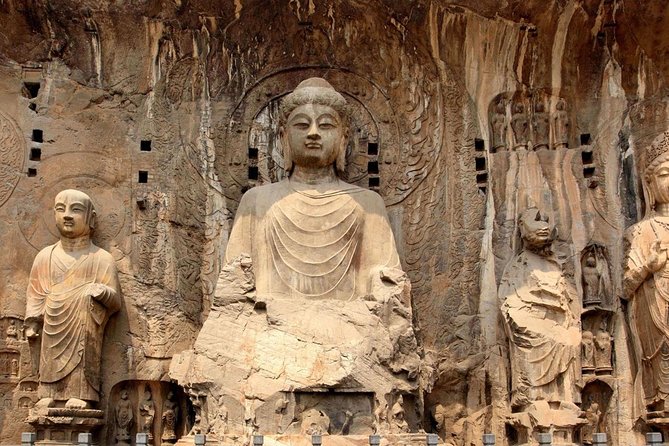
The political context amplifies the religious function. Empress Wu Zetian, who would later rule in her own name, sponsored the colossal Vairocana Buddha in the Fengxian Temple. By funding this massive project, she linked her own image to the cosmic Buddha. The central figure’s serene, rounded face is widely believed to have been modeled on the Empress herself. This is not simply a pious act. It is a calculated political statement rendered in stone. When you write your analysis, you must address this dual function: the caves served as both a merit-generating act for patrons and a projection of centralized authority.
Visual Evidence to AP Rubric: Your Analysis Chart
We have built a practical chart to help you move directly from observation to a model thesis. This method answers the question of how to analyze Longmen Caves for AP Art History by giving you a repeatable structure. You identify the visual fact, state its function within the site, connect it to materials and technique, unpack the Buddhist symbolism, and then link it to a broader historical claim. This is the engine of your essay.
| Visual Feature | Context & Function | Material & Technique | Symbolism | Sample Thesis Link |
|---|---|---|---|---|
| Colossal Vairocana Buddha (Fengxian Temple) | Imperial sponsorship by Empress Wu Zetian; central object of worship and political legitimization | Limestone carved in situ; high relief with undercutting for deep shadows around hands and robes | Vairocana as the universal, primordial Buddha; the cosmic center of all existence | “The scale and placement of the Vairocana Buddha transforms the natural cliff into a controlled imperial space, asserting Tang dynastic authority through Buddhist iconography.” |
| Elongated, linear drapery folds on Boddhisattvas | Reflects Han Chinese aesthetic preference over earlier Central Asian heaviness; dates figures to late Northern Wei period | Sinuous, shallow carving lines that create a rhythmic, downward-flowing visual movement | Drapery as a metaphor for the shedding of material weight; the body as a vessel for spiritual transcendence | “The shift from blocky, static robes to fluid, calligraphic drapery at Longmen visually enacts the Buddhist goal of liberation from physical constraint.” |
| Honeycomb of small votive niches | Donated by a range of patrons, from aristocrats to merchant guilds; demonstrates widespread devotional practice | Standardized, repeated carving process; shallow niches with polychrome traces | Accumulation of merit through repetitive sacred imagery; the cliff as a living ledger of piety | “The proliferation of smaller votive niches alongside imperial commissions reveals a stratified society unified through a shared visual language of devotion.” |
| Guardian figures with dynamic, tense postures | Flanking the main Buddha; apotropaic function to protect the sacred space | High relief with exaggerated musculature and swirling scarves; deep undercutting creates dramatic chiaroscuro | Wrathful protectors of the dharma; the tension between calm interior and violent exterior | “The contrast between the serene Buddha and the agitated guardians externalizes the Buddhist cosmology of an enlightened center surrounded by a chaotic, unenlightened periphery.” |
Writing Your Thesis: From Observation to Argument
Most students freeze when they need to answer how to write a thesis about Longmen Caves. They default to a descriptive statement: “The Longmen Caves contain many Buddhist sculptures.” That is a fact, not a thesis. A thesis must be arguable. It must stake a claim about meaning, function, or context that you then prove with visual evidence.
Start with a relationship. Identify two forces that interact at the site. The most productive pairs for Longmen include: imperial power and religious devotion, the natural landscape and human intervention, or the material permanence of stone and the spiritual goal of transcendence. Your thesis should propose a specific dynamic between one of these pairs.
Here is a weak thesis: “The Longmen Caves show Buddhist art from the Tang Dynasty.”
Here is a strong, exam-ready thesis: “At Longmen, the Tang imperial court transformed the raw limestone cliff into a calculated political landscape, where the colossal Vairocana Buddha fused the image of Empress Wu Zetian with cosmic Buddhist authority to legitimize female rule in a patriarchal dynasty.”
Notice the difference. The strong thesis names a specific patron, a specific formal quality, a specific political context, and a specific argument about function. It is a claim you can prove by describing the sculpture’s scale, its placement, the treatment of the face, and the historical record of Wu Zetian’s patronage. You do not need to know every fact. You need to know how to use the facts you have to support a clear, focused claim.
Structuring the Body Paragraph
Once you have your thesis, each body paragraph must function as a closed loop of evidence. Open with a sub-claim that supports one part of your thesis. Immediately follow with a specific visual detail. Then explain how that visual detail proves your sub-claim. Finally, connect it back to your main argument.
For a Chinese Buddhist sculpture AP Art History essay, your paragraph on the Vairocana Buddha might look like this: The centralized, hierarchical composition of the Fengxian Temple positions the Vairocana as the undisputed focal point of the site, mirroring the absolute authority of the Tang emperor. The central Buddha sits on a lotus throne at the apex of a symmetrical grouping, flanked by disciples, bodhisattvas, and guardians who diminish in scale. The figure’s frontal, rigid posture and the smooth, idealized planes of the face draw all visual attention inward. This compositional strategy does more than organize a sacred space. It creates a visual analogy for the centralized power structure of the Tang state, where all authority radiates from a single, divinely sanctioned ruler. The sculpture is not merely a religious icon; it is a diagram of imperial cosmology.
Contextualizing the Longmen Grottoes in the AP Curriculum
Your Longmen Caves art analysis will be stronger if you can position the site within the broader arc of the AP Art History curriculum. The caves do not exist in isolation. They belong to a unit that includes the Silk Road, the spread of Buddhism from South Asia through Central Asia to East Asia, and the adaptation of foreign artistic models to local traditions.
You can strengthen your argument by making a brief, controlled comparison. The colossal Buddha at Bamiyan in Afghanistan, destroyed in 2001, offers a direct precedent for the monumental rock-cut Buddha image. But where the Bamiyan figures stood on the exterior of the cliff, exposed and vulnerable, the Longmen figures sit within carved niches and caves, protected and framed by the stone. This architectural choice reflects a Chinese preference for integrating sculpture with a defined, architectonic space. Similarly, you can reference the earlier cave sites at Dunhuang, where painted murals dominate the interior walls. At Longmen, the emphasis shifts almost entirely to carved stone sculpture, with painting playing a secondary, supporting role. This material choice speaks to a desire for permanence and a mastery of stone carving technique that defines the high points of Chinese Buddhist art.
When you approach the AP Art History Longmen Grottoes content, think in terms of transformation. The site transforms a natural cliff into a sacred map of the Buddhist cosmos. It transforms foreign religious ideas into a distinctly Chinese visual language. It transforms imperial wealth and anxiety into an enduring material record. Every visual choice you analyze should be linked back to one of these transformations.
Common Pitfalls and How to Avoid Them
We see the same mistakes repeated in practice essays. The first is pure description without analysis. You write that the Vairocana Buddha is large and made of stone. That is true but useless. You must state why the large scale and stone material matter. The scale overwhelms the viewer, creating a sense of awe and submission appropriate to both a religious and political encounter. The stone permanence asserts that the dynasty’s power, like the Buddha’s teaching, is eternal and unchanging.
The second pitfall is treating the site as a single, undifferentiated monument. The Longmen Caves span centuries of patronage and stylistic change. Acknowledge this chronology. A Northern Wei dynasty figure with its sharp, flattened drapery folds and an elongated head makes a different statement than a Tang dynasty figure with its fuller, rounded body and naturalistic proportions. If you can identify which period a figure belongs to based on style, you immediately demonstrate a higher level of visual literacy.
The third pitfall is ignoring the physical material. Limestone is a specific choice. It allows for fine, detailed carving and a smooth, polished surface that catches light. The sculptors exploited the natural bedding planes of the rock. They carved deep into the cliff to create dramatic shadows that animate the figures as the sun moves across the face of the grottoes. This interplay of light and carved stone is not accidental. It is a fundamental part of the visual experience and should be part of your Longmen Caves visual analysis.
A focused study of the site reveals a sophisticated manipulation of space, scale, and material in service of a unified ideological program. The patrons and artists who created the Longmen Grottoes understood that a carved cliff face does more than depict the divine. It makes the divine physically present and politically useful. Your job on the AP exam is to articulate that understanding with precision and confidence. Use the chart. Build your thesis from a specific relationship. Let every observation earn its place in your argument. The limestone holds the evidence. Your essay must hold the meaning.