By
By Oldest Temple in China: 7 Sites That Claim the Title
The oldest temple in China does not have a simple, one-site answer. The result depends on what “oldest” is meant to describe: the earliest recorded foundation, the first Buddhist institution, the oldest surviving structure, or the longest-running temple community.
Temple history in China is layered. A monastery may trace its foundation to the Han dynasty yet have been rebuilt many times since. Another site may retain a Tang-era pagoda while its principal halls are far more recent. Some Buddhist temples also stand on places of worship that predate their present religious identity.
The seven sites below have some of the strongest and most commonly cited claims. Each comparison distinguishes between traditional founding dates, archaeological evidence, and surviving architecture. Those differences are essential when discussing ancient temples in China.
How the title “oldest temple” is decided
Four measures are especially useful when comparing historic Chinese temples:
- Documented foundation: Does a reliable historical source identify when the temple was established?
- Religious continuity: Has the site remained an active Buddhist or religious institution since its claimed founding?
- Archaeological evidence: Do excavations support the traditional date?
- Surviving structures: Are any buildings, pagodas, inscriptions, or foundations genuinely ancient?
Using these tests produces different winners. White Horse Temple has one of the strongest early documentary traditions. Xiantong Temple carries an equally significant first-century Buddhist foundation claim. Guangxiao Temple may occupy a much older sacred site, while Tanzhe Temple is more accurately described as Beijing’s oldest temple rather than China’s oldest.
1. White Horse Temple, Luoyang: the leading national claim
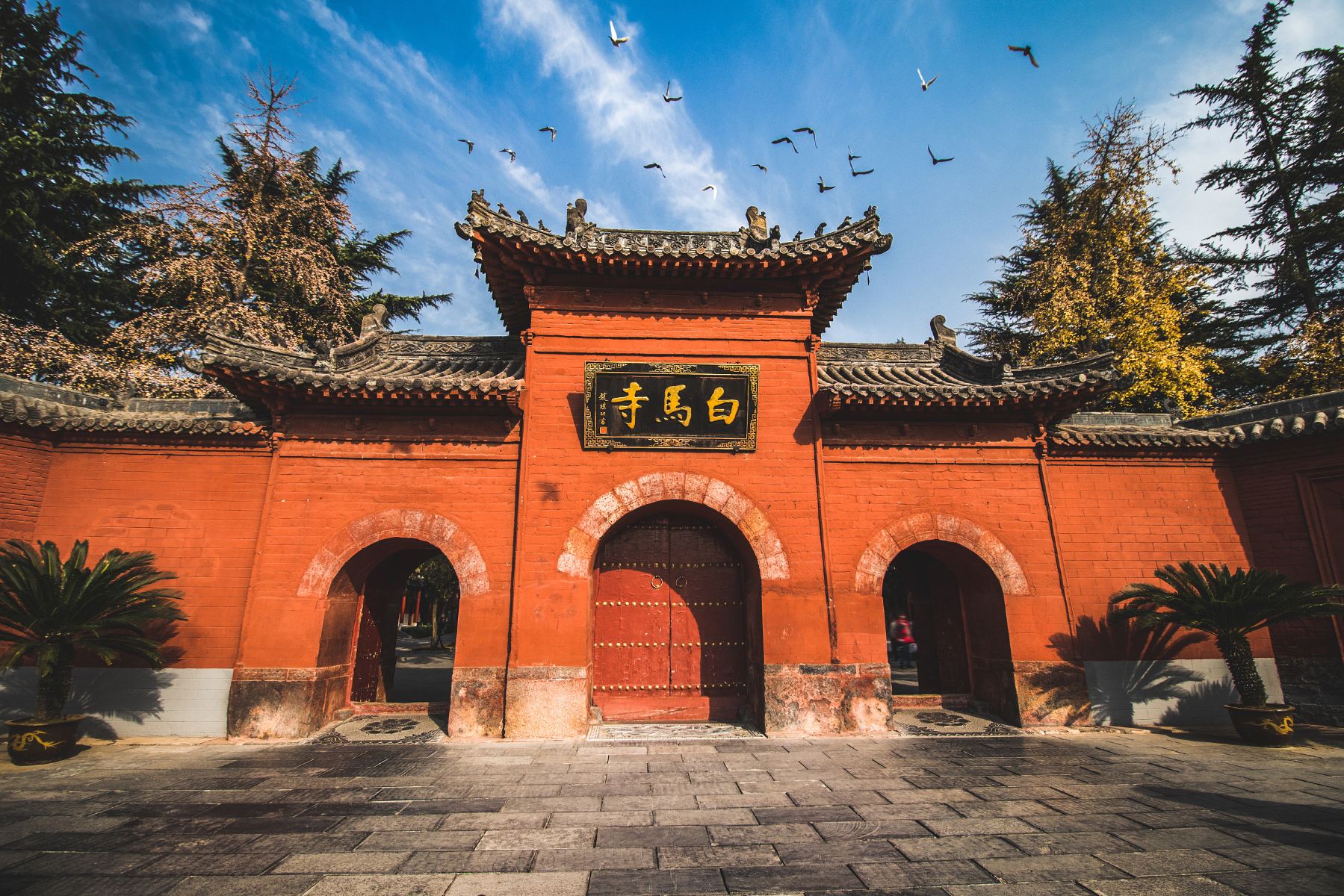
Traditional date: 68 CE
White Horse Temple, or Baima Temple, in Luoyang, Henan Province, is widely regarded as the first officially established Buddhist temple in China. According to tradition, Emperor Ming of the Eastern Han dynasty sent envoys west after dreaming of a golden figure. They returned with two Indian monks, Kashyapa Matanga and Dharmaraksha, accompanied by white horses carrying Buddhist scriptures and images.
The court is said to have founded the temple in 68 CE. That date gives White Horse Temple its powerful national claim and explains why it is so often described as the oldest Buddhist temple in China.
Its importance goes well beyond the founding story. Translators associated with the temple helped introduce Buddhist texts to the Chinese court, and the site became a lasting symbol of Buddhism’s arrival in imperial China. It also represented an early meeting point for Indian, Central Asian, and Chinese religious traditions.
What survives?
The challenge is that the current buildings are not original Eastern Han structures. White Horse Temple has been damaged, rebuilt, expanded, and restored under successive dynasties. Its gates, halls, and courtyards mostly reflect later architectural periods, although the site retains a long institutional history and several important monuments.
White Horse Temple is therefore the strongest answer when the question concerns the earliest officially recorded Buddhist temple foundation. It is not, however, the site with the oldest standing buildings.
2. Xiantong Temple, Mount Wutai: a first-century Buddhist tradition
Traditional date: 68 CE
Xiantong Temple, located in the heart of Mount Wutai in Shanxi Province, also claims a foundation date of 68 CE. The site was previously known by names including Dafu Temple. Buddhist tradition links its establishment to the same Eastern Han imperial era associated with White Horse Temple.
Mount Wutai later became one of China’s most important Buddhist pilgrimage centers, particularly through its connection with Manjushri, the bodhisattva of wisdom. Over the centuries, the mountain developed a broad network of monasteries, shrines, stupas, and pilgrimage routes. Xiantong Temple emerged as the leading complex among them.
The first-century date is central to the temple’s traditional history, but the physical evidence is more complicated. Most visible structures date from later periods, and the complex has been reconstructed repeatedly. Its claim rests on religious tradition, historical records, and Mount Wutai’s importance rather than on an intact first-century building.
Any discussion of which temple is considered the oldest in China should include Xiantong Temple alongside White Horse Temple. Both share a first-century foundation tradition, though White Horse Temple has the clearer link to Buddhism’s official introduction at the imperial court.
3. Guangxiao Temple, Guangzhou: an older sacred site beneath a Buddhist temple
Traditional origins: before the Common Era; Buddhist development from the 4th century
Guangxiao Temple in Guangzhou, Guangdong Province, presents a different kind of case. The site may have begun as a residence or religious compound linked to earlier southern Chinese rulers. It later developed into a Buddhist center, with major growth during the Jin and Southern Dynasties periods.
The temple is associated with several influential Buddhist figures. The Indian monk Bodhidharma is traditionally linked with Guangzhou and China’s southern coast, although accounts of his travels blend historical material with later religious tradition. The Chinese monk Huineng, recognized as the Sixth Patriarch of Chan Buddhism, is also connected with Guangxiao Temple. Tradition holds that he received recognition there before returning to Guangdong’s interior.
Guangxiao’s importance lies in both continuity and change. Its location may be older than the Buddhist institution now occupying it. That makes it a strong candidate for the oldest religious site in a broad sense, but a less certain answer when the question specifically concerns the oldest continuously documented Buddhist temple.
The present halls and structures result from later rebuilding campaigns. As at White Horse Temple, visitors should not confuse the age of the site with the age of every building standing there today.
4. Qixia Temple, Nanjing: an early Southern Dynasties monastery
Traditional date: 489 CE
Qixia Temple, also known as Qixia Monastery, stands northeast of Nanjing on the wooded slopes of Qixia Mountain. It was founded in 489 CE during the Southern Qi dynasty by the aristocrat Ming Sengshao, who is said to have built the temple after witnessing a spiritual manifestation on the mountain.
Unlike the first-century claims, Qixia Temple dates from an era when Buddhist institutions, images, and cave sanctuaries were becoming firmly established across southern China. The monastery developed into an important center for Buddhist learning and meditation.
Its most significant surviving evidence extends beyond the temple buildings. The nearby Qixia grottoes contain hundreds of Buddhist sculptures and inscriptions carved over several centuries. These works offer tangible proof of the area’s religious importance, even though many temple structures have been repaired or rebuilt.
Qixia is one of the clearest examples of an early Buddhist complex supported by substantial archaeological and artistic remains. It does not usually take the national “oldest” title, but its historic presence is more visible in material form than that of some earlier foundation claims.
5. Shaolin Temple, Henan: old, famous, and often misunderstood
Traditional date: 495 CE
Shaolin Temple was founded in 495 CE on Songshan in Henan Province during the Northern Wei dynasty. Emperor Xiaowen reportedly established the monastery for the Indian monk Batuo, also known as Buddhabhadra, who had traveled to China to teach Buddhism.
The temple gained international fame through Chan Buddhism and martial arts. Bodhidharma is traditionally said to have meditated at Shaolin, while later generations linked the monastery to the development of Shaolin kung fu. These stories remain central to the temple’s cultural identity, though many historical details are still debated.
Shaolin is not the oldest temple in China by foundation date. It was established more than four centuries after the traditional founding of White Horse Temple and Xiantong Temple. Its importance comes instead from the scale of its later religious, martial, artistic, and architectural influence.
The complex has endured fires, warfare, political upheaval, and repeated rebuilding. Several pagodas in the nearby Pagoda Forest preserve medieval funerary architecture, while many active temple buildings are later restorations. What visitors encounter is a layered historic landscape, not a fifth-century monastery preserved in place.
6. Tanzhe Temple, Beijing: the capital’s oldest temple tradition
Traditional date: 307 CE
Tanzhe Temple lies in the western mountains of Beijing. Its traditional foundation date is 307 CE, during the Western Jin dynasty. It is commonly described as the oldest temple in Beijing, a more precise and defensible title than claiming it is China’s oldest temple.
The name Tanzhe refers to a nearby pool and a zhe tree. For centuries, the temple has been associated with mountain Buddhism, imperial patronage, and monastic practice. It expanded considerably under later dynasties, especially when imperial governments supported religious institutions around the capital.
Tanzhe Temple’s surviving architecture is largely later than its founding date. Even so, its halls, courtyards, ancient trees, and stone features create a powerful sense of historical continuity. The temple shows why regional titles matter: a site can be Beijing’s oldest temple without being the oldest in the country.
For travelers comparing ancient temples in China, Tanzhe offers a useful example of how landscape, imperial history, and religious continuity can be as important as an early founding date.
7. Famen Temple, Shaanxi: an ancient foundation with extraordinary relic history
Traditional origins: often linked to the Han period; major development from the Sui and Tang dynasties
Famen Temple, near Fufeng in Shaanxi Province, is frequently included in discussions of China’s oldest temples because its origins are linked to the early spread of Buddhism. The temple became especially prominent during the Sui and Tang dynasties, when it was connected with a famous Buddhist relic believed to be a finger bone of the Buddha.
In 1987, workers discovered a sealed underground chamber beneath the temple’s pagoda area. It contained relics, gold and silver vessels, silk textiles, jade objects, and other treasures associated with Tang imperial Buddhism. The discovery greatly expanded scholarly understanding of Famen Temple as a major state-supported religious center.
Famen is not normally ranked first based on a securely documented foundation date. Its strongest claim is different: it preserves one of the richest archaeological records associated with medieval Chinese Buddhism. The underground chamber provides unusually detailed evidence of ritual practice, imperial patronage, craftsmanship, and international exchange.
That makes Famen essential to any discussion of the oldest temple question, even though its reputation rests more on archaeological discovery and relic history than on an uncontested first-century foundation.
What the evidence really shows
There is no universally accepted single winner because “oldest” can refer to several different measures. White Horse Temple and Xiantong Temple have the earliest major foundation traditions, both linked to 68 CE. White Horse Temple has the clearest national identity as the first officially established Buddhist temple, while Xiantong is central to Mount Wutai’s first-century Buddhist tradition.
Guangxiao may preserve an older sacred location beneath its later Buddhist identity. Tanzhe is the strongest regional answer for Beijing. Qixia and Shaolin have well-known early medieval foundations, while Famen offers exceptional archaeological evidence from the Sui and Tang periods.
Surviving buildings complicate every claim. Fire, warfare, dynastic change, weather, renovation, and new construction have reshaped nearly all of China’s major temples. A temple can be 1,900 years old as an institution while its oldest standing hall is only a few centuries old.
FAQ: China’s oldest temples
Which temple is considered the oldest in China?
White Horse Temple in Luoyang is most commonly considered the oldest Buddhist temple in China because tradition dates its official foundation to 68 CE. Xiantong Temple on Mount Wutai also claims a 68 CE founding tradition, so the answer depends on whether the focus is official court establishment, religious continuity, or regional Buddhist tradition.
What is the oldest Buddhist temple in China?
White Horse Temple is the usual answer. It is traditionally connected with the arrival of Buddhist monks and scriptures at the Eastern Han court in 68 CE. Xiantong Temple is a close competing claim and is likewise associated with a first-century foundation. Neither temple retains a completely original first-century building complex.
How old are China’s oldest temples?
China’s oldest major Buddhist temple traditions are nearly 2,000 years old. White Horse Temple and Xiantong Temple are traditionally dated to 68 CE, making their institutional histories about 1,958 years old in 2026. Their visible buildings are generally younger because both sites have been rebuilt repeatedly.
Does the oldest temple have the oldest building?
No. The age of a temple institution and the age of its surviving structures are different questions. A temple founded in the first century may have halls rebuilt during the Ming, Qing, or modern periods. Pagodas, foundations, inscriptions, and underground chambers can preserve older evidence than the main worship hall.
Conclusion: a title shared by history, tradition, and archaeology
The most practical answer is that White Horse Temple is the leading candidate for China’s oldest officially founded Buddhist temple, while Xiantong Temple presents a parallel first-century claim. Guangxiao, Tanzhe, Qixia, Shaolin, and Famen demonstrate why the question cannot be reduced to a single date.
For travel companies, cultural organizations, and heritage-focused businesses, these sites offer rich ways to present history through maps, interpretive displays, photography, and carefully selected cultural products. Explore our products to support engaging presentations of China’s religious heritage and historic temple traditions.