Blog
Sancai Pottery Identification: Form, Firing, and Provenance Guide

Sancai Pottery Tells Its True Age Through Form, Firing, and Provenance
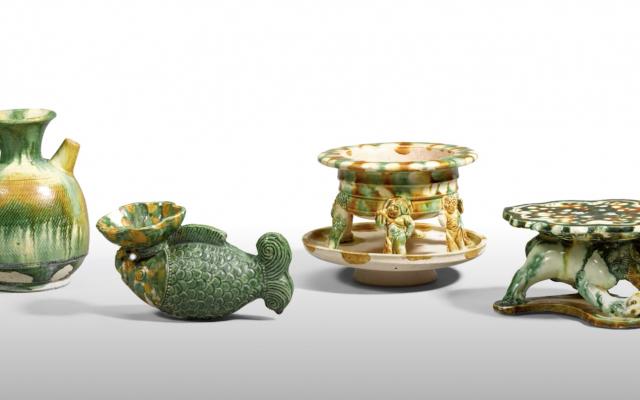
How can a buyer tell a genuine Tang-dynasty sancai vessel from a later workshop copy without sending it to a laboratory? That question comes up constantly among early-stage collectors and institutional researchers who need a defensible first opinion before committing budget to testing, shipping, or insurance. The term sancai literally means “three colors,” referring to the amber, green, and cream lead-glazed earthenware produced mainly during the Tang dynasty (618–907 CE). Thermoluminescence testing remains the only scientific dating method, but form, firing behavior, and documentation already filter out most obvious reproductions before a piece ever reaches a lab.
Step-by-Step Form Assessment: Vessels and Figurines
Form is the first and fastest screening tool, because Tang workshops followed production conventions tied to specific burial practices and regional kiln traditions.
- Identify the category. Tang sancai falls into two broad groups: tomb figurines (horses, camels, officials, guardian beasts) and vessels (ewers, bowls, pillows, jars). Each category has distinct proportion rules established by funerary custom — horses, for example, follow stocky, muscular conventions tied to Tang equestrian status symbolism, not later decorative taste.
- Check proportion against known type-series. Genuine figures show consistent anatomical weighting — thick legs, small heads relative to body mass, static poses meant for stability during burial placement. Reproductions frequently exaggerate dynamism (rearing horses, turned heads) because those poses photograph better for the decorative market, not the funerary one.
- Examine vessel symmetry under raking light. Hand-thrown or mold-assembled Tang vessels show slight asymmetry at the rim and foot. Perfectly uniform walls usually indicate slip-casting or power-assisted throwing, techniques unavailable to Tang workshops.
- Look for mold seams on figurines. Tang figures were typically built from two-part molds joined at the body’s midline, then hand-finished. A visible, crisply retouched seam is normal; a seam that is suspiciously absent, or one that cuts across unexpected anatomy, suggests a modern one-piece casting process.
Common failure reason at this step: relying on surface beauty alone. A well-potted, symmetrical, dynamic piece often fails the form test precisely because it looks too resolved for an object meant to be buried and never seen again.
Reading Low-Fire Construction Clues
Because sancai is a low-fire lead-glazed ware, its physical behavior during firing leaves traces that are difficult to fake convincingly.
- Inspect the body material. Tang sancai is built on a pale buff or pinkish earthenware body, fired at low temperature — not the dense porcelain or stoneware bodies used in many later reproductions aiming for durability over authenticity.
- Check glaze flow patterns. Lead glazes run during firing. Authentic pieces show glaze pooling downward, often stopping short of the foot where the piece was wiped before firing to prevent kiln-shelf sticking. Reproductions sometimes glaze the entire base, a shortcut that original workshops avoided.
- Look for glaze crazing and iridescence. Centuries of burial moisture interacting with lead glaze typically produce fine, irregular crackling and sometimes a faint rainbow sheen from slow chemical weathering. Uniform, glassy, craze-free surfaces are a warning sign, though crazing alone is not proof of age — some later wares crackle too.
- Examine unglazed areas (the foot and interior cavities). These expose the raw body color and texture. A gritty, slightly porous buff body with embedded firing particles is consistent with Tang-era low-fire construction; a dense, fine-grained, bright white body usually points to a later or non-Chinese production source.
Failure reason: evaluating glaze color alone. Amber-green-cream combinations have been reproduced since at least the early twentieth century, so color palette by itself carries almost no evidentiary weight.
Form, Firing Clues, and Provenance Compared: Historical Sancai Versus Later Reproductions
No single test is conclusive. The strongest evaluations combine all three lines of evidence — form convention, low-fire construction, and documented history — because each addresses a different category of forgery risk.
| Evaluation Point | Historical Tang Sancai | Later Reproduction (typical pattern) |
|---|---|---|
| Figurine pose | Static, stable, funerary-convention proportions | Dynamic, decorative poses for display appeal |
| Vessel symmetry | Slight hand-building irregularity | Mechanically uniform walls and rims |
| Body material | Pale buff/pink, porous, low-fire earthenware | Dense, fine, high-fire body |
| Glaze behavior | Downward run, foot often wiped clean | Even coverage including base |
| Surface aging | Irregular crazing, burial staining in recesses | Uniform gloss or artificially induced crackle |
| Burial context | Soil residue in crevices, wear consistent with excavation handling | Clean surfaces, no soil trace, or inconsistent artificial staining |
| Provenance | Excavation records, museum or auction history, published catalog references | No paperwork, or documentation starting only at point of recent sale |
Buyers should treat this table as a scoring framework, not a pass/fail checklist — a piece scoring well on four of seven points still warrants further research, while a piece failing even one category (especially provenance) should be treated as high-risk regardless of how convincing the glaze looks.
Burial Context and Provenance Research
Burial context refers to physical evidence that a piece actually came from a tomb rather than a workshop shelf: soil residue lodged in undercuts, consistent mineral staining, and wear patterns matching excavation handling rather than retail handling. This evidence is circumstantial on its own — soil can be applied artificially — but combined with documentation it becomes meaningful.
Documented provenance is the single most decision-relevant factor for buyers who cannot access lab testing. A defensible provenance trail typically includes some combination of: excavation or export records predating major regulatory changes, continuous ownership history through recognized auction houses, and publication in an exhibition catalog or academic reference. Gaps in this chain are common with genuinely old material too, but an unbroken story that begins conveniently at the moment of sale is a pattern worth treating with suspicion.
Common Mistakes in Early-Stage Sancai Evaluation
- Judging solely by color palette. Amber-green-cream glazing has been widely reproduced; color tells you almost nothing about age on its own.
- Assuming crazing proves antiquity. Crackle can be induced artificially and also occurs naturally in some later low-fire wares.
- Overweighting a confident seller story. Verbal history is not provenance. Request paperwork, catalog references, or prior auction listings.
- Ignoring the foot and interior. These unglazed, unseen areas are usually the most honest part of the object.
- Skipping comparison to published type-series. Museum catalogs and academic references establish the proportion and pose conventions genuine pieces follow.
A Worked Evaluation Scenario
Consider a sancai horse figurine offered with a seller claim of “Tang dynasty, ex-private collection.” Applying the framework above: the horse’s pose is static and stocky, consistent with funerary convention — a good sign. The glaze pools downward and the foot is wiped clean of glaze — another positive indicator. However, the seller can produce no auction history, excavation record, or catalog reference older than five years. Under the scoring approach described earlier, this piece passes the form and firing checks but fails the provenance check. The appropriate next step is not an outright rejection, but a request for thermoluminescence testing and a written provenance statement before any purchase decision proceeds.
Buyer’s Checklist Before Committing to a Purchase or RFQ
- Confirm figurine pose and vessel proportions against published type-series references.
- Examine the unglazed foot and interior for body color, porosity, and firing residue.
- Check glaze flow direction and crazing pattern under raking light.
- Request any excavation, export, auction, or catalog documentation in writing.
- Note any soil residue or burial staining in crevices, and ask how it was verified.
- Treat thermoluminescence testing as the final confirmation step, not a substitute for the checks above.
Form conventions and low-fire construction clues narrow down likely age quickly, and a documented provenance trail is what ultimately separates a confident guess from a defensible attribution. If you are reviewing a specific piece or preparing a shipment description for customs and insurance purposes, send photographs of the foot, interior, and any accompanying paperwork, and our technical team can advise on what additional verification steps make sense for your situation.