 By
By Understanding Longmen China Through Its Imperial Patrons
Visitors to the Longmen Grottoes are often struck by the monumental scale and intricate detail of the thousands of Buddhist statues carved into the limestone cliffs. But these are more than just works of art; they are historical documents carved in stone. The key to deciphering them lies in understanding who paid for them. The story of longmen china is fundamentally a story of patronage, where the ambitions, faith, and political statements of emperors, empresses, court officials, and common donors directly shaped what we see today.
Far from being a uniform collection of religious icons, the grottoes represent a dynamic conversation across centuries. The style, size, and even the subject matter of a carving can reveal the social status and motivations of its sponsor. An imperial commission by a powerful Tang empress had a very different purpose and appearance than a small niche funded by a group of local merchants. By learning to identify the signs of different types of patronage, you can transform a simple viewing into a deep historical analysis, reading the cliffs like a chronicle of dynastic power and evolving faith.
The Dynastic Fingerprints on Longmen’s Stone Canvases
The vast majority of the carvings at the Longmen Grottoes were created during two powerful dynasties: the Northern Wei and the Tang. Each period left a distinct and identifiable mark on the site, driven by different political climates, capitals, and imperial attitudes towards Buddhism. Understanding these two eras is the first step in recognizing the patrons’ influence.
The Northern Wei Dynasty (late 5th to early 6th centuries):
The Northern Wei emperors were the original patrons who initiated the carving at Longmen after moving their capital to nearby Luoyang. Their sponsorship was a powerful political statement. As rulers of non-Han ethnicity (the Tuoba clan of the Xianbei people), they used Buddhism to legitimize their rule over a predominantly Han Chinese population. By sponsoring massive Buddhist projects, they positioned themselves as universal chakravartin kings—pious rulers who turn the wheel of law for all beings. The art from this period reflects this, often characterized by more linear, abstracted, and spiritual figures with elongated faces and serene, transcendent smiles. The focus was on conveying a sense of otherworldly piety and imperial authority through faith.
The Tang Dynasty (late 7th to early 9th centuries):
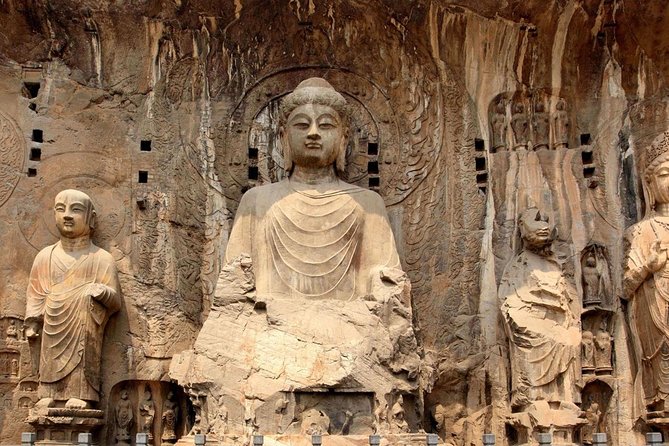
After a period of relative quiet, the Tang Dynasty ushered in a second golden age of carving at Longmen. This era, particularly under the patronage of Emperor Gaozong and Empress Wu Zetian, saw the creation of the site’s most famous and monumental works. Tang patronage was less about legitimizing foreign rule and more about projecting the immense power, confidence, and cosmopolitanism of a unified and prosperous empire. The art reflects this shift. Tang figures are full-bodied, realistic, and dynamic, expressing a worldly grandeur and powerful presence. They are not just spiritual icons but also symbols of a glorious and unchallengeable imperial court. The colossal Vairocana Buddha at Fengxian Temple is the ultimate expression of this Tang-era confidence.
How Patronage Shaped the Grottoes: A Comparative Analysis
The identity of the donor was the single most important factor determining the final form of a cave or niche at Longmen China. Imperial family members, high-ranking officials, and local religious societies all participated, but their resources, motivations, and aesthetic goals differed dramatically. This section breaks down how each group left its unique signature on the cliffs.
| Patron Group | Primary Motivation | Scale & Location | Artistic Style & Subject | Key Example (Conceptual) |
|---|---|---|---|---|
| Imperial Family (Emperors, Empresses) |
Political legitimation, projecting state power, personal devotion, and accumulating merit for the state and imperial line. | Massive, centrally located caves in the most prominent cliff sections. Often required state-level resources and years of labor. | Grand, formal, and often depicted deities as imperial figures. Figures are large, powerful, and project authority. The main Buddha is often seen as a representation of the emperor. | The Fengxian Temple, with its colossal Vairocana Buddha, is the quintessential example of imperial patronage, embodying the power and piety of the Tang court. |
| Court Officials & Aristocracy | Demonstrating loyalty to the throne, personal salvation, gaining political favor, and generating merit for their families. | Medium-to-large sized niches or smaller, complete caves. Often located near major imperial commissions to show association. | High-quality carving that often mimics the prevailing imperial style but on a smaller scale. Inscriptions are common, detailing the official’s name, title, and purpose of the dedication. | A well-carved niche featuring a Buddha with two bodhisattvas, located on the path to a major imperial cave, with a detailed inscription naming the donor and their official titles. |
| Religious Societies & Commoners | Purely devotional; pooling resources for personal and familial salvation, curing illness, or ensuring a favorable rebirth. | Small, numerous niches, often clustered together in less prominent areas of the cliffs. Sometimes “sponsored” by dozens of individuals. | Simpler, sometimes cruder carving styles reflecting more modest budgets and local craftsmen. Inscriptions list the names of many donors. The “Thousand Buddha” motif is common. | The Guyang Cave, though started by royalty, is filled with hundreds of small niches added by lower-ranking officials and commoners, creating a dense tapestry of personal devotion. |
Identifying Patron Influence: A Visitor’s Checklist
When you visit the site or analyze images, it’s easy to feel overwhelmed. However, by looking for specific clues, you can begin to identify the likely sponsors of a particular carving. This actionable checklist helps you move from passive observation to active analysis when examining the art of longmen china.
- Check for Inscriptions (The Most Direct Clue): Many niches contain dedicatory inscriptions. Look for them at the base or sides of the carving. Can you identify titles like “emperor,” “empress,” or specific government ranks? Or do you see a long list of common names, indicating a religious society? The inscription is the most reliable evidence of patronage.
- Assess the Scale and Location: Is the cave enormous and situated in a prime, easily visible location? Monumental scale and central placement almost always indicate imperial funding. Conversely, small niches crammed into upper, less accessible areas are typical of commoner or low-level patronage.
- Analyze the Central Figure’s Portrayal: Does the main Buddha or Bodhisattva appear majestic, powerful, and almost worldly, like a ruler holding court? This is a hallmark of the Tang imperial style. Or does the figure seem more ethereal, slender, and transcendent, with a gentle, enigmatic smile? This points toward the Northern Wei style, often associated with the early imperial vision. Our team can provide further historical art analysis for complex projects.
- Evaluate the Overall Composition: Is it a grand, symmetrical tableau with a central Buddha flanked by a court of disciples, bodhisattvas, and heavenly guardians, all carved with uniform excellence? This complexity and quality suggest a single, wealthy patron like an emperor or aristocrat. Is it a simple triad of a Buddha and two attendants, or a dense wall of tiny, repetitive Buddha figures? These simpler forms often point to non-aristocratic sponsors.
- Note the Quality of Craftsmanship: Observe the fineness of the details—the drapery folds, the facial expressions, the intricate halos. Consistently high-quality, refined carving across a large composition required the best artisans, who were typically employed on state-funded projects. Variable or cruder quality can indicate a lower budget and more local craftsmen.
Common Misinterpretations of Art and Patronage
Understanding patronage helps avoid common mistakes in interpreting the grottoes. The complexity of the site’s history means that simple assumptions can often be misleading. Awareness of these points can refine any analysis of the site’s cultural heritage.
Here are some frequent misinterpretations to avoid:
- Mistake 1: Assuming all large statues are imperial. While the largest are indeed imperial, many substantial niches were funded by powerful aristocratic families or high-ranking court officials seeking to emulate the court. Scale is a strong indicator, but it must be combined with location, style, and inscriptional evidence.
- Mistake 2: Viewing the art as purely religious. For imperial and aristocratic patrons, creating a Buddhist statue was as much a political and social act as a religious one. It was a public declaration of power, piety, and loyalty. The art served the state as much as it served the faith, a key factor in many cultural heritage projects.
- Mistake 3: Believing styles are strictly separated by cave. Many of the earliest caves, like the Guyang Cave, were initiated by Northern Wei royalty but were later filled with hundreds of smaller niches carved by Tang-era donors. This creates a fascinating mix of styles within a single cave, showing the site’s continuous use and the evolving dynastic influence.
- Mistake 4: Overlooking the importance of female patrons. Female patronage was immensely significant at Longmen, from the highest to the lowest levels of society. Empress Wu Zetian is the most famous, allegedly funding the Vairocana Buddha with her own cosmetics budget, but countless inscriptions show that court ladies, nuns, and laywomen also sponsored carvings for the spiritual benefit of their families.
By looking beyond the surface beauty and applying a framework of patronage, the cliffs of Longmen China transform from a gallery of statues into a rich social and political tapestry, telling the story of a nation’s faith and power over centuries.
For more detailed insights into the historical and cultural context of major heritage sites, contact our technical team to discuss your project needs.