 By
By White Horse Temple China: A Visitor’s Guide to Its Sacred Relics
Walking through the gates of White Horse Temple China, you don’t just enter a historical site—you step into a living sanctuary where objects hold power. The air smells of sandalwood incense, and the low murmur of chanting monks drifts from the main hall. I’ve visited dozens of Buddhist temples in China, but this one clings to you. Not because of its age—first built in 68 AD—but because of the relics still actively used in daily ritual. The temple in Luoyang is often called the cradle of Chinese Buddhism. Yet few visitors pause long enough to appreciate the physical artifacts that make this place pulse with meaning. That’s what we’ll explore: the sacred relics that define White Horse Temple China and why they still matter.
The Qiyun Pagoda Relics: Ashes and Light
The 13-story Qiyun Pagoda, built in the 12th century, holds more than bricks. Ascending its narrow wooden stairs feels like traveling back through the centuries. At the summit, behind glass, a set of miniature crystal stupas contains what the resident monks call śarīra—pearl-like remnants from the cremation of eminent masters. These White Horse Temple relics aren’t locked away in a museum. Every morning during the 4:30 a.m. chanting, the monk on duty lights butter lamps before them, wiping the glass with a silk cloth. When sunlight hits the stupas just right, the relic chambers glint with a faint, rainbow-edged glow. I’ve seen similar śarīra at other Buddhist temples in China, but the ones here feel less like curiosities and more like a heartbeat. The pagoda itself is one of the most striking Luoyang temple attractions, but its real draw is this quiet, ongoing veneration.
The Stone Sutra Pillars: Engraved Faith
South of the main courtyard, eight octagonal stone pillars stand tall, weathered by rain and incense smoke. Each pillar is carved entirely with the Lotus Sutra in classical Chinese characters. These aren’t replicas. They date from the Ming dynasty, around the 16th century, and were commissioned by a local merchant whose son survived plague. The White Horse Temple history is filled with such personal vows turned into permanent offerings. Trace your fingers along the grooves—you’ll feel the chisel marks where a craftsman’s hand wavered. That human touch makes these pillars something more than ancient relics. Some characters are rubbed smooth by centuries of pilgrims pressing their palms against them for blessings. In a world of digital texts, these stone sutras are a tactile reminder that faith here is literally carved into the earth.
Inside the Hall of Great Hero: Bronze Giants and Devotional Objects
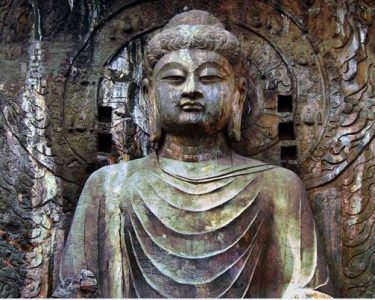
The Hall of Great Hero (Mahavira Hall) houses the temple’s most visually commanding relics. A colossal bronze statue of Sakyamuni Buddha, cast during the Yuan dynasty, sits in lotus posture. It’s flanked by Kasyapa and Ananda, his two chief disciples. But what catches my eye every time are the smaller objects arranged on the altar: an 18th-century cloisonné incense burner shaped like a mythical qilin, a stack of palm-leaf manuscripts bound with faded yellow silk, and a seven-tiered bronze bell that rings at dusk. The bell’s inscription indicates it was donated by the Ming emperor Wanli’s mother, a devout Buddhist. You won’t find detailed labels explaining each item. Instead, a young monk might quietly explain that the bell is struck exactly 108 times each evening—once for every earthly desire. This living use of White Horse Temple relics separates them from museum pieces. They’re not behind velvet ropes; they’re part of the temple’s respiratory system.
The Ancient Sutra Library: Fragile Wisdom
Tucked behind the main complex, a low wooden building with peeling red lacquer holds one of the temple’s greatest secrets. The sutra library contains over 10,000 woodblock-printed texts, some dating back to the Song dynasty. Among them is an incomplete copy of the “Mahaprajnaparamita Sutra” (Greater Perfection of Wisdom Sutra) hand-copied in gold pigment on indigo paper. The custodians unroll it only during the annual Wesak festival, and only for a few hours. I once arrived a week late and missed it—the abbot simply smiled and said, “The sutra finds you when you are ready.” That sense of timing underscores how White Horse Temple China treats these relics as spiritual beings, not artifacts. This library, modest compared to the giant scripture halls of other Buddhist temples in China, reminds me that preservation here is an act of deep reverence, not tourism.
The Horse Statue Courtyard: Where Symbolism Endures
Two stone horses guard the entrance to the temple’s inner sanctum. The legend tells that these statues commemorate the white horse that carried the first Buddhist scriptures from India to Luoyang—the very event that gave the temple its name. But the statues themselves are over 800 years old, Song dynasty creations. Rubbed to a glossy black sheen by countless hands, the horses’ flanks bear the greasy patina of centuries of incense and oil offerings. During the Laba Festival, locals press red paper charms onto the horses for luck, leaving the courtyard strewn with tiny blessings. This quiet practice is one of the most moving Luoyang temple attractions because it shows that White Horse Temple history isn’t fixed; it’s continually retold through these tangible symbols. Even the stone animals are part of the relic family.
Why These Relics Matter Now
In a fast-spinning world, I’ve found that standing before a 600-year-old bronze Buddha or a pillar of carved sutras slows something inside you. The relics at White Horse Temple aren’t behind glass—they’re part of a community that still uses them. The monks sweep around the same incense burners their predecessors lit in the Qing dynasty. The sutra pillars still receive fresh flower garlands every morning. That continuity makes White Horse Temple China different from many other Buddhist temples in China, where relics often become exhibits. Here, you catch the scent of damp stone mingled with cinnabar paste used to re-ink the sutra characters. You hear the bronze bell resonate across the courtyard as dusk falls. The relics are alive.
FAQ: Understanding the Sacred Side of White Horse Temple
What relics are housed at White Horse Temple China?
The temple safeguards śarīra (crystalline relics of Buddhist masters) in the Qiyun Pagoda, Ming-dynasty stone pillars carved with the Lotus Sutra, a Yuan-era bronze Buddha statue, Ming cloisonné incense burners, an imperial bronze bell, and a library of over 10,000 hand-printed sutras, including Song-dynasty texts. Many of these are still used in daily rituals.
Why is White Horse Temple important to Buddhism?
It’s regarded as the first Buddhist temple built in China, receiving the first Indian missionaries and scriptures. Its importance goes beyond history: the continuous use of its relics for worship and teaching makes it a living monastery, not just a monument. This spiritual continuity is what keeps White Horse Temple history deeply relevant to Chinese Buddhism today.
What can visitors see at White Horse Temple?
Beyond the grand halls, you can see the Qiyun Pagoda with its relic chambers, the eight stone sutra pillars, ancient bronze statues, and the sutra library (limited access). You’ll witness devotional practices like morning chanting, incense offerings, and bell-ringing rituals that bring these objects to life. It’s one of the most authentic Luoyang temple attractions for those seeking active religious practice, not just architecture.
Bringing the Spirit of White Horse Temple Home
The stillness I felt in that incense-filled hall—there’s a way to carry it with you. Our collection of handcrafted Buddhist art draws inspiration from the very objects that make White Horse Temple China so profound. We don’t replicate these irreplaceable relics, but our artisans study their forms: the serene mudra of a bronze statue, the patina of an ancient bell, the curve of a stone horse’s mane. Each piece in our selection is meant to invite that same contemplative pause into your daily space. Rather than simply photographing the relics, we channel their quiet presence into objects you can live with—incense holders with lotus motifs, small-scale bodhisattva figures cast in brass, sutra-inspired wall plaques. It’s a way to honor this sacred site without removing a single stone from Luoyang. Explore our store and let the enduring spirit of China’s oldest Buddhist temple settle into your home.
===BODY===