 By
By Why Do Longmen Caves China Face Different Directions?
Visitors often arrive at the Longmen caves China site expecting a uniform wall of carvings. They find the opposite. Some niches open east toward the sunrise. Others turn south to catch the low winter light. A few face almost due north, shaded for most of the day. This is not random. Every orientation answers a specific constraint—geological, hydrological, political, or ritual. Understanding why the caves face as they do reveals more about the site than any single statue list.
The Longmen Grottoes stretch for roughly one kilometer along the Yi River, about 12 kilometers south of modern Luoyang. The cliff faces are not continuous. They fracture, step back, and change angle. Carvers worked with these breaks rather than against them. The result is a complex, three-dimensional layout that confuses first-time visitors and rewards careful study.
How Cliff Geology and River Alignment Shaped Cave Placement
The physical landscape dictated where carving was possible at all. The cliffs at Longmen consist of limestone—specifically, hard, compacted carbonate rock from the Cambrian and Ordovician periods. Limestone is workable with iron tools, but only where the rock is sound. Fractures, bedding planes, and water seepage made some sections unusable.
Carvers did not select a cave orientation first and then find a wall. They found a stable wall and then adapted the orientation to fit. This is the single most important fact for understanding the site layout.
The Yi River flows northward through a narrow gap between two hills: Xiangshan to the east and Longmen Shan to the west. The river’s course is not perfectly straight. It bends slightly. This bend created different exposures along the western cliff. Some sections face east-northeast. Others face east-southeast. A few recessed areas face almost due north because the cliff line swings sharply.
Here is what each orientation actually affects in practice:
| Factor | What It Actually Affects | What Happens If Ignored |
|---|---|---|
| Rock bedding plane angle | Stability of the ceiling and walls after excavation | Ceiling collapse during carving or later; loss of the entire niche |
| Cliff face direction | Sun exposure, rain exposure, and visibility from the river path | Accelerated weathering on south-facing stone; dark, damp north-facing niches |
| Distance from river level | Flood risk and ease of transporting stone debris | Water damage to lower carvings; blocked access during high water |
| Natural fracture lines | Where a large carving can be safely placed | Splitting across a statue’s face or limbs after completion |
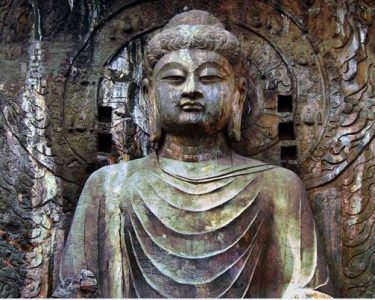
A clear example is the Fengxian Temple, the largest single niche at Longmen. It is cut into a wide, relatively smooth section of the western cliff. The wall faces slightly southeast. This orientation gives the main Vairocana Buddha direct morning light, which makes the carving legible from the opposite bank. It also reduces exposure to the prevailing northwest winds that drive rain into north-facing stone. The carvers did not choose this spot for the view alone. They chose it because the rock was massive, unbroken, and high enough above the floodplain to remain dry.
By contrast, many smaller niches cluster in recessed alcoves where the cliff line breaks. These alcoves face north or northeast. They receive almost no direct sunlight. That seems like a poor choice—until you consider preservation. Shaded, north-facing stone dries more slowly but also experiences less thermal expansion and contraction. Fewer temperature swings mean fewer micro-cracks. For small, finely detailed carvings, that stability mattered more than visibility.
Imperial Processional Views and the Politics of Orientation
Longmen was not a purely religious site. It was an imperial project. The Northern Wei court moved its capital to Luoyang in 494 CE. The Tang dynasty later continued patronage on a massive scale. Emperors, empresses, and high officials funded caves to display piety—and power.
Orientation therefore had a political dimension. The most prestigious caves were positioned to be seen from the route a ruler would take when approaching the site. This route ran along the western bank of the Yi River, moving from south to north. A visitor on this path would first see the southern caves, then the central Binyang caves, then the great Fengxian Temple, and finally the northern clusters.
The sequence was deliberate. Early Northern Wei caves sit in the central and southern sections. The Tang-era Fengxian Temple occupies the most visually commanding position, slightly set back but elevated. A ruler approaching from the south would see the progression of dynastic patronage unfold along the cliff. The orientation of each major cave ensured that its principal Buddha faced the river—and therefore faced the processional route.
This is why so many major niches face east or southeast. The river lies to the east of the western cliff. A Buddha facing east looks across the water toward the eastern hills. But more importantly for the imperial patron, a Buddha facing east is visible in three-quarter profile to anyone walking along the western bank. The face is turned toward the viewer. A south-facing Buddha would be visible only from directly in front, which is a much narrower viewing angle.
The directional logic changes when you move to the eastern hill, on the opposite side of the river. Fewer caves were carved there, and they are generally smaller. Those that exist face west, back toward the main western cliff. This creates a visual dialogue across the river. But the eastern caves never achieved the scale or prestige of the western ones. The rock on Xiangshan is more fractured. The processional route did not pass along the eastern bank in the same way. Political visibility favored the western side.
Feng Shui and Ritual Direction in Cave Placement
Feng shui—literally “wind and water”—shaped site selection for Buddhist cave complexes in China. The term is often reduced to interior decoration in modern usage. At Longmen, it operated at landscape scale. The basic principle: a site should have mountains behind, water in front, and a clear view to the south or east where beneficial energy flows.
The western cliff at Longmen fits this pattern almost perfectly. Longmen Shan rises behind the caves to the west. The Yi River flows north in front of the cliff. The caves face east, toward the water and the rising sun. East is the direction of dawn, renewal, and the Buddha Amitabha’s Pure Land in some traditions. For a site dedicated to Buddhist merit-making, facing east carried ritual meaning.
But feng shui was not a rigid formula. It interacted with the practical constraints already described. Where the cliff line forced a north-facing orientation, carvers compensated in other ways. Some north-facing niches have deeper canopies to protect them from rain. Others include dedicatory inscriptions that emphasize the donor’s intent rather than the physical orientation. The ritual function could be fulfilled even when the ideal directional alignment was impossible.
The Yi River itself played a feng shui role. Water in front of a site is considered auspicious because it carries energy and provides a natural boundary. But the river also created a soundscape. The constant low noise of flowing water would have been audible inside the caves. For meditative practice, this was not a distraction—it was a feature. The orientation of certain meditation caves toward the river was not accidental. Carvers positioned openings so that the sound entered at a consistent level, masking other noises and creating an acoustic focus.
A Comparative Look at Directional Choices
To make the patterns clear, here is a simplified comparison of the main orientation groups at Longmen:
| Orientation | Typical Location | Primary Driver | Practical Consequence |
|---|---|---|---|
| East / Southeast | Major imperial niches (Fengxian, Binyang) | Processional visibility, morning light, feng shui | Best legibility from the western bank; warm morning illumination; higher weathering risk on exposed surfaces |
| North / Northeast | Recessed alcoves, small votive niches | Cliff line geometry, microclimate stability | Shaded, stable temperature; darker interiors; less visible from the route |
| West | Eastern hill caves | Visual dialogue with the main cliff, local rock quality | Afternoon light; smaller scale due to fractured rock |
| South | Rare, isolated niches | Specific donor request or local cliff face | Strong midday light; high thermal stress; often heavily weathered today |
This table is a simplification. Individual caves sometimes combine orientations within a single complex. The Binyang caves, for example, include a central niche facing east and side niches angled slightly north and south. The result is a fan-shaped arrangement that catches light at different times of day. A visitor standing before the central Buddha sees the side figures emerge from shadow as the sun moves. That effect was planned.
Common Misconceptions About the Cave Orientations
Several ideas about Longmen’s layout circulate online and in guidebooks. Most are incomplete or wrong. Here are the most frequent ones:
- “All the caves face east.” False. The majority of major imperial niches face east or southeast, but many smaller niches face north or northeast. The eastern hill caves face west. A blanket east-facing claim ignores the geological breaks that forced other orientations.
- “The caves were carved facing the river for drainage.” Partly true, but incomplete. Facing the river did help with water runoff and debris removal. However, visibility from the processional route and feng shui principles were equally important. Drainage alone does not explain why some caves face away from the river.
- “Feng shui dictated everything.” Overstated. Feng shui provided a general framework, but carvers abandoned it when the rock was unsuitable. North-facing niches exist precisely because the cliff line overrode directional ideals. Practical geology came first.
- “The orientation was random.” The easiest assumption, and the most wrong. Every orientation reflects a decision about rock stability, light, water, visibility, or ritual meaning. The site is too large and too carefully planned for randomness.
What to Look For When You Visit
If you plan to visit the Longmen caves China site, use the orientation logic to structure your walk. Start at the southern end of the western cliff and move north, as imperial visitors did. Note where the cliff line changes angle. When you reach a north-facing alcove, pause and compare the interior condition to the exposed east-facing niches nearby. The difference in weathering is usually visible within a few meters.
Cross to the eastern hill in the afternoon. The western-facing caves there catch the low sun, which reveals details that are washed out in the morning. From the eastern bank, look back at the Fengxian Temple. The Vairocana Buddha’s face is clearly visible across the river—exactly as the Tang patrons intended. That single view explains more about orientation than any diagram.
For researchers and heritage professionals, a more detailed site plan showing individual niche orientations is available from the Longmen Grottoes Research Institute. Their documentation includes measured drawings that make the directional patterns explicit. Access is limited, but a formal request through an academic institution is often successful.
Understanding why the Longmen caves China face as they do turns a simple walk into a reading of the landscape. The geology constrained. The river guided. The emperors demanded visibility. And feng shui gave it all a ritual frame. The result is a site that still communicates its logic to anyone who stops to look at the angles.
For assistance planning a research-focused visit to Longmen or obtaining detailed orientation maps, contact the site’s visitor services office in advance with your specific study questions.