By
By How to Spot Wei and Tang Style Clues at the Luoyang Grottoes Longmen Site
Standing in front of a cliff full of carved niches, most first-time visitors ask the same question: how do you tell which figures were carved three centuries apart? The Luoyang Grottoes at Longmen were cut over roughly 400 years, and the site preserves two very different sculptural languages side by side — the lean, formal style of the Northern Wei dynasty and the fuller, more naturalistic style of the Tang dynasty. Knowing the difference turns a walk past thousands of niches into something you can actually read, rather than just photograph.
This matters because Longmen isn’t a single artwork. It’s a timeline carved into limestone. Once you know what to look for — proportions, drapery folds, facial modeling, and which caves represent which period — the site stops looking repetitive and starts looking like a sequence of decisions made by different generations of carvers.
Why Style Identification Actually Matters on Site
If you walk through without a framework, every Buddha starts to blur together. Get the period wrong, and you’ll misread the historical context of a cave — attributing a serene, elongated Wei-period bodhisattva to the same aesthetic sensibility as a robust Tang-era guardian figure, when the two reflect different court tastes, different Buddhist doctrinal emphases, and roughly two centuries of stylistic change.
For art learners doing pre-visit research, this isn’t a minor detail. It shapes how you plan your route through the site. Northern Wei highlights cluster in the earlier-cut caves near the northern end of the West Hill, while the most famous Tang work sits further south, culminating in the large-scale Tang commissions. Knowing this in advance saves you from backtracking across the site in the heat, camera in hand, trying to figure out why two carvings fifty meters apart look nothing alike.
Comparison: Northern Wei vs Tang Carving Traits
The clearest way to separate the two periods is to check four things in sequence: body proportion, drapery treatment, facial modeling, and the specific cave you’re standing in. Here’s how they typically differ at Longmen.
| Feature | Northern Wei Style | Tang Dynasty Style |
|---|---|---|
| Figure proportions | Elongated, slender bodies; narrow shoulders; a somewhat flat, frontal stance | Fuller, more rounded bodies with naturalistic weight distribution and relaxed poses |
| Drapery | Thin, symmetrical, closely stacked folds that resemble parallel ridges — often described as “wet drapery” clinging tightly to a flat surface | Deeper, freer folds that fall naturally, suggesting the volume of the body underneath rather than a flat pattern |
| Faces | Long, thin faces with a slight smile, narrow eyes, and an austere, contemplative expression | Rounder, fuller faces with softer modeling, more relaxed expressions, and greater naturalism in the eyes and mouth |
| Overall impression | Restrained, formal, almost linear — closer to earlier Chinese Buddhist sculpture traditions | Confident, physically grounded, closer to the idealized human form favored in high Tang court art |
| Major cave examples at Longmen | Guyang Cave, Binyang Central Cave | Fengxian Temple (Vairocana Buddha niche), Wanfo Cave |
If you only remember one shortcut, make it this one: thin and linear points to Wei; full and fleshy points to Tang. It won’t cover every transitional niche, but it will correctly sort the majority of what you see on a standard walk through the site.
A Step-by-Step Method for Reading Any Niche
Rather than guessing, apply the same short checklist to every carving you stop at. This takes under a minute per niche once you get used to it.
- Check the shoulders and waist. Narrow and boxy suggests Wei. Rounded and proportionate suggests Tang.
- Look at the fold pattern on the robe. Tight, evenly spaced ridges running in parallel lines are a Wei signature. Loose, irregular folds that seem to respond to gravity are typically Tang.
- Study the face shape. A long, narrow face with thin eyes and a faint, almost abstract smile leans Wei. A fuller, rounder face with softer cheeks and more naturalistic eyes leans Tang.
- Note the scale and setting. Tang commissions, especially at Fengxian Temple, tend to be monumental and set in open-air terraces. Many Wei-period niches are smaller and more densely packed into cave walls.
- Cross-check with the cave name. If you know you’re in Guyang Cave or Binyang Central Cave, you’re almost certainly looking at Wei-period work. If you’re at Fengxian Temple, you’re looking at Tang-period work.
Common Mistakes Visitors Make When Dating Carvings
Even attentive visitors misjudge periods on site. These are the recurring errors worth avoiding.
- Assuming size equals age. Large scale is a Tang tendency, not a rule. Some smaller Tang niches exist, and not every large figure is Tang.
- Judging solely by erosion or weathering. Wind and water damage varies by cave orientation and rock quality, not just age. A heavily worn face doesn’t automatically mean an earlier carving.
- Ignoring restoration work. Some niches have been repaired or recut over centuries, which can blend features from different periods in a single figure.
- Overlooking transitional caves. Work carved during the shift between dynasties can show mixed traits — slender bodies with fuller faces, for example — so treat borderline cases as approximate, not definitive.
- Relying on memory instead of a checklist. After an hour of walking, every niche starts to look similar. Pausing to run through proportions, drapery, and face shape keeps your identification consistent from the first cave to the last.
A Worked Example: Comparing Binyang Central Cave and Fengxian Temple
Binyang Central Cave, cut during the Northern Wei period, shows the seated Buddha with a long, thin face, a calm and slightly abstract expression, and drapery falling in tight, ridge-like folds that read almost like a textile pattern carved flat into stone. The overall body shape is narrow, with limited sense of volume beneath the robe.
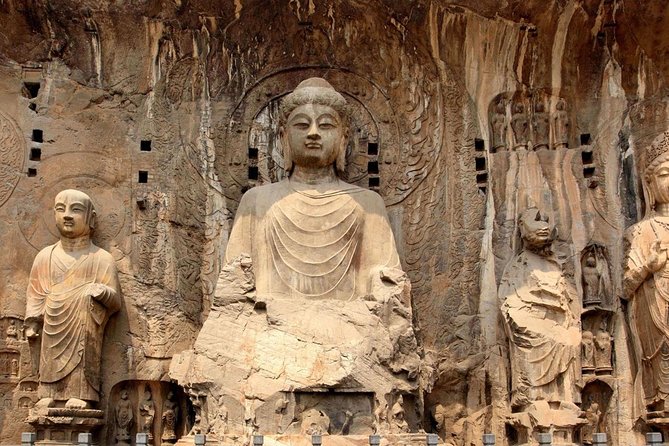
Walk south to Fengxian Temple and the contrast is immediate. The large Vairocana Buddha figure there — one of the most recognized carvings at Longmen Grottoes — has a fuller, rounder face, softened features, and robes that drape with visible weight and natural movement. The body beneath feels present rather than implied. Standing at both sites within the same visit, even a first-time observer can usually feel the stylistic shift without needing labels.
A Simple Decision Checklist Before You Visit
Use this list to plan a route that actually matches your interest in comparing periods, rather than wandering randomly.
- Do you want to start chronologically? Begin at the earlier Wei-period caves before moving toward Tang-period commissions.
- Are you most interested in facial modeling? Prioritize close viewing at Guyang Cave and Fengxian Temple, since faces are the clearest differentiator.
- Do you want to see the scale shift? Compare a smaller Wei niche against the open-air Tang terrace to feel the change in ambition and technique.
- Are you documenting drapery for study purposes? Photograph the robe folds straight-on in even lighting — midday shadows can obscure the fine ridge patterns that distinguish Wei carving.
- Do you have limited time? Focus on just two caves — one Wei, one Tang — rather than trying to survey the entire cliff face in one visit.
Reading the Site as a Timeline, Not a Museum Wall
The most useful mental shift for visitors is to stop treating Longmen as a collection of separate artworks and start treating it as a continuous record of changing taste. Carving activity spanned generations, and each cave reflects the sculptural conventions of its own moment — patron preferences, doctrinal emphasis, and available technique all shifted between the fifth and eighth centuries. The Wei-period work reflects restraint and formality. The Tang-period work reflects confidence and physical presence. Neither is a “better” version of the other; they’re separate answers to the same question of how to represent the divine in stone.
Approaching Buddhist stone carving with this lens also helps outside Longmen. The same proportion, drapery, and facial cues apply broadly across Chinese Buddhist sculpture from these periods, so the observation habits built here transfer directly to other sites and museum collections.
For visitors planning a self-guided trip, printing or saving the comparison table above, along with the five-point checklist, is usually enough to read most niches confidently on site without needing a guide standing next to every cave.
If you’re preparing a research itinerary or need help sourcing detailed reference material and cave maps ahead of your visit, reach out for guidance on planning a focused Wei-versus-Tang comparison route.