By
By Understanding the Claim Behind the Luoyang White Horse Temple as China’s First
The title “China’s first Buddhist temple” is a powerful claim, immediately positioning a site as the cradle of a faith that shaped the nation’s culture for two millennia. This distinction is almost universally given to the Luoyang White Horse Temple (Báimǎ Sì), with a traditional founding date of 68 CE. But for serious cultural researchers and discerning travelers, this raises a critical question: what does “first” actually mean? Does it refer to the original foundation, or the ancient structures visitors see today? Understanding this distinction is key to appreciating the temple’s true historical significance.
The claim originates from a well-documented imperial commission during the Eastern Han Dynasty. While the physical buildings have been rebuilt over centuries, the temple’s identity is rooted in this singular, continuous history as the first state-sponsored Buddhist institution in China. It marks the formal, royally sanctioned introduction of Buddhism into the country, an event that set the course for centuries of religious, artistic, and philosophical development.
The Founding Legend: Emperor Ming’s Dream and the Mission to the West
The origin story of the Luoyang White Horse Temple is inseparable from the account of Emperor Ming of Han (reigned 57–75 CE). According to historical texts like the Book of the Later Han, the emperor had a dream in which he saw a golden deity flying near his palace. The next day, his advisors interpreted this figure as the Buddha from India. Intrigued, Emperor Ming dispatched a delegation to seek out Buddhist teachings.
The envoys traveled west, eventually returning to the capital, Luoyang, around 67 CE. They were not alone. With them were two eminent Indian Buddhist monks, Kāśyapa Mātanga and Dharmaratna. Crucially, they also brought with them Buddhist scriptures and sacred images, carried on the backs of white horses. This detail is the source of the temple’s name. To honor the arrival and provide a base for the monks, Emperor Ming ordered the construction of a monastery in 68 CE outside the walls of Luoyang. This act established the temple as the first imperially endorsed center for Buddhist study and translation in China.
Key Elements of the Founding Narrative
- Imperial Patronage: The temple was not a grassroots development but a direct result of an emperor’s decree. This gave it immediate prestige and resources, setting it apart from any smaller, informal places of worship that may have existed.
- A Center for Translation: Its primary function was not just worship but scholarship. Kāśyapa Mātanga and Dharmaratna began the monumental task of translating Buddhist sutras from Sanskrit into Chinese. The Sutra of Forty-two Chapters, one of the first scriptures translated, became profoundly influential.
- Symbolic Importance: The journey, the white horses, and the imperial dream became a powerful founding myth. It legitimized Buddhism by linking it directly to the “Son of Heaven,” smoothing its integration into a society dominated by Confucianism and Taoism.
This history establishes the site’s claim as the “first.” It was the first state-sanctioned, purpose-built institution dedicated to the practice and dissemination of Buddhism in China, creating a template for thousands of temples to follow.
Fact vs. Foundation: Distinguishing Original Site from Surviving Structures
A common point of confusion for visitors and researchers is the gap between the 68 CE founding date and the age of the architecture visible today. No wooden structures from the Han Dynasty have survived two millennia of conflict, fires, and natural decay. Recognizing this is essential for an accurate assessment of the temple’s heritage. The “first” claim refers to the continuous occupation and function of the site, not the persistence of its original buildings.
The current complex is primarily a product of renovations and reconstructions from the Ming (1368–1644) and Qing (1644–1912) dynasties, with significant modern additions. Below is a breakdown comparing the traditional history with the archaeological and architectural reality.
| Historical Element | Traditional Date / Period | Surviving Physical Evidence & Date |
|---|---|---|
| Official Founding | 68 CE (Eastern Han Dynasty) | The historical site itself and textual records. No surviving 68 CE structures. |
| Qiyun Pagoda (The “First Pagoda”) | Traditionally associated with the original temple. | The current 13-story brick pagoda dates to the Jin Dynasty (1115–1234). It is stylistically different from Han-era architecture. |
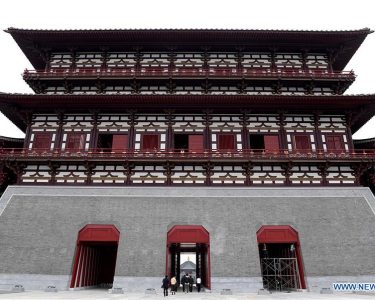
| Main Halls (Hall of Heavenly Kings, Great Buddha Hall, etc.) | Conceptually part of the original monastery layout. | The core architectural complex seen today was largely rebuilt during the Ming and Qing dynasties. The style, materials, and layout reflect later periods. |
| Tombs of the Indian Monks | Late 1st Century CE | The stone tombs located within the temple grounds are commemorative and were constructed in a much later era. |
| International Temple Zone (Thai, Indian, Burmese style halls) | N/A | Constructed in the late 20th and early 21st centuries as modern cultural additions. They are not part of the historical core. |
This evidence does not invalidate the temple’s claim. Rather, it refines it. The Luoyang White Horse Temple is the first site in China dedicated to Buddhism, a location of continuous religious importance since 68 CE. The value lies in its unbroken lineage and its role as the starting point of Chinese Buddhism, even if its physical form has evolved.
A Buyer’s Checklist for Assessing Historical Sites
When evaluating the claims of any ancient site, whether for academic research or planning a cultural tour, a systematic approach is necessary. Use this checklist to look beyond marketing slogans and understand the true nature of a location’s heritage.
- [ ] Differentiate Founding Date from Building Age: Always ask: “When was the site founded, and what is the age of the structures I am seeing?” This is the most crucial distinction.
- [ ] Verify with Textual Evidence: Does the founding story come from reliable historical records (like official court histories) or from later, unsubstantiated legends? For Baimasi, the claim is well-supported by texts like the Book of the Later Han.
- [ ] Look for Original In-Situ Artifacts: Are there any original stone steles, foundation stones, or smaller artifacts from the founding period? While Baimasi lacks original buildings, its historical context is supported by the surrounding Han-dynasty capital city archaeology.
- [ ] Analyze Architectural Styles: Do the buildings reflect the architectural style of the claimed founding period? As noted, the structures at the Luoyang White Horse Temple are clearly from later dynasties, which is an important piece of the story.
- [ ] Assess the “Continuity of Use”: Has the site been in continuous use for its original purpose? A site that has been continuously active, like Baimasi, holds more weight than one that was abandoned and rediscovered centuries later.
- [ ] Identify Modern Reconstructions: Are new buildings clearly marked as modern additions? The international halls at Baimasi are a good example of transparently modern contributions that enhance the site without confusing its history.
Significance Beyond “First”: A Hub of Cultural Exchange
Focusing solely on the “first” title risks overlooking the temple’s broader and arguably more important role in Chinese history. It was not just a symbol but a dynamic and functional center that drove the spread of Buddhism for centuries.
Its primary legacy was as a national translation center. Following Kāśyapa Mātanga and Dharmaratna, a stream of influential foreign and Chinese monks worked at the temple. Figures like An Shigao in the 2nd century and Dharmarakṣa in the 3rd century produced foundational translations of key Mahayana and Hinayana texts. This scholarly work was essential for adapting complex Indian philosophical concepts into a form that Chinese intellectuals and the general populace could understand. The temple was an engine of cultural exchange, absorbing foreign ideas and making them Chinese.
Architecturally, while the buildings are not original, the layout preserves a traditional plan. The Qiyun Pagoda, though from the Jin dynasty, is a vital early example of the transformation of the Indian stupa into the multi-tiered Chinese pagoda, a unique architectural form that would become an icon of East Asian Buddhism. The temple complex serves as a living museum of how Buddhist architecture evolved on Chinese soil.
Therefore, while the Luoyang White Horse Temple’s claim as the first is historically sound in terms of its founding, its true importance lies in what it *did*: it served as the gateway through which Buddhism entered China, the scholarly crucible where its ideas were first systematically translated, and the prototype for the thousands of temples that would follow.
For organizations requiring in-depth analysis of cultural heritage sites for tour development or academic projects, our team can provide detailed historical briefs and site assessments. Contact us to discuss your specific research needs.