 By
By How to Avoid Critical Errors in Your Longmen Caves AP Art History Analysis
Many students find analyzing the vast timeline of the Longmen Grottoes challenging, often leading to critical errors in essays and exams. The primary difficulty lies in treating the site as a monolithic entity rather than a complex that evolved over centuries, reflecting profound shifts in politics, religion, and artistic style. A successful longmen caves ap art history analysis hinges on your ability to distinguish between the key dynastic periods represented in the stone. This guide provides a clear framework for identifying these differences, correcting common misconceptions, and building a more nuanced argument about the site’s significance.
We will move beyond simple descriptions to provide diagnostic tools for attributing sculptures to their correct era and understanding the patronage that funded their creation. This approach will help you interpret the art as a direct reflection of its historical context.
Diagnosing Stylistic Periods: Correcting Common Attribution Errors
One of the most frequent mistakes in analyzing the Longmen Caves is confusing the distinct styles of the Northern Wei and Tang dynasties. This often results in misinterpreting the figures’ meaning and the patrons’ intent. The site was not built all at once; its construction spanned hundreds of years, with major commissions reflecting the different aesthetic and political values of each era. Use the following table as a diagnostic tool to correctly attribute sculptures and avoid these common attribution fallacies.
Troubleshooting Guide: Northern Wei vs. Tang Dynasty Styles
| Common Misconception or Error | Symptom in Your Analysis | Correct Diagnosis & Evidence |
|---|---|---|
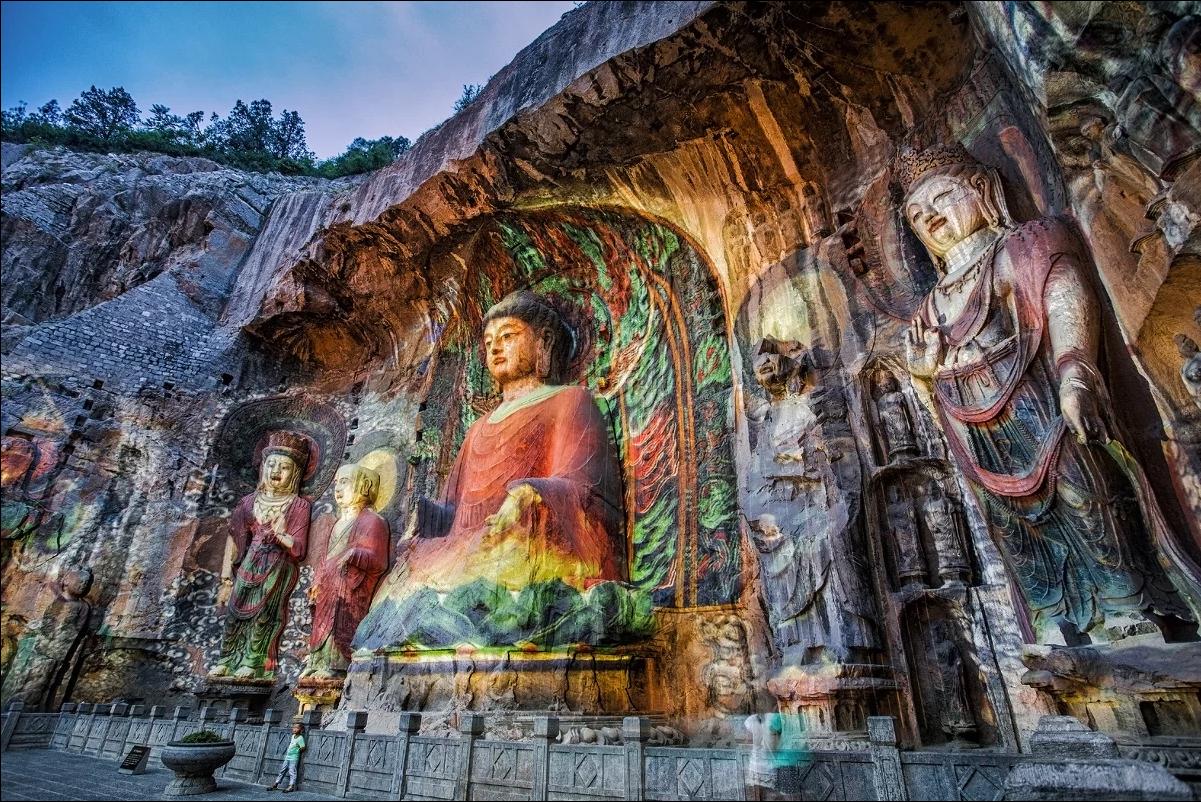
| The “Single Style” Fallacy | Describing all figures at Longmen as having the same characteristics (e.g., “The Longmen figures are elongated and spiritual”). | Correction: The site features at least two major, distinct styles. You must differentiate between the early (Northern Wei) and mature (Tang) periods. The evidence is in the figures themselves: compare the Central Binyang Cave (Wei) with the Fengxian Temple (Tang). |
| Confusing Elongation with Naturalism | Attributing the fleshy, three-dimensional, and naturalistic features of the Vairocana Buddha to the Northern Wei period. | Correction: The Northern Wei style is characterized by linear, schematic forms and an elongated, columnar body. Figures wear heavy drapery with stylized, repeating folds. This reflects a more abstract, transcendent spiritual goal. The naturalism, fleshy faces, and realistic drapery you see in the Fengxian Temple are hallmarks of the Tang Dynasty’s confidence and international influence. |
| Misattributing Patronage | Assuming all major works were commissioned by a single imperial family or for the same purpose. | Correction: Patronage varied significantly. Early Northern Wei caves were imperial commissions by emperors like Xiaowen to assert legitimacy and piety. Later, many smaller niches were funded by private individuals, families, or monastic groups. The colossal Tang-era Fengxian Temple was a massive imperial project under Emperor Gaozong and Empress Wu Zetian, designed to project political power and divine authority. |
| Ignoring External Influences | Analyzing the sculptures as a purely indigenous Chinese development without outside context. | Correction: The styles reflect the flow of ideas along the Silk Road. The early Northern Wei style shows strong influence from Gandharan and Mathuran art from India and Central Asia. The later Tang style displays a confident synthesis, creating a uniquely powerful and worldly Chinese Buddhist aesthetic that, in turn, influenced art in Korea and Japan. |
Analyzing Patronage: Power, Piety, and Politics in Stone
Understanding who paid for the caves and why is fundamental to any strong analysis. The patrons of the Longmen Grottoes ranged from powerful emperors and empresses to humble officials and devout families. Each sculpture’s scale, style, and iconography are directly linked to the patron’s motivations, whether they were seeking spiritual merit, political legitimacy, or personal salvation. Simply stating that “imperial patrons” funded the caves is insufficient; you must connect specific patrons to specific works and goals.
For example, the Northern Wei emperors commissioned the earliest caves to solidify their rule and present themselves as devout Buddhist kings, using the religion to unify their multicultural empire. Hundreds of years later, Empress Wu Zetian’s patronage of the Fengxian Temple, with the central Vairocana Buddha rumored to be modeled on her own face, was a masterful political statement. It aligned her authority with that of the cosmic, universal Buddha, reinforcing her power during a time when a female ruler was controversial.
Analyst’s Checklist for Evaluating Patronage
When examining a specific cave or niche at Longmen, use this checklist to deconstruct the patron’s intent and its artistic manifestation. This structured approach ensures you cover the key analytical points required for a high-scoring essay.
- Identify the Patron: Is the patron known? Are they imperial (emperor, empress), aristocratic, a monastic community, a military governor, or a private individual/family? Inscriptions often provide this information.
- Determine the Scale: Is it a colossal, site-defining monument like the Fengxian Temple, or a small, private niche? The scale is a direct indicator of the patron’s wealth and status. A massive imperial commission sends a public message of power. A small niche expresses personal piety.
- Analyze the Location: Is the work in a prominent, easily visible location, or a more remote, private part of the cliffside? Prominent locations were reserved for the most powerful patrons.
- Examine the Iconography: What figures are depicted? A colossal Vairocana (Cosmic Buddha) suggests a universal claim to power. A depiction of a Bodhisattva associated with mercy, like Guanyin, might reflect a patron’s personal prayer for compassion or salvation. Jataka tales (stories of the Buddha’s past lives) emphasize morality and merit.
- Connect to Historical Context: What was happening politically and socially when the work was commissioned? The Northern Wei used Buddhism to legitimize their foreign rule. The Tang Dynasty, at the height of its power, created art that was confident, worldly, and majestic. The art is a primary source document reflecting the values of its time.
Situating Longmen: The Flow of Ideas and Styles
No work of art exists in a vacuum. The Longmen Grottoes are a critical point in the vast network of Buddhist art that spread across Asia. Your analysis should acknowledge its position as both a recipient of earlier traditions and a source of later ones. The site’s location near the capital of Luoyang placed it at the heart of political, economic, and cultural life, making it a crucible for artistic innovation.
The development of the art at Longmen can be understood as a process of sinicization—the adaptation of a foreign religion and its artistic conventions into a distinctly Chinese form. The early Northern Wei figures, with their mask-like faces and linear drapery, clearly show their stylistic debt to Indian and Central Asian prototypes. Over time, these forms were softened and imbued with a uniquely Chinese sense of grace and solemnity.
By the Tang Dynasty, this process was complete. The figures in the Fengxian Temple are not copies of foreign models; they are a powerful, new creation. They are majestic, yet approachable; divine, yet human. Their calm expressions, heavy bodies, and the way their thin robes reveal the form underneath represent the pinnacle of Chinese Buddhist sculpture and a style that would become the standard across East Asia. A comprehensive longmen caves ap art history essay must address this evolution, showing how the grottoes document the transformation of Buddhism from an imported faith into an integral part of Chinese civilization.
For further context on its global significance, the site is recognized as a UNESCO World Heritage Site, which underscores its universal cultural value and the importance of its preservation.
By applying these diagnostic frameworks and contextual points, you can move beyond a superficial description of the Longmen Caves. You will be equipped to build a sophisticated argument that correctly identifies different historical periods, analyzes the motivations of its creators, and situates the site within the broader narrative of global art history.
To discuss complex heritage site analysis or access specialized research materials, please contact our technical team for a consultation.