 By
By How Inscriptions and Style Illuminate Longmen Caves for AP Art History
For students preparing for the AP Art History exam, the Longmen Caves present a fascinating, yet often challenging, case study in art historical analysis. Rather than simply memorizing arbitrary dates for these monumental Buddhist cave temples, a deeper understanding comes from dissecting the tangible evidence left by their creators. This article provides a comprehensive guide on how to approach the Longmen Caves for AP Art History, focusing on the critical methods historians use to establish chronology and meaning. We will explore how donor inscriptions, reign dates, and stylistic developments combine to paint a coherent picture of their creation and evolution.

The Core Challenge: Dating Complex Sites for AP Art History
Understanding the precise chronology of a site like the Longmen Caves is fundamental for any serious art historical study, especially for the analytical demands of the AP Art History curriculum. The site, sprawling over a kilometer along the Yi River in China, contains tens of thousands of statues and over 2,800 inscriptions, reflecting centuries of artistic and religious activity. Simply stating “Northern Wei Dynasty” or “Tang Dynasty” is insufficient. A nuanced answer requires demonstrating *how* art historians arrive at those conclusions.
Memorizing isolated facts about the Longmen Caves for AP Art History without understanding the underlying analytical framework is a common pitfall. The exam often requires students to justify their claims with visual and contextual evidence. For instance, questions might ask how specific features of a sculpture or cave indicate its period, or how patronage influenced its creation. This necessitates moving beyond surface-level recall to a robust engagement with the evidence itself. Students must be equipped to explain *why* a particular sculpture is dated to the early Tang period, rather than simply stating it as fact. This analytical skill is paramount, as it underpins all effective art historical interpretation.
Evidence-Based Dating at Longmen: Inscriptions, Reigns, and Style
Effective dating of the Longmen Caves for AP Art History relies on a triangulation of distinct evidence types. Rather than simply memorizing specific cave dates, students must understand the utility and limitations of donor inscriptions, imperial reign dates, and stylistic chronology. Each element offers unique insights and, when combined, provides a robust framework for historical placement.
| Dating Method | Description | Practical Impact for AP Art History | Limitations |
|---|---|---|---|
| Donor Inscriptions (Epigraphy) | Directly carved texts within the caves, often detailing the patron’s name, their intention (e.g., merit-making), and sometimes precise dates corresponding to specific events or imperial eras. These are primary textual sources. | Crucial for Pinpointing Specific Creations: Provides the most direct and precise dating for individual sculptures or cave projects. Allows students to link specific patrons (e.g., Empress Wu Zetian for the Fengxian Temple) to their artworks. Misinterpretation or overlooking these means missing direct evidence for patronage and religious intent. | Not all sculptures or caves have clear inscriptions. Inscriptions can degrade over time, making them illegible. They may refer to a broader period rather than a precise completion date of the artwork itself. |
| Imperial Reign Dates | References to the ruling emperor’s reign (e.g., “Year 1 of the Yongping reign”) found within inscriptions or historical records. These provide a precise calendrical bracket for the artworks created during that period. | Establishes Broader Chronological Framework: Helps place specific artistic developments within known political and historical contexts, such as the flourishing of Buddhist art under certain emperors. Incorrectly associating a sculpture with the wrong reign leads to significant chronological errors and flawed historical arguments. | Only useful when an inscription explicitly references a reign. Many sculptures lack such direct attribution. The beginning and end of a reign do not necessarily align with the start and end of specific artistic projects. |
| Stylistic Chronology | Analysis of visual characteristics such as drapery folds, facial features, body proportions, posture, iconography, and overall sculptural aesthetic. Styles evolve over time, allowing art historians to group similar works into periods (e.g., Northern Wei slender figures vs. Tang Dynasty full-figured forms). | Essential for Undated Works & Broader Trends: Allows students to date works without inscriptions by comparing them to securely dated pieces. Critical for discussing artistic evolution and influences (e.g., Indian or Central Asian influences). Ignoring stylistic shifts means an inability to analyze visual evidence, a core AP Art History skill. | More subjective than epigraphic evidence, requiring extensive knowledge of comparative examples. Stylistic transitions can be gradual, and regional variations exist, making precise dating challenging for transitional pieces. |
Each of these methods offers a distinct lens through which to view the Longmen Caves. Relying on just one can lead to an incomplete or even inaccurate interpretation. For instance, a beautifully preserved Tang-style Buddha *without* an inscription might be tentatively dated to the Tang based on its form, but an overlooked inscription could reveal it was a later imitation or an earlier work with unusual features. The strength of art historical analysis, particularly for the Longmen Caves AP Art History exam, lies in the ability to synthesize these different types of evidence.
Decoding Donor Inscriptions: A Primary Source for Longmen Caves AP Art History
Donor inscriptions are paramount for understanding the Longmen Caves. These carved texts, often found at the base of statues, on steles, or within cave entrances, provide direct, contemporaneous insights into the creation of the Buddhist sculptures. They are a treasure trove for students of the Longmen Caves for AP Art History, offering concrete evidence of patronage, religious motivation, and specific dates.
The study of these inscriptions, known as epigraphy, reveals who commissioned the works—from emperors and their families to wealthy merchants, monks, and even ordinary villagers. The content often expresses vows for the merit of ancestors, living family members, or the emperor, illustrating the deep Buddhist belief in karma and the transfer of merit. Crucially, many inscriptions include precise reign dates, allowing art historians to anchor specific artworks within a tight chronological window. For example, the famous Fengxian Temple at Longmen, with its colossal Vairocana Buddha, is securely dated to the Tang Dynasty through inscriptions explicitly mentioning Empress Wu Zetian’s patronage and specific reign years.
Interpreting these primary sources requires careful attention to detail. The language, calligraphy, and phrasing can themselves offer clues about the period and the social status of the donor. For AP Art History students, knowing *how* to use an inscription – not just that it exists – is key to a high-scoring response.
Common Mistakes in Interpreting Longmen Inscriptions
- Assuming Universal Presence: Not every sculpture or cave has a dating inscription. Many significant works are dated primarily through stylistic analysis.
- Ignoring Context: An inscription might refer to the dedication of the cave, not necessarily the completion of every sculpture within it. Construction could span years.
- Misinterpreting Patronage: While an inscription names a prominent donor, smaller figures or additions might have been made by others at different times.
- Overlooking Degradation: Many inscriptions are damaged or illegible due to weathering or human activity, leading to gaps in knowledge.
- Focusing Only on Dates: Inscriptions also provide invaluable social, religious, and political context that is crucial for a holistic art historical analysis.
An effective AP Art History response discussing the Longmen Caves will not just mention an inscription, but will explain *what* the inscription says, *who* it references, and *how* that information helps date the artwork or sheds light on its purpose. This demonstrates a sophisticated understanding of primary source analysis.
Stylistic Analysis: Visual Clues in the Longmen Caves
Beyond direct textual evidence, stylistic analysis is an indispensable tool for dating and interpreting the Buddhist sculptures of the Longmen Caves. This method involves meticulously observing and comparing visual characteristics that evolve over time, reflecting changing aesthetic ideals, religious influences, and artistic techniques. For students studying the Longmen Caves for AP Art History, mastering stylistic analysis allows them to interpret undated works and trace the broader artistic evolution of the site.
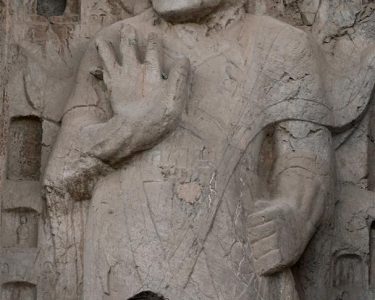
The Longmen Caves span several major artistic periods, primarily the Northern Wei (late 5th to early 6th centuries CE) and the Tang Dynasty (7th to 9th centuries CE). Each era left a distinct stylistic imprint. Northern Wei sculptures, for instance, are often characterized by their slender, elongated figures, ethereal drapery with “waterfall” or “fish-tail” folds, and archaic smiles. The figures tend to be more two-dimensional, emerging from the rock face with a sense of linear elegance. Their iconography frequently includes a specific type of flaming mandorla behind the Buddha’s head.
In contrast, Tang Dynasty sculptures, particularly from the High Tang period, exhibit a shift towards more naturalistic, voluminous forms. Figures become full-bodied, with soft, rounded contours and realistic drapery that clings to the body, emphasizing anatomical curves. Facial features are often more individualized and less stylized, conveying a sense of serenity or powerful presence. The Vairocana Buddha at Fengxian Temple is a prime example of this mature Tang style, with its monumental scale, robust physique, and compassionate yet authoritative expression. Understanding these shifts is vital for any comprehensive art historical analysis of the Longmen Caves.
Step-by-Step Guide to Stylistic Analysis for AP Art
- Observe Overall Form and Proportion: Is the figure slender and elongated (Northern Wei) or full-bodied and rounded (Tang)? Note the relationship between head, torso, and limbs.
- Examine Facial Features: Are the eyes almond-shaped with an archaic smile (Northern Wei) or more naturalistic with a serene, often downcast gaze (Tang)? Look at nose, mouth, and ear details.
- Analyze Drapery: Does it fall in cascading, angular folds (“waterfall” style) that create a linear pattern (Northern Wei), or does it cling realistically to the body, revealing form underneath (Tang)?
- Identify Pose and Gesture (Mudra): Are the figures stiff and frontal, or do they exhibit a more relaxed, contrapposto-like stance? What specific hand gestures are depicted, and what do they signify?
- Assess Iconography and Attendants: Are there specific bodhisattvas, arhats, or guardian figures present? How do their forms and attributes compare across different periods? The presence and style of halos or mandorlas also provide clues.
- Consider Material and Technique: While all are carved from limestone, subtle differences in carving depth, precision, and finishing can be indicative of period techniques.
- Compare to Securely Dated Examples: This is the most critical step. Once you’ve analyzed an unknown piece, compare its features to works at Longmen (or other sites) that are firmly dated by inscriptions or historical records. This comparative method strengthens your dating argument.
By systematically applying these analytical steps, students can confidently discuss the stylistic evolution within the Longmen Caves, providing a robust, evidence-based argument for dating and interpreting the artworks. This skill is directly applicable to essay questions on the AP Art History exam.
Integrating Evidence for Comprehensive Dating
For a truly robust understanding of the Longmen Caves for AP Art History, and for excelling in examination responses, the various dating methods—donor inscriptions, reign dates, and stylistic chronology—must be integrated. No single piece of evidence tells the whole story, and a strong art historical argument always cross-references multiple sources of information. This holistic approach ensures accuracy and provides a nuanced interpretation of the artworks and their historical context.
Consider a scenario where an AP Art History question asks for an analysis of a specific cave. A student might first identify any visible inscriptions, noting the patron and any associated reign dates. This provides a foundational chronological anchor. Next, they would apply stylistic analysis, observing the characteristics of the Buddhist sculpture within the cave: Are the figures slender and linear, suggesting a Northern Wei origin, or robust and naturalistic, pointing to the Tang Dynasty? Does the drapery style, facial features, or iconography align with securely dated examples from either period?
The most compelling responses for the Longmen Caves on the AP Art History exam will demonstrate this synthesis. For example, a student might argue that “while the precise inscription for this particular niche is illegible, its elongated figures, cascading drapery, and archaic smile strongly align with the known stylistic conventions of the Northern Wei period, as exemplified by the Guyang Cave, which is securely dated by multiple donor inscriptions to the early 6th century.” This approach not only provides a date but also explains *how* that date was derived, leveraging both visual and textual evidence. It showcases a deep understanding of art historical analysis that goes far beyond simple memorization.
To deepen your understanding of the Longmen Caves and prepare effectively for your AP Art History exam, we encourage you to explore further academic resources and visual databases that provide detailed analyses of these magnificent Buddhist art treasures.