 By
By How Luoyang City Became the Eastern Anchor of the Ancient Silk Road
Many historical accounts of the Silk Road focus on the vast deserts and western frontiers. This often raises a key question for historians and cultural travelers: why was Luoyang, a metropolis deep within ancient China’s central plains, so fundamental to this legendary network? The answer lies not just in geography, but in its status as a political, cultural, and spiritual powerhouse that actively shaped the flow of goods, ideas, and people for centuries.
Understanding the significance of luoyang city requires looking beyond a simple line on a map. It was not merely a starting point but a dynamic hub—a crucible where goods were consolidated, ideas were translated, and imperial policies governing trade were forged. For any serious student of global trade history or anyone planning a heritage-focused visit, grasping this role is essential.
The Strategic Geography That Positioned Luoyang for Greatness
A city’s influence rarely happens by accident. Luoyang’s rise to prominence was a direct result of its strategic placement at the confluence of major geographical and political currents. It served as the capital for numerous dynasties, including the Eastern Han and Northern Wei, making it the political center from which trade missions were authorized and foreign envoys were received.
Its location in the fertile Central Plains, nestled between the Luo River to the south and the Yellow River to the north, provided critical advantages:
- Agricultural Abundance: The surrounding plains produced vast surpluses of grain and other resources, which could sustain a large urban population, including merchants, artisans, and foreign delegations. This stability made it a reliable economic center.
- Natural Transportation Corridors: The rivers served as ancient highways, connecting Luoyang to other major population centers in eastern and southern China. This allowed goods from across the empire, such as coastal salt and southern rice, to be brought to Luoyang for consolidation before being sent west.
- Defensible Position: Surrounded by mountains and rivers, the city offered a degree of security that was essential for an imperial capital. This safety attracted wealth, investment, and skilled craftspeople, creating a stable environment for long-term commercial planning.
This combination of political power, resource security, and logistical connectivity made Luoyang city the undeniable eastern anchor for overland trade. It was the point where the full economic might of the Chinese empire was focused and directed outward toward the vast network of the Silk Road.
Mapping Luoyang’s Role in Trade, Culture, and Diplomacy
To truly appreciate Luoyang’s function, one must view it not as a single point but as a multi-faceted hub with distinct, overlapping networks. For educators and researchers, mapping these connections reveals the city’s complex role. Here is a procedural guide to understanding how these routes functioned and what they carried.
Step-by-Step Guide to Analyzing Luoyang’s Silk Road Connections
- Identify the Route’s Primary Purpose: Not all traffic was about silk. Different routes served different primary functions, although they often overlapped. Start by categorizing the interaction: was it commercial, diplomatic, or religious?
- Trace the Key Pathways: From Luoyang, routes branched out. The main commercial artery went west through the Hexi Corridor. Diplomatic missions might take different, more direct paths. Religious pilgrims followed routes connecting to major Buddhist sites.
- Analyze the Flow of Goods and Ideas: Determine what was being exchanged. This was a two-way street. While silk went west, new ideas, technologies, and beliefs flowed east into Luoyang.
- Assess the Cultural and Political Impact: The final step is to evaluate the consequence of this exchange. How did it change society in Luoyang and beyond? The introduction of new religions or the demand for specific export goods could reshape the entire economy.
Applying this framework helps to deconstruct the city’s role beyond simple trade. The following table breaks down these functions in more detail.
| Network Type | Primary Function & Key Routes | Goods / Ideas Exchanged | Historical Significance |
|---|---|---|---|
| Commercial Route | The primary economic engine. Routes led west from Luoyang through Chang’an (modern Xi’an) and the Hexi Corridor, connecting to Central Asia, India, and the Roman Empire. | Outbound: Silk, ceramics, lacquerware, iron tools, paper. Inbound: Horses, glassware, wool, exotic spices, precious metals. |
Established Luoyang as the central clearinghouse for luxury goods. Fueled the imperial treasury and drove innovation in local craft production like ancient Chinese ceramics. |
| Religious/Cultural Route | Primarily associated with the spread of Buddhism from India. Monks and pilgrims traveled between Luoyang and the Buddhist heartlands of Central Asia and India. | Outbound: Chinese philosophical texts, pilgrims seeking knowledge. Inbound: Buddhist scriptures (sutras), religious art styles, new philosophical concepts, astronomical and medical knowledge. |
Transformed Luoyang into a major world center for Buddhist study. The White Horse Temple, China’s first Buddhist temple, was established here, marking a profound cultural shift. See the key Buddhist sites in Luoyang for more. |
| Diplomatic Route | Formal missions sent by the imperial court to establish alliances, gather intelligence, and manage tributary relationships. These routes connected Luoyang with various kingdoms and tribal confederations. | Outbound: Imperial decrees, diplomatic gifts (often silk and gold), political envoys. Inbound: Tribute goods, foreign dignitaries, intelligence reports on western territories. |
Solidified the imperial court’s political control and influence over the trade routes. Diplomatic exchanges often paved the way for safer and more profitable commercial ventures during the Han Dynasty. |
Beyond Silk: The Intangible Exchanges That Defined the Era
While silk was the most famous commodity, focusing on it alone misses the true impact of the trade routes on Luoyang city. The city became a cosmopolitan center where ideas were as valuable as any physical product. The influx of foreign merchants, monks, and diplomats created an environment of unprecedented cultural fusion.
This exchange is most visible in three key areas:
- Technology Transfer: Techniques for glassmaking arrived from the West, while the revolutionary Chinese invention of paper began its slow journey outward from the East. Metallurgical knowledge and agricultural techniques were also part of this exchange.
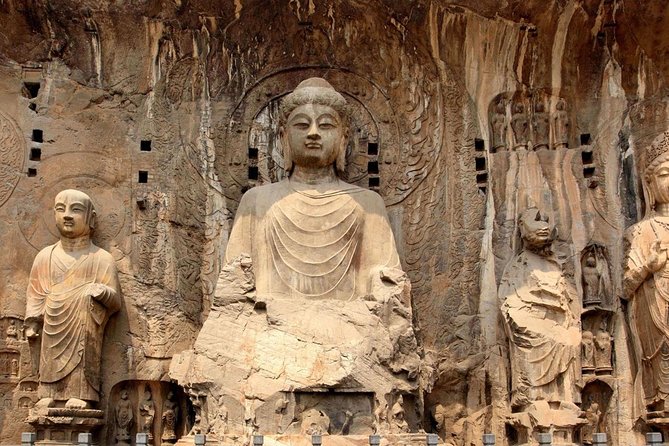
- Artistic Styles: The influence of Gandharan and other Central Asian art, brought with Buddhism, is clearly visible in the sculptures of the nearby Longmen Grottoes. Motifs, forms, and artistic sensibilities from distant lands were adapted by Luoyang’s artisans, creating unique hybrid styles.
- Philosophical and Scientific Ideas: The translation of Buddhist scriptures in Luoyang was a massive intellectual project that introduced new concepts of metaphysics, logic, and psychology into Chinese thought. Similarly, knowledge of astronomy, mathematics, and medicine from India and Persia found a receptive audience in the imperial capital.
For anyone studying artifacts from this period, identifying Luoyang’s influence requires a keen eye. The following checklist can help researchers and collectors pinpoint characteristics indicative of the city’s role as a cultural melting pot.
Checklist: Identifying Luoyang’s Silk Road Influence on an Artifact
Use this list to evaluate whether an object or piece of art reflects the cosmopolitan environment of ancient Luoyang.
- [ ] Hybrid Motifs: Does the piece combine traditional Chinese symbols (like dragons or phoenixes) with foreign motifs (like Hellenistic floral patterns, Sasanian winged horses, or Buddhist lotuses)?
- [ ] Exotic Materials: Is the object made from materials not native to central China, such as lapis lazuli from Afghanistan, cobalt from Persia (for ceramics), or Roman-style glass?
- [ ] Foreign Forms: Does the shape of the object, such as a ewer with a bird’s head or a long-necked vase, mimic forms popular in Persia or Central Asia?
- [ ] Religious Iconography: Does the artifact feature clear Buddhist imagery, especially styles associated with the early period of its introduction to China?
- [ ] Evidence of Export Production: Was the item, particularly silk or ceramics, clearly designed for a foreign market, with patterns or forms known to be popular in the West?
Answering “yes” to several of these questions strongly suggests the artifact was either created in, passed through, or was heavily influenced by the international character of Luoyang city during its peak as a Silk Road hub.
Ultimately, Luoyang was more than a stop on a trade route; it was an engine of cultural and economic change. Its legacy is a powerful reminder that the exchange of ideas can be just as transformative as the exchange of goods.
For organizations planning educational or cultural tours focused on global history, understanding these deep-rooted connections is the first step. Contact our team to discuss how to build a historically rich and insightful itinerary.