 By
By How the White Horse Temple Luoyang Shaped Chinese Buddhism
Most know the White Horse Temple in Luoyang as the first Buddhist temple in China. While true, this title only scratches the surface of its profound impact. Its real significance lies not just in being the first, but in establishing the fundamental institutional model—a blueprint for scripture, study, and state-sponsorship—that allowed Buddhism to take root and flourish across a vast new empire. Understanding this origin story is key to understanding the trajectory of Buddhism in East Asia.
The establishment of the White Horse Temple Luoyang during the Eastern Han Dynasty wasn’t merely the construction of a building; it was the creation of a system. It transformed an imported philosophy into an integrated Chinese institution, setting precedents in translation, imperial patronage, and monastic training that would be replicated for centuries. This article explores the specific mechanisms established at the temple that made this transformation possible.
The Imperial Dream That Sparked a Religious Revolution
The origin of the Baima Temple is a story of imperial curiosity meeting cross-cultural exchange. The traditional account, recorded in various historical texts, begins with Emperor Ming of the Eastern Han Dynasty. In approximately 64 CE, he reportedly had a dream of a golden deity flying near his palace. His advisors, interpreting the dream, suggested the figure was the Buddha from India.
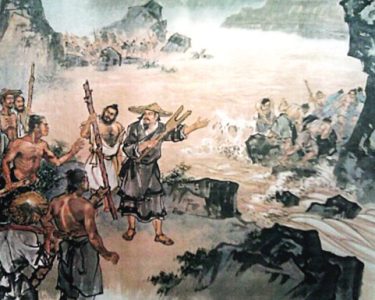
Intrigued, Emperor Ming dispatched a delegation westward along the Silk Road to seek out Buddhist teachings. The mission returned years later, not just with information, but with two eminent Indian monks, Kashyapa Matanga and Dharmaratna. They also brought with them sacred texts and relics, carried on the backs of white horses—the very animals that would give the temple its name. Upon their arrival in the capital, Luoyang, the emperor provided them with lodging and a place to work. This location, initially a government reception office, was formally established as the White Horse Temple in 68 CE.
This founding narrative is crucial for several reasons:
- Imperial Initiative: Buddhism did not arrive in China as a grassroots movement. Its introduction was a top-down event, driven and sanctioned by the emperor himself. This imperial patronage gave it immediate legitimacy and protection.
- A Gateway to the West: The temple’s location in Luoyang, the Han capital and a major terminus of the Silk Road, positioned it as a natural hub for cultural and intellectual exchange between China, Central Asia, and India.
- Focus on Scripture: From day one, the mission was about acquiring and understanding sacred texts. The monks were not just missionaries; they were scholars and translators, and their primary task was to make Buddhist doctrine accessible.
This unique origin story directly answers the question of when was White Horse Temple built (68 CE) and how did Buddhism enter China through Luoyang—through an imperially sponsored mission that brought monks and scriptures directly to the capital.
How the Monk-and-Scripture Tradition Forged an Institution
The most critical contribution of the White Horse Temple was its establishment of a “monk-and-scripture” model. It wasn’t just a place for worship; it was China’s first state-sponsored institute for Buddhist translation and study. This created the institutional framework that allowed Buddhism to become more than a foreign curiosity. It provided a structure for doctrinal consistency, training, and expansion.
The arrival of Kashyapa Matanga and Dharmaratna marked the beginning of a massive, centuries-long project of translating Sanskrit sutras into Chinese. Their first and most famous translation was the Sutra of Forty-two Chapters, a concise compilation of essential Buddhist principles. This act set a powerful precedent. The table below breaks down how each element of this tradition connected the temple to Buddhism’s institutional development.
| Core Tradition Established at White Horse Temple | Impact on Chinese Buddhism’s Institutional Growth |
|---|---|
| Centralized, Scholarly Scripture Translation | This established a text-based foundation for doctrine. Instead of relying solely on oral transmission, which can lead to fragmentation, Chinese Buddhism developed around a standardized canon of translated scriptures. It made the temple an authoritative academic center, not just a spiritual one. |
| Direct Imperial Patronage and Endorsement | By housing the monks and funding their work, the emperor gave Buddhism a level of legitimacy that other foreign belief systems lacked. This state-level support provided resources, protection, and prestige, paving the way for its acceptance among the elite and its eventual spread throughout society. |
| Formalized Monk Training and Ordination | The temple became the first place where Chinese disciples could formally study under foreign masters. This created a structured clergy (the Sangha) and a reliable method for transmitting knowledge from one generation to the next, ensuring the religion’s long-term survival and consistency. |
| The Temple as a Permanent Institution | By dedicating a permanent, state-supported complex to this work, the emperor set the precedent for monasteries as enduring centers of community, learning, and ritual. This physical permanence was a stark contrast to the transient nature of itinerant preachers, anchoring Buddhism to specific, powerful locations. |
Getting this foundation right was everything. Without the White Horse Temple’s focus on rigorous translation and institutional structure, Han dynasty Buddhism might have remained a collection of disparate folk beliefs, easily distorted or absorbed by native traditions like Taoism. The temple ensured its philosophical and theological integrity from the very beginning.
Legacy in Stone: Architecture and Enduring Influence
While the White Horse Temple’s foundational role is its primary legacy, its physical form and ongoing history also tell a vital story. It is important to address common misconceptions about the site to fully appreciate its significance.
Today, the Baima Temple is a sprawling complex that reflects centuries of reconstruction and expansion. No original Han-dynasty timber structures survive. The oldest existing buildings, such as the Main Hall, date primarily from the Ming and Qing dynasties (1368-1912). However, the site itself, its foundational layout, and its spiritual importance are continuous. Walking through its gates is walking onto ancient ground, even if the buildings are more recent.
Common Mistakes in Understanding the White Horse Temple History
Visitors and researchers sometimes misinterpret the temple’s history, which can lead to a misunderstanding of its role. Here are a few common points of confusion to avoid:
- Mistake 1: Assuming the current structures are 2,000 years old.
Reality: The legacy of the temple is in its continuous function as a monastic center on this specific site since 68 CE. The architecture itself is a layered history of patronage and rebuilding, with the current visible structures being from later periods. The value is in the site’s unbroken lineage. - Mistake 2: Viewing it as a purely Chinese-style temple.
Reality: While its core architecture is Chinese, the modern complex uniquely reflects its international origins. In recent decades, international Buddhist communities have built replica temples in their native styles on the grounds, including Indian, Thai, and Burmese halls. This makes the temple a living museum of Buddhist architectural diversity, echoing its ancient role as a cultural crossroads. - Mistake 3: Underestimating its role as a translation center.
Reality: The Cool Terrace (Qingliang Terrace), located at the back of the main complex, is believed to be the site of the original translation activities. For centuries, this was the primary function. Eminent monks from across Asia, such as An Shigao and Dharmaraksha, later worked here, translating hundreds of scriptures that formed the bedrock of the Chinese Buddhist canon. Its importance as a scholarly hub arguably exceeded its role as a public worship center in its early history.
Recognizing these nuances helps clarify why White Horse Temple is important. Its significance is not just its age, but its role as the prototype for Buddhist institutions in China—a role it continues to honor through its international connections and focus on heritage.
The White Horse Temple Luoyang remains a pivotal site for understanding not only the history of Buddhism but also the dynamics of cultural transmission. It stands as a testament to an emperor’s dream, the arduous journey of monks, and the painstaking intellectual labor of translation that forever changed China’s spiritual landscape.
For historical consultations or inquiries into cultural asset management, contact our team for expert guidance.