 By
By How to Trace Sancai Glazed Wares Along Ancient Trade Routes
One of the central challenges in historical ceramics is determining provenance. When a piece of sancai glazed earthenware is unearthed far from China, how can researchers, collectors, and institutions confidently distinguish a genuine Tang dynasty export from a later, local imitation inspired by it? The answer lies not just in the object itself, but in a rigorous analysis of its geographical and historical context. The key is to map the find-spot against known trade corridors and couple that data with material and stylistic analysis.
This process moves beyond simple visual identification to build a compelling case for an object’s origin story. It helps differentiate items carried along the bustling Silk Road from those produced in regional kilns in places like Persia, Japan, or the Middle East that adopted and adapted the vibrant tri-color style. For any organization involved in the acquisition or study of historical artifacts, mastering this contextual analysis is fundamental to sound investment and scholarship.
Identifying Core Characteristics of Authentic Tang Sancai Ware
Before tracing an object’s journey, one must first understand its starting point. Authentic Tang dynasty sancai glazed ceramics have a distinct material and aesthetic signature. These wares were not high-fired porcelain; they were typically earthenware, fired at a lower temperature. This fundamental property influences their texture, durability, and the appearance of their iconic glazes. Misidentifying these core features is the first and most common error in provenance assessment.
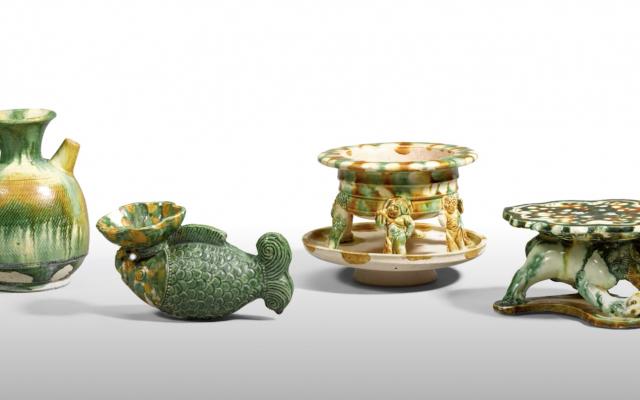
The term “sancai” means “three colors,” but the palette often included more. The base colors were typically amber, green, and a creamy off-white, often with splashes of cobalt blue, a prized and costly import. The lead-fluxed glazes were fluid, running and mingling during firing to create dynamic, abstract patterns that were a hallmark of the style. This controlled “unpredictability” is difficult to replicate and often distinguishes Tang originals from more rigid or crudely executed copies.
Checklist for Visual and Material Assessment
Use this checklist to perform a preliminary evaluation of a potential Tang-era sancai glazed piece. While not a substitute for scientific testing, it helps screen for common indicators of authentic production techniques.
- Ceramic Body: Is the body a buff or pinkish-white earthenware? Authentic pieces are not porcelain. The unglazed base should feel slightly porous and granular, unlike the smooth, vitrified body of high-fired stoneware.
- Glaze Application: Does the glaze stop short of the base in a neat, flowing line? Tang potters applied glaze this way to prevent it from running onto the kiln floor. Imitations may have fully glazed bases or messy, uncontrolled drips.
- Color Interaction: Do the green, amber, and cream glazes blend and bleed into one another? This signature effect is due to the lead-silicate base glaze. Copies often feature colors that are too distinct, with hard edges between them.
- Crazing: Does the glaze exhibit a fine network of cracks (crazing)? This is a common feature resulting from the different cooling rates of the glaze and the earthenware body over centuries. Its absence can be a red flag, though its presence alone is not proof of age.
- Form and Function: Does the shape correspond to known Tang dynasty forms? Common shapes include tomb figures (camels, horses, court officials), vessels like ewers and jars, and small plates. Atypical or clumsy forms may suggest a provincial or later origin.
Mapping Find-Spots to Trade Routes to Differentiate Export from Imitation
The most powerful tool for determining if a sancai glazed artifact is an export is plotting its discovery location against the major trade arteries of the 7th to 10th centuries. The Tang dynasty presided over a period of extensive international trade via both the overland Silk Road and maritime routes. Wares found directly along these corridors, especially at major trading posts or in shipwrecks, have a strong claim to being Chinese exports. In contrast, pieces found in regions with known local sancai-style kilns require much closer scrutiny.
This method provides a framework for building a hypothesis about an object’s origin, which can then be tested with stylistic and material analysis.
A Step-by-Step Guide to Contextual Mapping
Follow these steps to systematically evaluate the geographic evidence for a sancai artifact’s provenance.
- Pinpoint the Archaeological Find-Spot: The first step is to establish the precise location of the discovery with as much accuracy as possible. Vague provenances like “from Persia” are insufficient. An ideal record includes the specific site, the associated archaeological layer (stratigraphy), and any other artifacts found in the same context.
- Correlate Location with Tang Trade Corridors: Compare the find-spot to established maps of the overland and maritime Silk Roads. Was the item found near a known caravan city like Samarkand, a port like Siraf (in modern-day Iran), or along a major river route? Proximity to these hubs significantly increases the probability of it being a traded export.
- Investigate Local Production Evidence: Crucially, research whether the region of discovery had its own ceramic workshops producing sancai-style wares during or after the Tang dynasty. For example, kilns in Japan (Nara sancai) and the Islamic world produced their own versions. If the find-spot is near one of these production centers, the likelihood of it being a local product increases.
- Analyze for Stylistic Divergence: Compare the piece in question to both authenticated Tang exports and known examples from the relevant local kilns. Local imitations often exhibit distinct “accents”—subtle (or obvious) differences in form, motif, or glaze application that diverge from the Chinese originals.
The table below contrasts key indicators for a direct export versus a local imitation, helping to structure the analysis.
| Attribute | Strong Indicator of a Chinese Export | Strong Indicator of a Local Imitation |
|---|---|---|
| Find Location | On a major Tang-era trade route (e.g., Belitung shipwreck, Fustat in Egypt, Samarkand). | Far from established trade routes but near a known regional production center (e.g., Nara, Japan). |
| Clay Body | Consistent with clays from known Tang production kilns in China (e.g., Gongxian). Requires scientific analysis. | Consistent with local geological clay sources. The color and composition differ from Chinese earthenware. |
| Stylistic Fidelity | Forms, motifs, and glaze techniques are highly consistent with mainstream Tang metropolitan styles. | Forms are simplified, motifs are misinterpreted, or glaze technique appears less controlled or different. |
| Associated Artifacts | Found alongside other Chinese trade goods of the same period (e.g., Changsha stoneware, Tang coins). | Found primarily with local pottery and artifacts of a later period. |
Using Associated Artifacts for Deeper Contextual Analysis
A single ceramic sherd tells a limited story. The true analytical power comes from examining the full archaeological context in which a sancai glazed piece was found. The objects buried or discarded with it provide invaluable, independent data points for dating and provenance. A piece’s “neighbors” in the ground can confirm its age and its connection to long-distance trade networks.
For instance, the discovery of sancai ware in the Belitung shipwreck, found alongside thousands of other Chinese ceramics, provided undeniable proof of large-scale maritime export during the Tang dynasty. The ship’s cargo acted as a time capsule, confirming the date and origin of its contents. In land-based excavations, the presence of Tang dynasty coins or other export ceramics like Yue celadon in the same stratigraphic layer provides powerful corroborating evidence.
Common Mistakes in Contextual Analysis
Even with a structured approach, errors can lead to incorrect conclusions. Awareness of these common pitfalls is essential for accurate assessment.
- Ignoring Stratigraphy: Assuming all objects at a site are contemporaneous. An object from a disturbed or later-period layer may have been deposited long after its creation, obscuring its true history.
–Over-relying on a Single Attribute: Basing a conclusion solely on style or find-spot. A stylistically perfect piece found near a local kiln still requires material analysis to rule out a highly skilled local copy.
–Circular Reasoning: Using the presence of sancai ware to date a site, and then using the site’s supposed date to authenticate the sancai ware. Independent dating evidence (like coins or radiocarbon dating) is needed to break this loop.
–Neglecting Regional Scholarship: Failing to consult specialized research on local ceramic production. Experts in Islamic, Central Asian, or Japanese ceramics often hold the key to identifying regional sancai variants.
By avoiding these errors and adopting a multi-faceted approach that combines geographical mapping, stylistic evaluation, and contextual analysis of associated finds, one can build a robust and defensible case for the origin of any sancai glazed artifact found along the ancient trade routes.
For expert assistance in authenticating and tracing the provenance of historic ceramics, contact our technical team for a consultation.