
 By
By China Longmen Grottoes: A Complete Guide to the Ancient Art
The China Longmen Grottoes are a vast repository of Buddhist art carved into limestone cliffs. This complex houses tens of thousands of statues, stretching along the Yi River. For any professional organizing a cultural or historical tour, understanding this site is essential. It is not just a collection of old carvings. It is a tangible record of artistic evolution, imperial power, and spiritual devotion spanning centuries. You need a clear, detailed resource to plan a meaningful visit, and this guide provides exactly that.
Why the Longmen Grottoes Matter
The significance of the Longmen Grottoes extends far beyond their aesthetic appeal. Construction began in the late 5th century under the Northern Wei dynasty. The capital had moved to Luoyang, and the ruling elite, seeking to consolidate power and express piety, commissioned the first caves. This was a state-sponsored project on a colossal scale. The work continued through the Tang dynasty, a golden age of Chinese culture. What you see today is a fusion of two distinct artistic sensibilities. The earlier Wei statues are slender, ethereal figures with gentle, enigmatic smiles. Later Tang figures are more robust, worldly, and confidently proportioned. The shift in style mirrors a fundamental change in society itself. This makes the site invaluable for scholars, historians, and anyone seeking the roots of East Asian art.
The carvings were not created in isolation. They represent a crucial link in the chain of Buddhist cave art that began in India, moved through Central Asia, and reached its zenith in Dunhuang and Yungang before culminating here. Longmen represents the final, most mature phase of this artistic journey within China. Its influence on later Korean and Japanese Buddhist sculpture is unmistakable. When you stand before the central Vairocana Buddha, you are looking at the prototype for countless images across Asia.
The Must-See Masterpieces
With over 2,300 caves and niches, you cannot see everything in a single day. Prioritization is key. You should focus your energy on the works that define the site. These are not just the largest or most famous. Each offers a unique window into the technical mastery and spiritual ambition of its creators. We have selected the essential stops for a first-time visitor. They represent the pinnacle of the China Longmen Grottoes.
The Fengxian Temple and the Vairocana Buddha
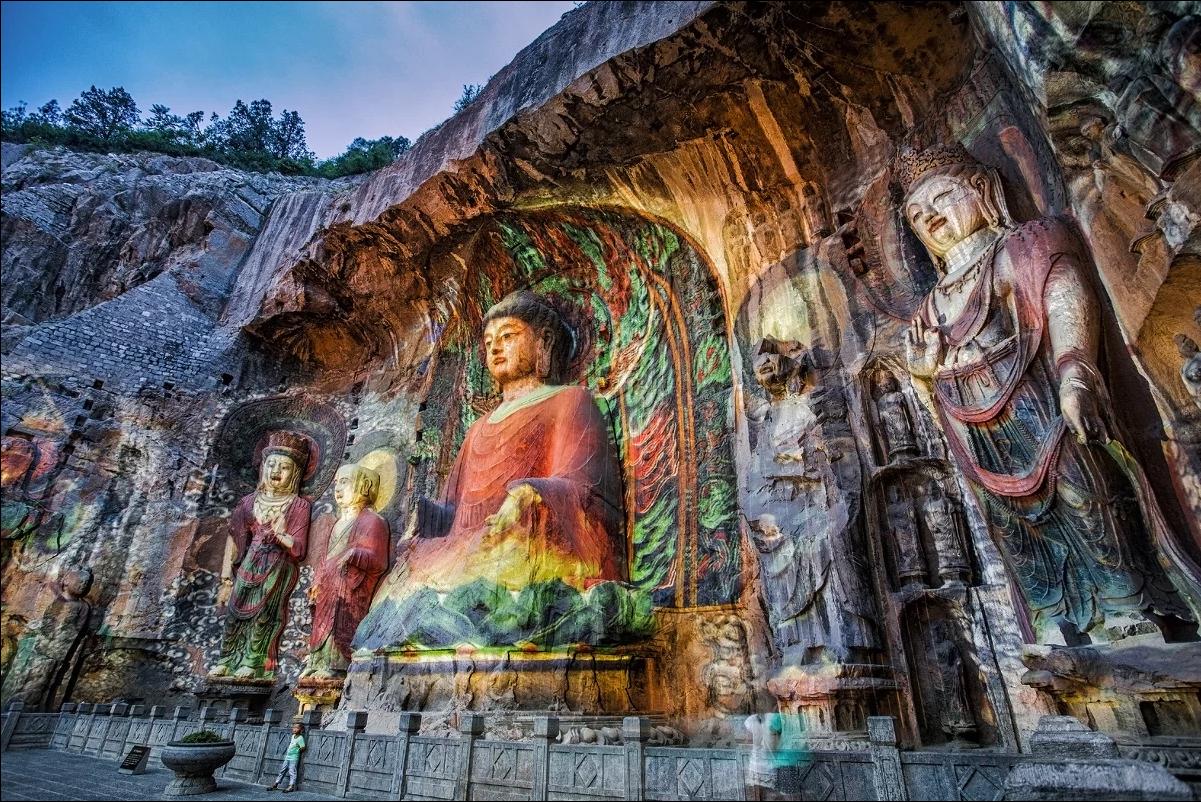
The undisputed icon of the China Longmen Grottoes is the colossal Vairocana Buddha. This figure dominates the Fengxian Temple, the grandest niche in the entire complex. The seated Buddha stands over 17 meters tall. The head alone is 4 meters high, with ears measuring nearly 2 meters. The carving was completed in 676 AD under the patronage of Emperor Gaozong and, significantly, his wife Wu Zetian. She would later become the only female emperor in Chinese history. Many historians believe the face of the Vairocana Buddha was modeled after Wu Zetian herself. This was a direct fusion of spiritual authority and imperial power. The Buddha’s expression is serene but commanding. It is a masterpiece of psychological realism carved from solid stone. The surrounding disciples, bodhisattvas, and guardian kings are equally imposing. The entire ensemble is a perfectly preserved Tang dynasty power statement.
The Guyang Cave
If Fengxian is the grand finale, Guyang Cave is the foundational text. This is the oldest dated cave at Longmen, begun in 493 AD. It is a treasure trove of Northern Wei artistry. The central Buddha is a classic example of the Wei style—elongated, flattened, with a cascade of intricate robes. The true value of Guyang, however, lies in its inscriptions. The cave walls are covered with hundreds of dedicatory texts. These are known as the “Twenty Calligraphies of Longmen.” For connoisseurs of Chinese calligraphy, this is a sacred place. The script, known as “Wei stele style,” is a bold, angular transition between ancient clerical script and modern standard script. Studying these carvings is a direct encounter with the evolution of written Chinese.
The Wanfo Cave (Ten Thousand Buddhas Cave)
Completed in 680 AD, this cave is a dizzying display of precision. The name is not an exaggeration. The interior walls are covered with a grid of 15,000 tiny, identical Buddha figures. Each is only a few centimeters tall. The sheer consistency of the work is staggering. It speaks to an organized, almost industrial, level of artistic production. At the center, a full-figured Amitabha Buddha sits on a lotus throne. Behind him, the wall is a tapestry of 54 carved lotus flowers, each holding a bodhisattva. The contrast between the mass-produced miniature Buddhas and the individually sculpted central figures creates a powerful visual rhythm. This cave demonstrates the technical mastery Tang artisans possessed.
The Binyang Caves
The three Binyang caves are a study in ambition and interruption. The central cave was commissioned by Emperor Xuanwu of the Northern Wei to honor his parents. It took over 800,000 man-days to complete. The result is a perfectly symmetrical, harmonious space. The famous bas-relief panels of imperial processions, now partially housed in museums in the United States, originally flanked the entrance. The two flanking caves, North and South Binyang, were left unfinished by the Wei dynasty and only completed much later under the Tang. This gives you a unique, side-by-side comparison of the two great artistic periods within a single architectural frame. You can literally see the stylistic shift from one doorway to the next.
Planning Your Visit: A Professional’s Approach
A trip to the China Longmen Grottoes requires logistical forethought. The site is located 12 kilometers south of Luoyang in Henan province. The high-speed rail station, Luoyang Longmen, connects directly to major cities like Beijing, Xi’an, and Shanghai. The station is conveniently close to the grottoes. We recommend allocating a full day for the visit. This allows for a thorough exploration without the pressure of a return train schedule. The site is linear, following the west bank of the Yi River. Your route is a simple, one-way walk from the entrance to the far end. You cannot double back, so ensure you have seen everything before moving past a section.
Timing is everything. The morning light illuminates the west bank caves directly, making it the ideal time for photography. The afternoon sun can leave the main statues in shadow. The site is extremely exposed. The limestone cliffs radiate heat in summer and offer no protection from winter winds. A hat, water, and appropriate layers are non-negotiable. The walkway is mostly flat but extensive. Comfortable shoes are a critical piece of equipment. We advise against visiting during Chinese national holidays. The narrow paths become impassably crowded, and the contemplative atmosphere is lost. A weekday in spring or autumn provides the most comfortable climate and the fewest people.
Beyond the Caves: The Complete Site
Many visitors fixate solely on the west bank caves and leave. This is a mistake. Your ticket also grants access to the east bank, the Xiangshan Temple, and the Bai Juyi Memorial Garden. Cross the bridge over the Yi River. From the east bank, you get the definitive panoramic photograph of the entire cliff face. The view puts the scale of the endeavor into proper perspective. You see the honeycomb of cave openings stretching for a kilometer. The Xiangshan Temple, perched on the hillside, offers a quiet counterpoint to the crowded grottoes. The Bai Juyi Memorial Garden is the tomb of the famous Tang dynasty poet, who lived out his final years in Luoyang. The entire complex is a UNESCO World Heritage site, a designation that testifies to its universal cultural value.
Frequently Asked Questions
How long does it take to see the China Longmen Grottoes?
A thorough visit to the main west bank caves requires three to four hours. If you plan to walk the east bank and visit the temple and garden, you should allocate five to six hours for the entire site.
What is the best time of year to visit the Longmen Grottoes?
April, May, September, and October offer the most pleasant temperatures. The site is open year-round, but summer heat and winter cold can be extreme. Avoid the first week of October and the first week of May due to national holidays.
Are the grottoes accessible for visitors with limited mobility?
The main path along the west bank is paved and relatively flat, making it accessible for wheelchairs. However, viewing some specific caves requires climbing steep stairs. The east bank has more elevation changes.
Is photography allowed inside the caves?
Yes, non-flash photography is generally permitted in the outdoor and semi-outdoor niches. Flash photography and tripods are strictly prohibited to protect the ancient pigments. Some interior caves may have specific restrictions.
Preserving the Legacy
The China Longmen Grottoes face constant environmental threats. Centuries of wind and water erosion have worn away delicate details. Acid rain, a byproduct of modern industry, accelerates the dissolution of the limestone. Earlier theft and vandalism took a heavy toll, with many heads and hands now residing in foreign museum collections. Today, the site is under national-level protection. Conservation is a continuous battle. Digital scanning projects are creating a permanent record of the carvings in their current state. When you visit, you contribute directly to the preservation effort. Your entrance fee funds the ongoing work to stabilize the stone and document the art. Respect the barriers. Do not touch the carvings. The oils from human skin are damaging. You are a steward of this place for the generations of professionals and pilgrims who will come after you. The goal is to ensure this stone library of faith and power endures for another 1,500 years.
