 By
By How the Longmen Grottoes Document a 400-Year Evolution in Buddhist Art
Visitors and researchers often ask how a single location can reveal such dramatic shifts in artistic style. The answer lies in the nearly 400 years of continuous construction at the longmen grotto complex. The caves serve as a stone library, charting the transformation of Buddhist sculpture from the foreign-influenced, abstract spirituality of the Northern Wei Dynasty to the confident, worldly realism of the Tang Dynasty. Understanding this evolution is key to deciphering the art’s deeper meaning and historical context.
The transition was not merely aesthetic; it reflected profound changes in Chinese society, politics, and religious interpretation. By examining the figures carved into the limestone cliffs, we can trace the complete sinicization of Buddhism, from an imported faith to a cornerstone of Chinese imperial identity. This guide breaks down the key stylistic markers that distinguish these two pivotal eras.
The Northern Wei Period: An Era of Spiritual Abstraction
The earliest carvings at the Longmen Grottoes, initiated by Emperor Xiaowen of the Northern Wei Dynasty around 493 AD, carry a distinct visual signature. This style is heavily influenced by the Greco-Buddhist art of Gandhara and Central Asia, which traveled along the Silk Road. The primary goal of these sculptures was not to depict realistic human forms but to convey the transcendent and otherworldly nature of Buddhist enlightenment.
The figures from this period are characterized by a sense of asceticism and serene detachment. They are spiritual icons, not portraits of earthly beings. When analyzing these early works, artisans and historians look for a specific set of features that clearly mark them as products of their time. Misidentifying these features can lead to incorrect dating and a misunderstanding of the patron’s intent.
Checklist for Identifying Northern Wei Sculptural Features
Use this checklist to distinguish the early-period carvings at Longmen. A sculpture is likely from the Northern Wei if it exhibits the majority of these traits:
- Elongated Faces and Bodies: Figures are slender, almost stretched, with long necks and narrow shoulders. This verticality emphasizes their non-earthly nature.
- The “Archaic Smile”: A subtle, enigmatic smile that signifies serene, inner bliss rather than an external emotional reaction. It is a hallmark of early Buddhist sculpture.
- Linear, Stylized Drapery: Robes feature sharp, flat, parallel pleats that cascade in a “waterfall” pattern. The fabric appears stiff and schematic, concealing the body underneath rather than revealing it.
- Large Heads in Proportion to the Body: The head, as the center of spiritual wisdom, is often rendered slightly oversized compared to the torso and limbs.
- Prominent Ushnisha: The cranial protuberance symbolizing the Buddha’s expanded wisdom is often sharply defined and high.
- Hieratic Scale: The central Buddha figure is significantly larger than the attendant bodhisattvas and disciples, indicating spiritual hierarchy, not physical reality.
These features combine to create an impression of ethereal grace and solemn spirituality. The artists were not attempting to capture reality; they were carving a visual representation of complex theological ideas for a court seeking to legitimize its rule through the patronage of a powerful foreign religion.
Comparing Northern Wei and Tang Styles: A Visual Breakdown
The stylistic gulf between the Northern Wei and Tang dynasties is the most compelling story the Longmen Grottoes have to tell. The shift from abstract spiritualism to powerful realism is stark. Understanding these differences is critical for anyone studying the timeline of Chinese art or the cultural integration of Buddhism. The following table provides a direct comparison of the key artistic parameters.
| Artistic Feature | Northern Wei Dynasty (c. 493–534 AD) | Tang Dynasty (c. 618–907 AD) |
|---|---|---|
| Robe Lines & Drapery | Linear, schematic, and sharp. Fabric is depicted with parallel, incised lines (“waterfall” pleats) that completely obscure the body’s form, emphasizing the spiritual over the physical. | Fluid, naturalistic, and soft. Fabric drapes realistically, clinging to the body in a “wet look” that reveals the powerful, fleshy form underneath. This highlights the Buddha’s presence in the world. |
| Facial Proportions & Expression | Elongated, narrow face with high-arched eyebrows, a sharp nose, and the serene “archaic smile.” The expression is detached, otherworldly, and introspective. | Round, full, and fleshy face with naturalistic features. Expressions are more human and varied, conveying compassion, authority, or contemplation in a direct, accessible way. |
| Body Scale & Form | Slender, attenuated, and ethereal. The physical form is de-emphasized, appearing flat and dematerialized beneath the stiff robes. Proportions are often intentionally distorted for spiritual effect. | Powerful, voluminous, and lifelike. Figures have broad shoulders, full chests, and a tangible physical presence. The anatomy is natural and grounded, reflecting a confident, worldly aesthetic. |
| Patronage & Intent | Imperial patronage by the Tuoba Wei court sought to establish legitimacy and demonstrate piety. The art served to introduce and solidify Buddhist concepts in a new cultural context. | Imperial patronage, particularly by Emperor Gaozong and Empress Wu Zetian, projected the power, wealth, and divine mandate of the Tang Empire. The art reflects a fully assimilated, confident Chinese Buddhism. |
The Tang Dynasty Shift: Embracing Realism and Imperial Grandeur
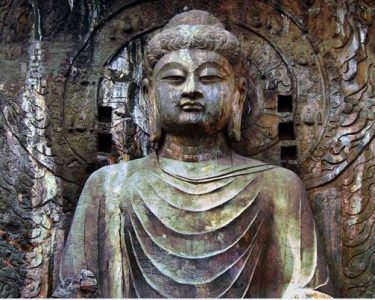
By the time the Tang Dynasty sponsored major works at the Longmen Grottoes, China was a confident, unified, and cosmopolitan empire. This cultural self-assurance is powerfully reflected in its art. Tang sculpture sheds the foreign-influenced abstraction of the Wei period and embraces a robust, worldly realism that is distinctly Chinese.
The colossal figures of the Fengxian Temple, commissioned by Emperor Gaozong and completed around 675 AD, are the pinnacle of this style. The central Vairocana Buddha, said to be modeled on the face of Empress Wu Zetian, is the ultimate expression of this new aesthetic. It is not an ethereal, distant deity but a powerful, compassionate, and immanent ruler. The figure is grounded, majestic, and undeniably human in its emotional resonance, embodying the fusion of divine authority and imperial power that defined the era.
Common Mistakes When Interpreting Tang Sculptures
Visitors and researchers sometimes misinterpret the naturalism of Tang art. Avoiding these common errors provides a more accurate understanding of the sculptures’ cultural significance.
- Mistake 1: Viewing the realism as purely secular. While the forms are lifelike, they are not simple portraits. The realism serves a religious purpose: to make the divine accessible and relatable, presenting the Buddha and bodhisattvas as compassionate beings actively present in the world.
- Mistake 2: Overlooking the political messaging. The grandeur and scale of Tang sculptures, especially at Fengxian Temple, were a deliberate projection of state power. This was art as imperial propaganda, equating the glory of the Buddha with the glory of the Tang Empire.
- Mistake 3: Assuming a uniform style. While characterized by realism, the Tang period saw stylistic evolution. Early Tang figures retain some of the stiffness of the preceding Sui Dynasty, while High Tang figures exhibit the fullest, most voluminous forms. Late Tang works sometimes show a trend towards greater ornamentation.
The art of the Tang dynasty at Longmen represents the successful culmination of a long process of cultural adaptation. It is the visual evidence of Buddhism becoming a truly Chinese religion, fully integrated into the nation’s political and aesthetic life, a journey that began centuries earlier with the abstract carvings of the Northern Wei.
For detailed assessments of historical artifacts and their cultural context, our team provides in-depth analysis and reporting. Contact us to discuss your research or collection needs.