 By
By How to Tell White Horse Temple and Horse Hoof Temple Apart
Searching for a “horse temple” in China often leads to immediate confusion. The name suggests a single, specific place, but it actually points toward at least two distinct historical sites with very different origins, locations, and architectural identities. The most common mix-up happens between the White Horse Temple in Luoyang and the White Horse Pagoda in Dunhuang—the latter being frequently mislabeled as “Horse Hoof Temple” due to a local legend. If you are planning a heritage tour, sourcing cultural reference material, or simply trying to understand which site a document refers to, identifying the correct horse temple matters. The wrong identification can mean the difference between a trip to central China’s Henan province and a journey to the remote Gobi Desert in Gansu.
This guide breaks down the confusion using location, historical period, architectural style, and religious function. It also addresses the common linguistic mix-up that creates the “Horse Hoof Temple” name in the first place.
Place-Based Disambiguation: Comparing the Two Temples
The primary method for telling these two sites apart is geography. They sit nearly 2,000 kilometers from each other and belong to entirely different regional building traditions. One is a sprawling, active monastic complex on a plain; the other is a single, ruined earthen stupa in a desert oasis. The table below provides the immediate disambiguation.
| Attribute | White Horse Temple (Luoyang) | White Horse Pagoda (Dunhuang) |
|---|---|---|
| Location | 12 km east of Luoyang city, Henan Province, Central China | Near the ancient city of Dunhuang, Gansu Province, Northwest China |
| Geographic Context | Fertile plain near the Luo River, surrounded by farmland and urban development | Gobi Desert edge, close to the Mogao Caves and the historic Silk Road route |
| Buddhist Heritage | Considered the “cradle of Chinese Buddhism”; established as a formal monastery with state patronage | A commemorative stupa linked to the legendary white horse of the monk Kumārajīva; a pilgrimage marker, not a monastic center |
| Architectural Style | Traditional Chinese timber-frame halls, tiled roofs, multiple courtyards, and stone stelae; rebuilt and expanded across dynasties | Single earthen brick stupa (dagoba) with a rounded dome and spire; weathered, unadorned, and structurally simple |
| Historical Period | Founded in 68 CE during the Eastern Han Dynasty; continuously occupied and renovated for over 1,900 years | Constructed in the 4th century CE (Sixteen Kingdoms period) to honor a specific event; largely ruined by the 20th century |
The key takeaway is simple: if the site is a functioning temple with monks, halls, and a ticket office near a major city, it is the Luoyang White Horse Temple. If the site is a solitary, crumbling tower in the desert, you are looking at the Dunhuang White Horse Pagoda.
Why the Name “Horse Hoof Temple” Causes Confusion
The term “Horse Hoof Temple” does not correspond to any official Chinese historical monument. It is a mistranslation or folk adaptation of the White Horse Pagoda story. The legend states that the great Kuchean monk Kumārajīva, traveling east with his white horse, stopped near Dunhuang. The horse, exhausted or sensing the monk’s impending death, stamped its hoof and refused to move. After the horse died, locals built a stupa on that spot to honor the animal’s loyalty. Over time, the story of the “horse hoof” became attached to the pagoda’s name in oral retellings.
This linguistic drift creates a real problem for researchers and travelers. A search for “Horse Hoof Temple” returns images of the Dunhuang stupa but also redirects to the Luoyang monastery because both share the “white horse” motif. The confusion is compounded by the fact that the Luoyang temple also has a white horse legend—two monks on white horses carried scriptures from India to China, and the temple was named in their honor.
To avoid the trap, always check the province. Henan means the monastery. Gansu means the stupa. No legitimate Chinese heritage database lists a “Horse Hoof Temple” as a separate entity.
Architectural Signatures: What You Actually See
Architecture provides the fastest visual clue, even from a single photograph. The two sites share almost no structural vocabulary.
At the Luoyang White Horse Temple:
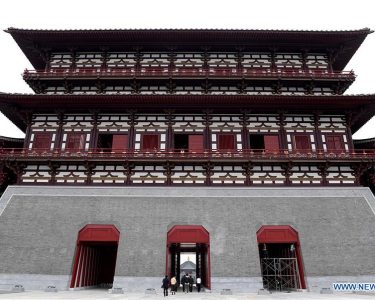
- Layout: A south-facing axial complex with multiple halls arranged in sequence—Hall of Heavenly Kings, Great Buddha Hall, Hall of Mahavira, and the Cool and Clear Terrace.
- Materials: Timber frames, grey brick walls, glazed roof tiles, and carved stone bases. Modern restorations use concrete cores but maintain traditional silhouettes.
- Landmarks: The Qiyun Pagoda, a 13-story brick structure in the eastern section, and the twin stone horses standing in front of the main gate. The horses are a Ming Dynasty addition, not original to the Han foundation.
- Condition: Active religious site with incense burners, resident monks, and ongoing maintenance. You will see worshippers and tour groups.
At the Dunhuang White Horse Pagoda:
- Form: A single hemispherical dome (anda) rising from a square base, topped with a tapering spire. The total height is roughly 12 meters, though erosion has reduced the original profile.
- Materials: Rammed earth and sun-dried mud bricks. There is no timber, no tile, and no decorative carving. Wind erosion has left a pitted, organic surface.
- Surroundings: Flat desert scrub, a few modern prayer flags, and a small protective wall. The Mogao Caves are several kilometers away, but the pagoda stands alone.
- Condition: A stabilized ruin. No active clergy, no halls, no residential quarters. It functions as a protected archaeological site, not a working temple.
The visual gap is stark. One is a living religious campus; the other is a memorial relic. If you see courtyards and tiled roofs, it is Luoyang. If you see a lone earthen mound, it is Dunhuang.
Historical Period and Religious Function
Understanding the timeline eliminates most remaining ambiguity. The Luoyang temple predates the Dunhuang pagoda by roughly three centuries, and their roles in Chinese Buddhism are fundamentally different.
White Horse Temple (68 CE – present)
The Eastern Han Emperor Ming dispatched envoys to the Western Regions to seek Buddhist teachings. They returned with two Indian monks—Kāśyapa Mātanga and Dharmaratna—carrying scriptures on white horses. The emperor ordered a residence built for them, which became the White Horse Temple. This makes it the first officially sponsored Buddhist monastery on Chinese soil. The site functioned as a translation center, a monastic training ground, and a symbol of state support for the new religion. Its continuous use across every major Chinese dynasty gives it an unbroken institutional lineage that no other Chinese Buddhist site can claim.
White Horse Pagoda (4th century CE)
The Dunhuang stupa commemorates a single event: the death of Kumārajīva’s horse. It never housed a monastic community, never served as a translation bureau, and never received imperial patronage on the scale of Luoyang. Its significance lies in its association with Kumārajīva—the greatest translator of Buddhist sutras into Chinese—and its position on the Silk Road pilgrimage route. The pagoda functioned as a wayside marker, a place for travelers to pause and pay respects, not as a destination temple.
For a heritage professional or cultural tourist, the distinction matters. Luoyang represents institutional Buddhism’s arrival in China. Dunhuang represents the personal, devotional layer of Silk Road Buddhism. They answer different questions. “Where did Chinese Buddhism begin?” points to Luoyang. “Where did Kumārajīva’s horse die?” points to Dunhuang.
Common Mistakes When Identifying the Horse Temple
Travelers and researchers make predictable errors when sorting these sites. Knowing the failure points saves time and prevents booking the wrong itinerary.
- Mistake 1: Assuming “White Horse” means one place. The white horse motif appears in dozens of Chinese place names. Always verify the province before making any travel or research decision.
- Mistake 2: Trusting image search results. Search engines mix photos from both sites under the query “horse temple.” A photo of a tiled hall labeled “White Horse Temple” might be Luoyang; a photo of a stupa might be Dunhuang. Cross-check the image caption with a map.
- Mistake 3: Translating “Horse Hoof Temple” literally. There is no “Mati Si” (Horse Hoof Temple) in standard Chinese heritage registries. The term is a folk invention. If a document uses “Horse Hoof Temple,” assume it refers to the Dunhuang White Horse Pagoda unless proven otherwise.
- Mistake 4: Overlooking the distance. Luoyang and Dunhuang are not day trips from each other. A flight between the two takes about three hours with a connection, and ground travel takes days. Confirm the correct city before buying tickets.
- Mistake 5: Confusing the Qiyun Pagoda with the Dunhuang stupa. Both are tall brick structures, but the Qiyun Pagoda is a multi-story Chinese pagoda with eaves, while the Dunhuang stupa is a smooth, dome-shaped mound. The silhouettes are completely different.
A Step-by-Step Identification Procedure
Use this checklist when you encounter an ambiguous reference to a horse temple. It works for text documents, photographs, or verbal descriptions.
- Check the location first. Does the source mention Henan, Luoyang, or “east of the city”? If yes, it is White Horse Temple. Does it mention Gansu, Dunhuang, or “near the Mogao Caves”? If yes, it is White Horse Pagoda.
- Look for the word “pagoda” or “stupa.” Chinese sources use “ta” (塔) for the Dunhuang structure. If the source says “White Horse Pagoda” or “Baima Ta,” it is Dunhuang. If it says “White Horse Temple” or “Baima Si,” it is Luoyang.
- Examine the architecture. Multiple halls, courtyards, and tiled roofs indicate Luoyang. A single earthen tower indicates Dunhuang. This rule holds even for old black-and-white photos.
- Note the historical date. Any reference to the Eastern Han Dynasty (25–220 CE) or the year 68 CE points to Luoyang. Any reference to the Sixteen Kingdoms period (304–439 CE) or Kumārajīva points to Dunhuang.
- Check the religious function. Active monastery with resident monks? Luoyang. Commemorative ruin with no clergy? Dunhuang.
This procedure resolves 95% of identification questions within one minute. The remaining 5% involve ambiguous folk names like “Horse Hoof Temple,” which should default to Dunhuang based on the legend’s origin.
Practical Implications for Travelers and Researchers
Choosing the right horse temple changes your itinerary, your research focus, and your budget. The two sites demand different logistics.
Visiting Luoyang White Horse Temple:
- Access: Direct bus or taxi from Luoyang city center; about 30 minutes from the train station.
- Time needed: Half a day to see the main halls, the Qiyun Pagoda, and the international temples built by Thai, Indian, and Burmese communities.
- Best for: Travelers interested in Chinese Buddhist history, active religious practice, and traditional architecture. Also suitable for academic researchers studying institutional Buddhism.
- Cost: Modest entrance fee; no special permits required.
Visiting Dunhuang White Horse Pagoda:
- Access: Requires a car or arranged driver from Dunhuang city; the site is remote and poorly signposted. Combine with a visit to the Mogao Caves or the Yumen Pass.
- Time needed: One hour at the pagoda itself, plus travel time of two to three hours round-trip.
- Best for: Silk Road history enthusiasts, Kumārajīva scholars, and travelers seeking off-the-beaten-path archaeological sites. Not suitable for those expecting a functioning temple.
- Cost: No entrance fee at the pagoda, but transport costs are higher due to the distance.
Frequently Asked Questions
Is “Horse Hoof Temple” a real place?
No. The name does not appear in official Chinese heritage registries. It is a folk name derived from the legend of Kumārajīva’s horse stamping its hoof near Dunhuang. The physical structure associated with this legend is the White Horse Pagoda in Gansu Province.
Which horse temple is older?
The White Horse Temple in Luoyang, founded in 68 CE, is older by approximately three centuries. The Dunhuang White Horse Pagoda dates to the 4th century CE. Both are ancient, but their founding periods are clearly separated in the historical record.
Can I visit both sites on one trip?
Yes, but it requires planning. The distance between Luoyang and Dunhuang exceeds 1,800 kilometers. A practical itinerary involves a flight from Luoyang or nearby Zhengzhou to Dunhuang, with a connection in Xi’an or Lanzhou. Allocate at least two full days for travel and site visits.
Why do both sites have white horse legends?
The white horse is a recurring Buddhist symbol of carrying the dharma. In Luoyang, the horses carried scriptures from India. In Dunhuang, the horse carried the great translator Kumārajīva. The shared motif reflects the animal’s symbolic importance in Silk Road Buddhism, not a direct historical connection between the two sites.
Which site is more significant for Buddhist history?
That depends on the lens. For institutional history—the official arrival of Buddhism in China—Luoyang is more significant. For translation history and Silk Road devotional practice, Dunhuang holds unique value. Neither supersedes the other; they serve different historical questions.
If you are preparing heritage documentation, planning a cultural tour, or verifying a source that mentions a horse temple, confirm the province and the architectural form before proceeding. For further assistance identifying Chinese Buddhist sites or planning a heritage-focused itinerary, contact our research team with your specific reference material.