 By
By How to Identify Later Reconstructions at Luoyang White Horse Temple
Visitors often arrive at luoyang white horse temple expecting to see a building that has stood unchanged since 68 CE. That expectation collapses quickly. The temple grounds contain structures spanning nearly two millennia, and almost nothing visible today dates to the Eastern Han period. The question is not whether the site has been rebuilt, but how to tell which parts are older and which are modern interpretations of antiquity.
This guide explains the physical evidence you can read on site. Roof profiles, beam construction, hall positioning, stele dates, and material weathering all reveal the construction history. Once you know what to look for, the temple becomes a layered document rather than a single monument.
How Roof Forms, Hall Layouts, Steles, and Construction Periods Reveal Later Reconstructions
The most reliable way to distinguish original Eastern Han fabric from later work is to cross-reference four independent lines of evidence. Each one alone can mislead. Together, they form a consistent picture.
Roof Forms as Period Indicators
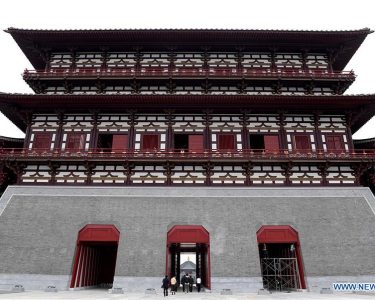
Roof curvature is the fastest visual clue. Eastern Han buildings, as depicted in tomb reliefs and ceramic models from the period, had relatively straight ridge lines and shallow eaves. The deep, upturned eaves that visitors associate with classical Chinese architecture emerged gradually during the Tang and Song dynasties and became pronounced by the Ming and Qing periods.
At luoyang white horse temple, the main halls feature double-eaved hip-and-gable roofs with strongly curved ridges and upturned corner eaves. This profile is characteristic of Ming and Qing restoration work, not Han construction. The sweeping eaves require a complex bracket system that was not used in the same form during the Eastern Han.
What happens if a visitor gets this wrong: they misattribute the visual style to the temple’s founding period and misunderstand how Chinese Buddhist architecture evolved. The temple did not look like this in 68 CE. It looked closer to the simpler hall forms seen in Han-era tomb engravings.
Hall Layout and Axis Alignment
The current axial layout — gate, Hall of Heavenly Kings, Great Buddha Hall, Mahavira Hall, and Qiyun Pagoda arranged along a north-south line — follows the mature Chinese Buddhist monastery plan. That plan crystallized centuries after the temple’s founding. Early Buddhist complexes in China were often centered on a pagoda, with the pagoda occupying the primary position and halls arranged around it.
At White Horse Temple, the pagoda now stands at the rear of the complex rather than the center. This inversion reflects a shift in liturgical focus from relic worship to image worship, a change that occurred gradually between the Northern Wei and Tang periods. The current arrangement is a product of later reordering, not the original Han layout.
Steles as Dated Anchors
The stone steles scattered across the grounds are the most concrete evidence. Many carry inscriptions recording restoration campaigns. Some date to the Ming dynasty, others to the Qing, and a few to the Republican era. These steles often explicitly state that earlier structures had fallen into disrepair and were rebuilt.
A visitor who reads even one Ming stele will find language describing the reconstruction of halls that had collapsed. The steles function as a paper trail. They anchor specific buildings to specific rebuilding efforts. When a stele dated 1555 CE describes the reconstruction of a hall, that hall cannot be original Han fabric.
Construction Periods and Material Weathering
Materials tell the same story. The oldest surviving above-ground structures at luoyang white horse temple date to the Ming dynasty. The Qiyun Pagoda, often described as the temple’s most ancient element, is generally dated to the 12th century (Jin dynasty) with later repairs. Its brick construction and dense, multi-eaved profile are Jin-period characteristics.
The Great Buddha Hall and Mahavira Hall are Ming and Qing reconstructions. Their timber frames, column spacing, and bracket proportions match those periods. Weathering patterns on stone bases and staircases often show multiple phases of repair, with newer stone spliced against older fragments.
| Feature | Eastern Han (25–220 CE) | Jin (1115–1234) | Ming/Qing (1368–1912) | What to Look For at White Horse Temple |
|---|---|---|---|---|
| Roof profile | Straight ridges, shallow eaves | Moderate curvature, multi-eaved pagoda | Deep curves, upturned corners | Strongly curved double eaves on main halls |
| Bracket system | Simple, functional | Dense, decorative | Highly ornate, small spacing | Ornate brackets under eaves |
| Pagoda position | Central to layout | Central or rear | Rear or side | Qiyun Pagoda at rear |
| Primary material | Timber, rammed earth | Brick | Timber on stone base | Brick pagoda, timber halls |
| Stele evidence | None surviving | Rare | Abundant restoration records | Multiple Ming/Qing steles on site |
Reading the Qiyun Pagoda: The Oldest Structure on Site
The Qiyun Pagoda is the single most instructive structure for understanding reconstruction at luoyang white horse temple. It stands apart from the main hall axis, slightly to the southeast. Its thirteen tiers of densely packed eaves rise from a square brick base. This form is not Han. It is a Jin dynasty interpretation of earlier brick pagoda traditions.
The pagoda’s brickwork shows at least two distinct construction phases. The lower courses use larger, more irregular bricks with thicker mortar joints. The upper sections show smaller, more uniform bricks laid with tighter joints. This transition marks a repair or partial reconstruction. The lower portion may retain Jin fabric; the upper portion is almost certainly later.
Visitors should examine the pagoda’s door and window openings. The arched openings are relatively simple compared to the elaborate bracketed openings on later Ming pagodas elsewhere in Henan. That simplicity is one reason scholars assign the pagoda to the Jin period rather than later centuries. But simplicity alone is not proof — it must be weighed against brick size, mortar composition, and stylistic parallels with dated Jin pagodas in the region.
What this means for a visitor: the Qiyun Pagoda is the closest thing to original fabric at the site, and even it is a 12th-century structure, not a Han one. The gap between the temple’s founding in 68 CE and its oldest surviving building is roughly one thousand years.
Common Mistakes Visitors Make When Dating Temple Structures
Misreading the architecture is easy. Here are the most frequent errors and how to avoid them.
- Assuming the founding date equals the building date. The temple was founded in 68 CE. The buildings visible today date from the 12th to 20th centuries. Founding date and construction date are different things.
- Treating the temple as a single building. It is a compound of structures built, rebuilt, and relocated over centuries. Each hall has its own construction history.
- Using architectural style as a precise dating tool. Style narrows the range but cannot pinpoint a year. Ming and Qing restorations often imitated earlier styles, so a hall may look older than it is.
- Ignoring the steles. The stone inscriptions are the most explicit evidence. Skipping them means missing the temple’s own written record of its rebuilding.
- Assuming the pagoda is the oldest part. The Qiyun Pagoda is the oldest surviving structure, but it is not Han. It is Jin. The original Han pagoda, if one existed, is gone.
- Confusing reconstruction with forgery. Rebuilding a hall in Ming style is not a fake. It is a later phase of a living religious site. The distinction matters for accurate interpretation.
A Step-by-Step Procedure for Identifying Reconstruction Phases on Site
Use this sequence when you walk through luoyang white horse temple. It takes about two hours at a slow pace.
- Start at the main gate. Note the roof profile and bracket style. Compare them to photos of Han tomb reliefs before your visit. The gate is a Qing reconstruction. Its roof curvature is the giveaway.
- Walk the central axis. Observe how each hall sits on its stone platform. Look for mismatched stone blocks, different weathering levels, and patches of newer masonry. These indicate repairs.
- Read the steles. Photograph each stele and note its date. Cross-reference the dates with the halls nearby. A stele dated 1661 describing the rebuilding of the Great Buddha Hall tells you that hall is not earlier than the 17th century.
- Examine the Qiyun Pagoda. Compare the lower and upper brick courses. Look for a change in brick size and mortar color. This is the pagoda’s repair boundary.
- Check the roof tiles. Glazed tiles are almost always later replacements. Unglazed gray tiles may be older, but they are also easily replaced. Tile evidence alone is weak; use it only as supporting detail.
- Sketch the layout. Draw the position of the pagoda relative to the halls. Central pagoda layouts are older; rear pagoda layouts are later. The current arrangement tells you the site was reorganized after the Tang period.
This procedure works because it layers independent evidence. Roof style gives a broad period. Steles give specific dates. Materials give construction phases. Layout gives liturgical history. No single observation is decisive, but together they are hard to refute.
What the Reconstruction History Means for Interpretation
Understanding that luoyang white horse temple is largely a Ming and Qing reconstruction does not diminish its significance. It changes what the site represents. The temple is not a frozen moment from 68 CE. It is a record of how Chinese Buddhists remembered and rebuilt their first monastery over twenty centuries.
The repeated reconstructions reflect shifts in architectural taste, liturgical priorities, and political patronage. The Ming halls reflect Ming imperial sponsorship of Buddhism. The Jin pagoda reflects the continuation of relic veneration in the north. The Qing gate reflects the final phase of imperial temple building before the modern era. Each layer is a historical document in its own right.
For a visitor who learns to read these layers, the site becomes more interesting, not less. The absence of Han fabric is itself a fact worth understanding. It tells you that the temple’s importance was never tied to the permanence of its buildings. It was tied to the continuity of its function as a place of Buddhist learning and worship.
When you plan your visit, bring a notebook or use your phone to record stele dates and photograph roof profiles. Compare what you see against dated examples from the Jin, Ming, and Qing periods. The more you cross-reference, the clearer the reconstruction history becomes.
If you are preparing a research trip or heritage study program and need detailed architectural notes on the temple’s construction phases, contact our team for site-specific documentation and interpretation resources.