 By
By How luoyang in china reveals four historical eras
Which historical period should guide your first visit, and how can you avoid treating an ancient capital as a disconnected list of monuments? That is the central planning question for history-minded travelers researching luoyang in china. The city is easier to understand when its sites are arranged by the type of historical change they reveal: early state formation, Buddhist patronage, Tang-era exchange, and the working life of a modern city shaped by its past.
This framework does not ask visitors to memorize every ruling house. Instead, it helps them decide what to see, what to compare, and how much time each stop deserves. A traveler interested in archaeology will need a different route from someone focused on religious art. Likewise, a visitor seeking evidence of cosmopolitan exchange should not rely only on imperial ruins.
Seen through this structure, luoyang in china becomes more than a former capital. It becomes a place where political authority, belief, international contact, and contemporary urban life can be studied side by side. The sections below turn that idea into a practical method for building an itinerary.
Use four historical layers instead of a dynasty list
The most useful way to interpret the city is to move through four distinct layers: early capitals, Northern Wei Buddhism, Tang-era exchange, and the modern city. This is more practical than a dynasty list because each layer points to different evidence, different sites, and different questions. A dynasty list can tell a visitor who ruled. A layered approach explains what changed in the city and what can still be observed.
| Historical layer | What to look for | What it affects in practice | Planning risk if misunderstood |
|---|---|---|---|
| Early capitals | Settlement patterns, archaeological remains, palace-city planning, and political geography | Helps visitors understand why the region mattered before later monuments were built | Focusing only on visible landmarks can obscure the older foundations of state power |
| Northern Wei Buddhism | Cave temples, carved figures, patronage, and changing artistic styles | Directs visitors toward religious art and the relationship between court support and visual culture | Treating sculpture as decoration alone misses its religious and political purpose |
| Tang-era exchange | Transport links, visiting communities, imported ideas, and urban connections | Shows how the city participated in wider networks rather than existing as an isolated capital | Assuming all sites represent one closed imperial culture leads to a narrow interpretation |
| Modern city | Museums, public spaces, transport, neighborhoods, and heritage presentation | Determines how easily a visitor can connect historical research with present-day conditions | Ignoring current logistics can leave important sites poorly sequenced or rushed |
The conclusion is straightforward: choose sites according to the historical question you want answered. This approach fits travelers who have limited time or who want a coherent research route. It does not replace deeper study for specialists examining a single reign, inscription, or excavation report. For broad early-stage planning, however, it is more effective than moving chronologically from one dynasty name to another.
When researching luoyang in china, begin by selecting one primary layer and one secondary layer. For example, archaeology may be the primary interest, while Buddhist art provides a secondary comparison. That choice prevents an itinerary from becoming a long but disconnected sequence of entrances, ticket counters, and photo stops.
Start with early capitals to understand the city’s political geography
The early-capital layer is the right starting point for visitors who want to understand why this area repeatedly mattered to rulers and administrators. The key issue is geography: a capital is not simply a prestigious label. It requires access, defensible terrain, agricultural support, transport routes, and an administrative landscape capable of concentrating power.
For research on luoyang in china, archaeological museums and site interpretation are especially useful because they can explain evidence that is no longer fully visible above ground. Foundations, settlement boundaries, burial materials, and reconstructed layouts often communicate more than a surviving gate or wall fragment can do alone.
What the early-capital layer changes in an itinerary
- Choose archaeology when your question concerns origins. This is the best option for visitors asking how political centers developed. It is less suitable for travelers who primarily want monumental religious sculpture or highly intact architecture.
- Read maps before entering a site. A site plan can reveal spatial relationships between ceremonial, residential, and administrative areas. Without it, ruins may appear to be isolated fragments.
- Separate archaeological certainty from later tradition. Some places carry powerful cultural associations, but the evidence behind specific identifications can be debated. Use museum labels, excavation summaries, and reputable reference material to distinguish established findings from interpretive claims.
- Allow time for context, not only ruins. A short stop may be enough to see structures, but not enough to understand why their location mattered within the wider capital region.
This layer matters because it establishes the baseline for everything that follows. Later religious monuments and urban exchanges did not emerge in an empty landscape. They developed in a region already shaped by long-term political importance. Visitors who skip this stage may still enjoy the major sites of luoyang in china, but they may miss the underlying reason the city became so historically influential.
Read Northern Wei Buddhism as art, belief, and state patronage
The Northern Wei layer is often the most visually immediate. It is centered on Buddhist patronage, cave-temple art, and the transformation of religious imagery into a durable public record. The Longmen Grottoes are especially valuable because they allow visitors to observe how carving, devotion, elite support, and landscape work together.
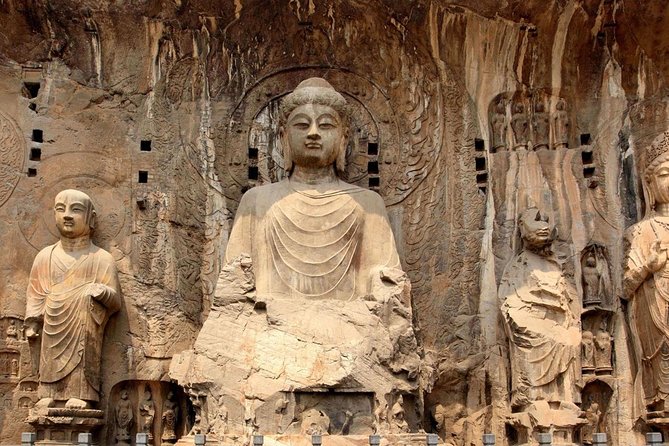
For a visitor to luoyang in china, the practical question is not merely whether to visit a cave-temple complex. It is how to look at it. Compare the scale of figures, the arrangement of niches, inscriptions where accessible, and the relationship between carved spaces and movement through the landscape. These are clues to patronage and intended religious experience.
Northern Wei Buddhism should be approached as more than a sequence of styles. Court involvement could shape artistic priorities, while donors and religious communities influenced what was commissioned and remembered. The visible result is not simply “old sculpture.” It is evidence of how belief, authority, and craftsmanship could intersect.
A practical viewing sequence for Buddhist sites
- Identify the setting first. Observe the cliff, river corridor, paths, and viewing distance before concentrating on individual carvings.
- Compare at least two groups of sculptures. Look for differences in scale, pose, surface treatment, and spatial arrangement rather than trying to inspect every niche.
- Ask who the work addressed. Consider whether a feature appears designed for elite patronage, public devotion, monastic activity, or ceremonial display.
- Use interpretation materials critically. A concise label is useful for orientation, but it cannot settle every question of dating, donor intention, or religious meaning.
- Record comparisons, not just photographs. Write down what changed between carvings or spaces. That note will be more useful later than a large, unstructured image collection.
This approach fits visitors interested in art history, religion, or the material expression of political authority. It does not apply as strongly to travelers whose only aim is a rapid scenic visit. In that case, a shorter route may be sufficient, but it will provide less historical depth.
Use Tang-era exchange to look beyond the imperial center
The Tang-era layer shifts attention from capital status alone to networks of movement. The relevant questions are broader: Who arrived, what ideas circulated, how were goods and beliefs transmitted, and how did an urban center connect with other regions? For luoyang in china, this perspective prevents the common mistake of imagining the city as culturally self-contained.
Exchange does not always survive as a single, obvious monument. It may appear through religious institutions, artistic influences, burial evidence, written records, museum collections, or the historical logic of routes that connected the city to wider parts of Asia. The visitor’s task is to compare evidence rather than expect one site to explain the entire story.
| Research question | Best type of evidence to seek | Useful itinerary choice | Limit of the approach |
|---|---|---|---|
| How did ideas travel? | Religious art, texts, translation traditions, and institutional history | Pair a museum visit with a religious heritage site | One object or building rarely proves the full route of exchange |
| How did people move through the region? | Maps, waterways, roads, and historical geography | Review regional maps before choosing distant stops | Modern transport patterns do not perfectly reproduce historical routes |
| How cosmopolitan was the city? | Material culture, artistic motifs, records of visiting groups, and trade context | Compare multiple collections or interpretive sources | “Cosmopolitan” should not be used as a vague label without evidence |
The conclusion here is to build comparisons into the day. A visitor studying Tang-era exchange in luoyang in china should not rely on a single palace-related stop. Combine urban history with religious, artistic, or museum evidence. This method is ideal for early-stage research. It is not a substitute for consulting specialist scholarship when the question concerns a specific community, object type, or route.
Include the modern city because logistics shape historical understanding
The modern layer is not an afterthought. It determines how a visitor reaches sites, where historical interpretation is presented, and how heritage is experienced amid contemporary neighborhoods, roads, public spaces, and visitor infrastructure. Ignoring the present city can create an unrealistic plan that treats every location as if it were isolated from current conditions.
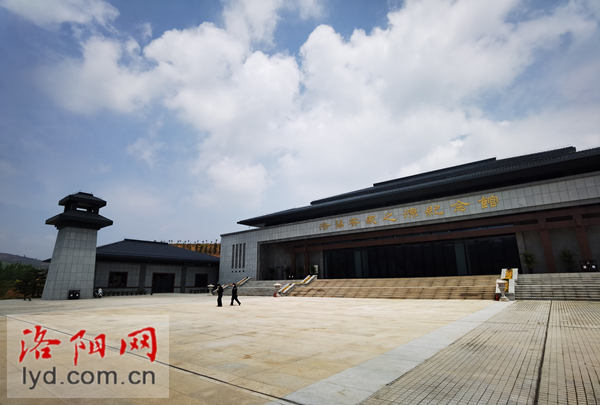
In luoyang in china, modern museums and public interpretation can be particularly helpful for connecting archaeological fragments, religious art, and urban history. They often provide the chronological bridges that individual sites cannot. A museum visit is therefore most useful at the beginning or midpoint of a route, when it can shape what visitors notice afterward.
Common itinerary mistakes and how to avoid them
- Mistake: choosing sites only by fame. Better approach: choose one site for each historical layer that supports your research question. Fame is useful for prioritization, but it is not a historical method.
- Mistake: treating all ancient remains as equally visible. Better approach: prepare for archaeology to require maps, reconstructions, or exhibits. This is especially relevant when researching early capitals.
- Mistake: visiting Buddhist art without learning its context. Better approach: identify the role of patronage, devotion, and landscape before arrival. A purely visual reading is incomplete.
- Mistake: planning distant sites back-to-back. Better approach: group stops by area and reserve transition time. This applies to any visitor using public or hired transport.
- Mistake: overlooking the present city. Better approach: use current transport, museum schedules, and neighborhood geography to make the historical route workable.
This final layer is especially important for travelers building a first itinerary for luoyang in china. It turns historical curiosity into a manageable sequence of visits. It also has limits: modern presentation can simplify difficult debates, so travelers should balance clear visitor information with reliable historical references.
Build a research itinerary around one question per day
A practical itinerary does not need to cover every period in one day. The stronger method is to assign each day a central question. This reduces rushed travel and makes later notes easier to organize.
- Day focused on origins: Ask how early capital landscapes were organized. Prioritize archaeological context, site maps, and museum collections.
- Day focused on Buddhism: Ask how religious patronage became visible in carved space and sculpture. Prioritize close observation over a long list of stops.
- Day focused on exchange: Ask what evidence connects the city to wider cultural networks. Compare at least two kinds of evidence.
- Day focused on continuity: Ask how the modern city presents, preserves, and uses its historical inheritance. Include museums, public spaces, and practical transport observation.
For visitors with only one full day in luoyang in china, select one main layer and one shorter comparison layer. For example, pair a Buddhist heritage site with a museum that supplies archaeological or urban context. For visitors with more time, the four-layer method creates a complete sequence without forcing every stop into a rigid dynasty-by-dynasty narrative.
The value of this approach is clarity. Early capitals explain the political foundation. Northern Wei Buddhism shows religious and artistic transformation. Tang-era exchange reveals wider connections. The modern city makes the past accessible, selective, and visible in the present. Together, these layers give luoyang in china a structure that is easier to research and more rewarding to explore.
For help shaping a focused historical research itinerary, submit your preferred sites and travel priorities for selection advice.