 By
By How China’s Longmen Grottoes Were Carved from a Sheer Cliff Face
The monumental task of creating the thousands of statues at the China Longmen Grottoes raises a fundamental engineering question: how did ancient artisans, working over 1,500 years ago, transform sheer limestone cliffs into one of the world’s most impressive collections of Buddhist art? The answer lies not in a single technique, but in a highly organized, multi-stage process that combined sophisticated planning, immense labor, and masterful craftsmanship.
This was not simply art; it was a massive construction project executed on a vertical surface. Understanding the workflow, from site selection to the final application of paint, reveals a deep understanding of geology, logistics, and subtractive manufacturing. The creation of the China Longmen Grottoes required a systematic approach to remove thousands of tons of rock with precision, leaving behind detailed figures that have endured for centuries.
The Strategic Choice of Material and Location
The placement and longevity of the Longmen caves are a direct result of deliberate geological and political decisions. The artisans and their imperial patrons did not choose this site by chance. The very foundation of the project depended on the unique properties of the cliffs lining the Yi River, just south of the ancient capital of Luoyang.
The primary material is a dense grey limestone. This rock was ideal for the project’s ambitious scale for several key reasons:
- Workability: Limestone is a relatively soft sedimentary rock, making it significantly easier to carve than harder materials like granite. This allowed artisans using iron and steel hand tools to excavate grottoes and shape figures with a high degree of detail.
- Structural Integrity: Despite its softness, the limestone at this location is dense and strong enough to support the creation of massive figures—some over 17 meters tall—without collapsing. It could also support the weight of the overlying cliff face once a niche was hollowed out.
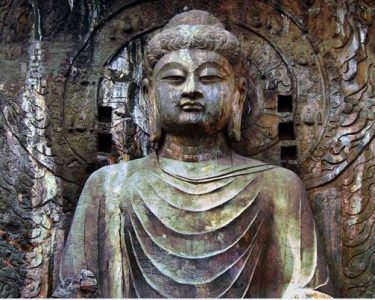
- Fine Detail Retention: The fine grain of the rock enabled sculptors to render delicate features, from the serene expressions on the faces of Buddhas to the intricate folds of their robes and the detailed patterns of halos.
However, this choice of material was not without its challenges. Limestone is susceptible to chemical weathering and erosion from water. The proximity to the Yi River, while useful for transporting materials and people, has also contributed to centuries of moisture damage, which has softened details and, in some cases, led to the collapse of smaller features.
The Artisan’s Workflow: From Cliff Surveying to Final Polish
Creating a sculpture within a cliff face is a subtractive process of immense complexity. Unlike sculpting a freestanding block of stone in a workshop, the work at Longmen was performed in place, often hundreds of feet in the air. This required a highly structured workflow managed by master artisans and executed by teams of skilled laborers. The entire operation was a marvel of project management and vertical construction.
The process can be broken down into a clear, sequential series of steps:
- Patronage and Planning: A project would begin with a commission from a patron, often a member of the imperial family, a high-ranking official, or a monastic community. They would dictate the scale, subject, and location of the grotto. Master artisans would then survey the cliff face to find a stable and suitable section of rock.
- Scaffolding and Access: To work on the vertical cliff, an extensive network of wooden scaffolding was erected. Workers would drill holes into the rock, insert wooden beams as anchors, and build a sturdy platform. This scaffolding was a major engineering feat in itself, providing safe access for dozens of workers and their tools.
- Rough Grotto Excavation: The first physical step was to carve the cave, or niche, out of the rock. Using heavy-duty tools like large hammers, picks, and long iron wedges, laborers would remove massive chunks of limestone. They would work from the top down, clearing the space that would eventually house the sculptures.
- Blocking Out the Main Figures: Once the niche was formed, a master carver would sketch the outlines of the primary statues directly onto the back and side walls. A team of less-skilled apprentices would then use pointed and claw chisels to remove the excess rock around the outlines, creating the rough, blocky forms of the figures. This was the most labor-intensive part of the sculptural process.
- Detailed Carving and Finishing: With the general forms established, the master sculptors and their most skilled assistants would take over. They used a variety of smaller, more precise chisels, gouges, and drills to create the fine details: the gentle curve of a lip, the specific hand gesture (mudra), the flowing lines of drapery, and the intricate patterns of jewelry and halos.
- Surface Polishing: After the carving was complete, the surfaces of the statues and walls were smoothed. This was done by rubbing them with abrasive stones and sand, removing the marks left by the chisels and preparing the surface for the final step.
- Painting and Gilding: Contrary to their modern appearance, the statues were not bare stone. They were coated with a layer of gesso (a white plaster-like substance) and then brightly painted with mineral pigments. Cinnabar provided rich reds, azurite and malachite yielded blues and greens, and carbon was used for black outlines. Some statues may have also been gilded with gold leaf to create a radiant, divine appearance inside the dark caves.
Tools and Techniques of the Ancient Sculptors
The tools used at the China Longmen Grottoes were simple by modern standards but highly effective in the hands of skilled artisans. The entire technological system was based on hand power and expertly crafted iron and steel implements. There was a clear division of labor, with different teams using specialized tools for each phase of the construction.
The toolkit varied significantly depending on the task, ranging from heavy demolition equipment to delicate finishing instruments.
| Tool Category | Specific Tools Used | Primary Function |
|---|---|---|
| Heavy Excavation | Large iron hammers, wedges, long-handled picks, crowbars | Removing large volumes of rock to create the grotto niche and clear the initial workspace. |
| Rough Shaping | Pointed chisels (points), claw chisels, flat chisels | Blocking out the general form of the sculpture from the rock face and defining the main planes. |
| Fine Detailing | Smaller flat chisels, gouges, bow drills, rasps, files | Creating delicate features like eyes, lips, drapery folds, jewelry, and intricate background reliefs. |
| Finishing | Abrasive stones (e.g., sandstone), sand, polishing cloths | Smoothing the surface of the sculpture to remove tool marks and prepare it for painting. |

Deconstructing Misconceptions About the Grottoes’ Construction
The immense scale and age of the Longmen Grottoes have given rise to several popular myths about their creation. Understanding the historical and technical reality provides a deeper appreciation for the achievement. Here are some common misconceptions and the facts that correct them.
- Myth: The statues were carved elsewhere and then placed in the caves.
Reality: Every statue is an *in situ* sculpture, carved directly from the living rock of the cliff face. This is a subtractive process, meaning material was removed to reveal the form within. This is why the statues are integral to the grotto walls and cannot be moved. - Myth: The project was completed quickly by a single dynasty.
Reality: Construction of the grottoes spanned nearly 400 years and multiple dynasties. The work began with the Northern Wei Dynasty (starting in 493 A.D.) and saw its most prolific period during the Tang Dynasty. This extended timeline is visible in the distinct artistic styles of the sculptures, which evolved over centuries. - Myth: The statues have always been a uniform gray stone color.
Reality: The grottoes were originally a vibrant, colorful spectacle. Almost all statues and reliefs were covered in gesso and painted with rich mineral pigments. Traces of these paints can still be found in protected crevices on some figures, hinting at their original, dazzling appearance. - Myth: The work was done by a few lone, divinely inspired artists.
Reality: The creation of the China Longmen Grottoes was a massive, state-sponsored industrial undertaking. It involved a highly organized workforce of engineers, quarrymen, laborers, scaffold-builders, and tiered teams of artisans, from apprentices roughing out forms to master sculptors carving the final details.
By understanding the intricate processes and immense logistical challenges, we can better appreciate the grottoes not just as a repository of sacred art, but as one of history’s great feats of engineering and project management.
For projects requiring deep material understanding and precision execution, our technical team is available to provide expert insights. Contact us to discuss your requirements.