By
By Longmen Caves AP Art History: A Complete Guide
Longmen Caves is a monumental complex of Buddhist cave temples carved into limestone cliffs along the Yi River in China’s Henan province. For AP Art History students, the site represents a critical case study in the intersection of imperial patronage, religious devotion, and monumental sculpture. Understanding this site is not just about memorizing dates; it is about grasping how art served as a tool for political legitimacy and spiritual practice in medieval China.
In my years of analyzing Asian art for technical and educational publications, I have found that students often struggle to connect the visual density of sites like Longmen with the broader historical narratives they need for the exam. The key is to break the site down into manageable components: context, form, function, and content. This guide will do exactly that, providing a structured approach to mastering the essential points for your AP Art History curriculum.
Historical Context and Patronage
The Longmen Caves, or Longmen Grottoes, were developed over several centuries, with the most intense period of construction occurring from the late Northern Wei dynasty (386–534 CE) through the Tang dynasty (618–907 CE). The site contains tens of thousands of statues of the Buddha and his disciples, ranging from tiny votive figures to colossal monuments. The scale of this undertaking was not accidental; it was a deliberate statement of power.
The initial impetus for carving at Longmen came from the Northern Wei court. After the capital was moved to Luoyang, the imperial family sought to create a new sacred space that could rival the earlier cave sites at Yungang. This act of creation was deeply tied to the concept of Buddhism as a state religion. By commissioning massive carvings, emperors and empresses positioned themselves as patrons of the faith, thereby reinforcing their own authority. The act of patronage was a form of political theater, visible to all who traveled the river.
The shift from the Northern Wei to the Tang dynasty brought a change in artistic style. Northern Wei figures are often characterized by their elongated bodies, linear drapery, and an ethereal, otherworldly quality. In contrast, Tang dynasty sculptures exhibit a more naturalistic, robust, and fleshy physicality. This stylistic evolution reflects broader changes in Chinese society, from a more austere, nomadic-influenced court to a cosmopolitan, confident empire. For the AP exam, being able to distinguish between these two styles is a high-value skill.
Form and Function of the Longmen Caves
The form of the Longmen Caves is dictated by their function as spaces for worship and meditation. The caves are not natural caverns but were laboriously carved into the hard limestone. This process required immense resources, including skilled artisans, engineers, and vast sums of money. The resulting spaces served multiple purposes: they were temples, pilgrimage destinations, and eternal monuments to their donors.
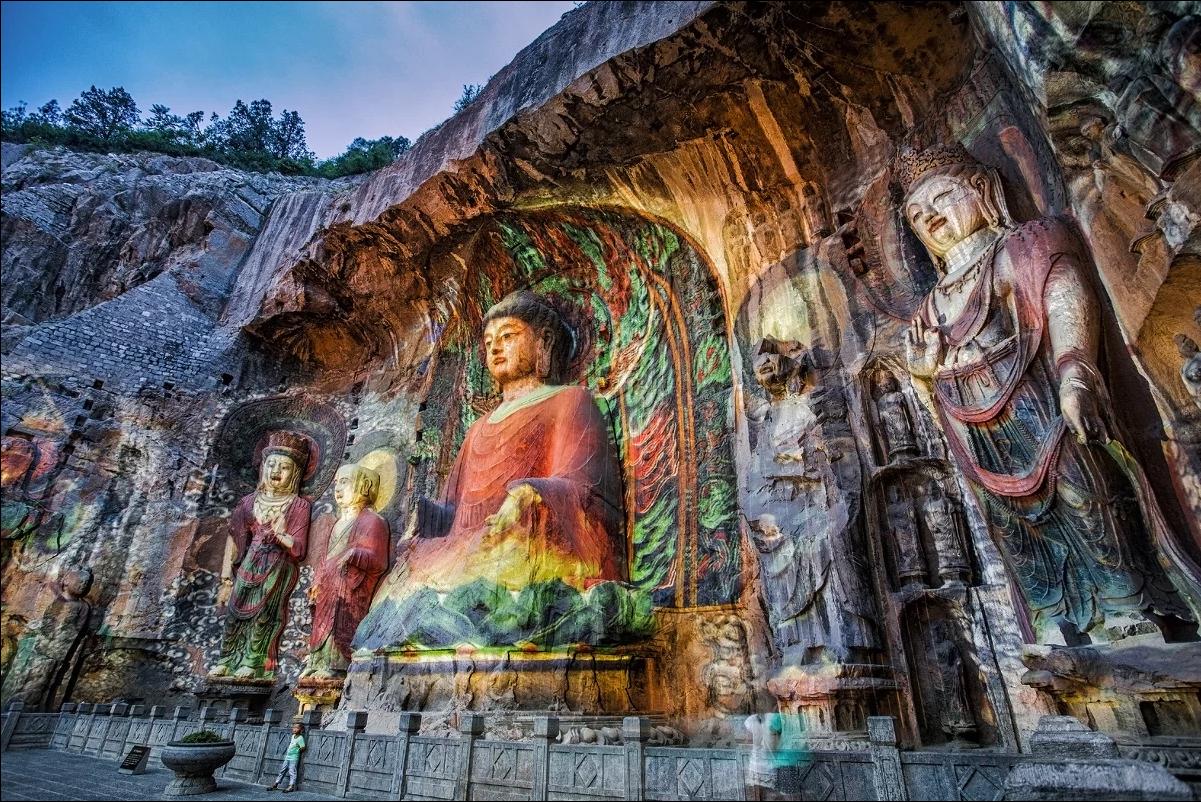
One of the most important caves is the Fengxian Temple, commissioned by Emperor Gaozong and completed under the auspices of Empress Wu Zetian. This cave houses the iconic Vairocana Buddha, a colossal seated figure that dominates the space. The sheer scale of the Vairocana Buddha—its height, the careful modeling of its face, and the sense of serene power it projects—epitomizes the Tang dynasty’s artistic achievement. The figure is not merely a representation of a deity; it is an embodiment of the cosmic Buddha, whose presence was meant to inspire awe and devotion.
- Scale: The monumental size of figures like the Vairocana Buddha was designed to humble the viewer and convey the immensity of the divine.
- Architectural Integration: Caves were often designed with an antechamber and a main hall, mirroring the layout of wooden temples of the time.
- Surface Treatment: Originally, many of the sculptures were brightly painted and gilded, creating a dazzling visual effect that is largely lost today.
Key Works: The Vairocana Buddha and Fengxian Temple
When the AP Art History exam asks about Longmen, it is most likely asking about the Fengxian Temple and its central figure, the Vairocana Buddha. This work is a cornerstone of the curriculum. The Vairocana Buddha represents the primordial, cosmic Buddha from which all other Buddhas emanate. In the context of Tang dynasty politics, the choice to depict Vairocana was highly significant. Some scholars argue that Empress Wu Zetian, who was a fervent Buddhist and sought to legitimize her rule, may have used the imagery of Vairocana to associate herself with the divine.
The sculpture itself is a masterclass in Tang dynasty aesthetics. The Buddha is depicted with a full, rounded face, a gentle smile, and a body that conveys both mass and grace. The drapery falls in smooth, rhythmic folds, suggesting the softness of the fabric. The figure is flanked by attendants, including disciples, bodhisattvas, and guardian figures. Each figure is carved with a high degree of individuality, from the serene expressions of the bodhisattvas to the fierce, muscular poses of the guardians. This ensemble creates a complex theological statement about the structure of the Buddhist cosmos.

The iconography is precise. The Vairocana Buddha typically performs the dharmachakra mudra, the gesture of teaching, which signifies the turning of the wheel of the law. This gesture reinforces the Buddha’s role as a teacher of the path to enlightenment. The central placement of the figure, combined with its size and gesture, leaves no doubt about its importance. For students, memorizing these visual details—the mudra, the facial features, the arrangement of attendants—is essential for a successful visual analysis essay.
How to Analyze Longmen Caves for the AP Exam
A common pitfall for students is to simply describe what they see without connecting it to a deeper meaning. The AP Art History exam rewards analysis, not just description. To earn the highest scores, you must be able to articulate how the form of the artwork relates to its function and content. Here is a framework I recommend to my readers for approaching a question on Longmen.
- Identify the Work: Start by clearly identifying the artwork. For example, “This is the Vairocana Buddha from the Fengxian Temple at Longmen Caves, dating from the Tang dynasty.”
- Contextualize: Place the work in its historical context. Mention the imperial patronage, specifically the role of Emperor Gaozong and Empress Wu Zetian. Explain how the work reflects the political and religious climate of the Tang dynasty.
- Analyze Form: Describe the visual characteristics. Discuss the scale, the naturalistic modeling of the body, the stylized drapery, and the use of the dharmachakra mudra. Note the contrast between the serene central figure and the dynamic, expressive attendants.
- Explain Function: Explain the purpose of the cave temple. It was a site for worship, a demonstration of imperial power, and a means of accumulating spiritual merit for the patrons.
- Connect Form and Function: This is the most important step. Explain how the formal qualities serve the function. For example, “The monumental scale of the Vairocana Buddha was intended to overwhelm the viewer, creating a sense of awe and reinforcing the power of both the Buddha and the imperial patrons who commissioned the work.”
Understanding the materials and techniques is also crucial. The carvers worked directly into the limestone cliff face, a process that required immense planning and skill. The sculptures were not carved elsewhere and moved into place; they were an integral part of the mountain itself. This physical connection to the landscape is a key feature of Chinese Buddhist cave temples and speaks to the desire to create a permanent, sacred space.
Longmen Caves in the Broader Context of Buddhist Art
Longmen does not exist in a vacuum. It is part of a long tradition of Buddhist cave temple construction that stretches from India through Central Asia and into China. Comparing Longmen to earlier sites like the Ajanta Caves in India or the Yungang Grottoes in China can be a powerful way to demonstrate your understanding of artistic exchange and adaptation.
While the Indian caves at Ajanta are primarily painted and feature more narrative scenes from the Buddha’s life, the Chinese caves at Longmen are dominated by monumental sculpture. This shift reflects both cultural preferences and the evolution of Buddhist practice. The emphasis on the colossal image of the Buddha at Longmen suggests a focus on the Buddha as a cosmic, eternal principle. The artistic style also became increasingly sinicized, moving away from the more Indian-influenced styles of earlier periods. The elongated, linear figures of the Northern Wei period gradually gave way to the more rounded, naturalistic forms of the Tang, reflecting a distinctly Chinese aesthetic sensibility.
For the AP Art History exam, being able to make these cross-cultural comparisons is a hallmark of a sophisticated answer. It shows that you understand not just the individual work, but also its place within a larger global narrative. You can discuss how the Silk Road facilitated the transmission of Buddhist ideas and artistic styles, and how local rulers adapted these foreign ideas to suit their own political and cultural needs.
The Longmen Caves stand as a testament to the power of art to shape belief and legitimize authority. By systematically studying its context, form, function, and content, you can master this essential work and be well-prepared for any question the AP exam might pose. The site is more than a collection of carvings; it is a complex text that, once decoded, reveals the ambitions and faith of an empire.