
Blog
Luoyang Grottoes Longmen vs Yungang: Key Differences

Luoyang Grottoes Longmen vs Yungang: Key Differences
luoyang grottoes longmen and the Yungang Grottoes rank among China’s most significant Buddhist cave complexes. Both preserve sculpture, inscriptions, and architectural features from early imperial China. Yet their histories, visual languages, and visitor experiences are strikingly different.
Longmen rises beside the Yi River near Luoyang in Henan Province. Yungang sits outside Datong in Shanxi Province, several hundred kilometers to the north. Their settings, stone types, political origins, artistic influences, and conservation concerns all differ. Those distinctions matter for travelers, cultural researchers, and heritage-focused businesses planning an itinerary or comparing China’s leading Buddhist monuments.
This guide looks at the two sites side by side, from their founding periods and artistic styles to the practical details visitors encounter today.
1. Location and Historical Setting
Longmen Grottoes near Luoyang
The Longmen Grottoes are carved into cliffs on both banks of the Yi River, about 12 kilometers south of central Luoyang. Luoyang was a major capital under several Chinese dynasties. Its political importance drew imperial patrons, monks, officials, and wealthy families to the site.
Work began in 493 during the Northern Wei dynasty, after Emperor Xiaowen moved the capital from Pingcheng, present-day Datong, to Luoyang. Carving continued for roughly 1,400 years, with the busiest periods under the Northern Wei and Tang dynasties. The Tang era, particularly during the reign of Empress Wu Zetian, produced some of Longmen’s best-known sculptures.
Today, the complex includes thousands of caves, niches, statues, and inscriptions. Official descriptions often cite more than 2,300 niches and around 100,000 Buddhist images, though the carvings vary greatly in size and condition.
Yungang Grottoes near Datong
The Yungang Grottoes lie about 16 kilometers west of Datong, once the Northern Wei capital. The caves were begun in the 5th century under imperial patronage, with most major work carried out between approximately 460 and 525.
The site is closely associated with the Tuoba rulers of the Northern Wei, a dynasty founded by the Xianbei people. When the capital moved from Pingcheng to Luoyang in 494, state-sponsored cave construction shifted south. That transition makes Yungang a natural counterpart to Longmen: Yungang reflects the Northern Wei court in its northern capital, while Longmen records the dynasty’s later years in Luoyang and the artistic changes that followed.
Yungang contains 252 numbered caves and more than 51,000 surviving statues. Several caves retain richly decorated interiors and traces of paint, although much of the original pigment has faded or vanished over time.
2. Architectural Scale and Stone Materials
The physical character of each site is obvious from the first walk through it. Longmen’s caves and niches stretch along steep limestone cliffs beside the river. Visitors move between the West Hill, East Hill, Xiangshan Temple area, and nearby historic structures. The Yi River opens up broad views and gives the complex a long, linear rhythm.
Yungang, by contrast, is cut into a continuous sandstone escarpment. Its principal caves are grouped more closely together, and several feature substantial facades or monumental interiors. Sandstone made it possible to create deep chambers and huge figures, but it is also vulnerable to erosion, water infiltration, salt crystallization, and changes in temperature.
Longmen’s limestone is harder and can preserve fine surface carving with remarkable precision. Still, exposure has damaged many faces, hands, inscriptions, and projecting details. Its riverside setting brings another set of challenges, including humidity, runoff, air pollution, and pressure from heavy visitor traffic.
3. Artistic Style: From Northern Wei Abstraction to Tang Realism
Yungang’s international artistic vocabulary
Yungang is particularly important for understanding the early development of Buddhist sculpture in China. Its Northern Wei images combine local traditions with influences carried across Central Asia, Gandhara, India, Persia, and the Silk Road.
In several early caves, Buddhas have broad shoulders, elongated bodies, patterned robes, and formal expressions. Some garments fall in crisp, regular folds, while other sculptures use rounder faces and fuller bodies. Rather than presenting one fixed style, Yungang records changing artistic contacts across Asia.
Large seated Buddhas dominate several of the best-known caves. Cave 20, for instance, contains a monumental seated Buddha whose exposed upper body and strong facial features have become iconic images of Yungang. Cave 6 is renowned for its elaborate interior decoration, painted surfaces, carved pillars, and narrative scenes.
Longmen’s refined Chinese court style
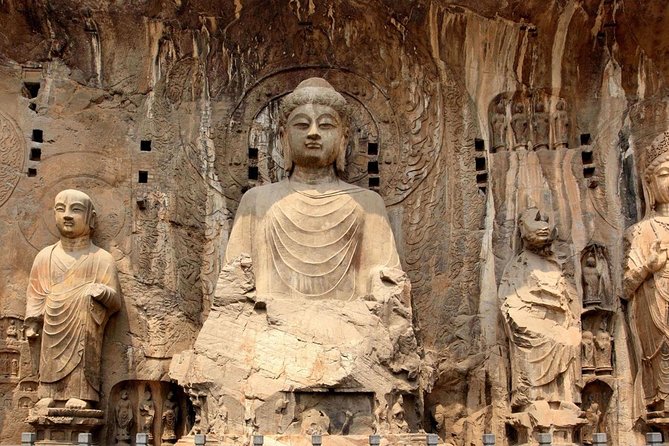
Longmen reveals a later shift toward elegant proportions, naturalistic faces, flowing robes, and highly finished details. Northern Wei sculpture remains central to the site, especially in Guyang Cave and other early sections, but Tang-period works give Longmen its most recognizable visual identity.
The most famous image is the Vairocana Buddha at Fengxian Temple. Carved between 672 and 675 during the Tang dynasty, the figure stands about 17 meters high. Its serene face, full cheeks, restrained smile, and balanced posture project imperial confidence and mature court aesthetics. The sculpture is often linked with Empress Wu Zetian, who supported Buddhist projects and used religious patronage to reinforce political legitimacy.
Longmen also preserves smaller niches commissioned by officials, aristocrats, monks, and ordinary devotees. Together, they offer a broader social record than the grand imperial caves alone. Names, dates, prayers, and donor statements cut into the stone make the site especially valuable to historians of language, religion, and administration.
4. Religious Influences and Iconography
Both complexes are Buddhist, but neither is simply a collection of isolated religious images. Their caves reflect state power, family devotion, funerary concerns, merit-making, pilgrimage, and changing interpretations of Buddhist teaching.
At Yungang, the early images show how the Northern Wei court adapted Buddhism to its own political world. Massive Buddha figures could express protection, authority, and the emperor’s sacred status. The mix of foreign artistic features and Chinese ritual settings also shows how Buddhism took root in northern Chinese society.
Longmen spans a broader period. Visitors encounter imagery connected with Mahayana traditions, Pure Land devotion, Maitreya beliefs, Avalokitesvara, and Vairocana worship. Inscriptions often identify donors and explain why a niche was commissioned. Some were created for deceased relatives, while others sought healing, protection, political favor, or spiritual merit.
For researchers studying Chinese Buddhist caves, Longmen is especially useful for tracing links between religious imagery and social history. Yungang, in contrast, is an outstanding place to examine the early imperial phase of Buddhist sculpture and the movement of artistic ideas across Asia.
5. Inscriptions and Historical Research Value
Longmen is one of China’s richest sites for stone inscriptions. The famous “Twenty Calligraphies of Longmen” are frequently cited in studies of Chinese calligraphy because they preserve major examples of Northern Wei regular script. The characters are sturdy, angular, and carefully balanced. Calligraphy students and specialists continue to study them for both technique and historical importance.
The large number of donor inscriptions also turns Longmen into a social archive in stone. During a single visit, you may find references to officials, military personnel, monks, family groups, women patrons, and local communities. These records help scholars understand who funded religious art and how Buddhist devotion operated beyond the imperial court.
Yungang preserves inscriptions as well, but its greatest research value lies more in its sculptural programs, cave planning, materials, and early religious imagery. Its carved interiors reveal how a major state-sponsored Buddhist complex was organized during the Northern Wei capital period.
6. Preservation Conditions and Conservation Challenges
Longmen’s conservation issues
Longmen’s exposed limestone carvings are affected by rain, wind, humidity, and seasonal temperature shifts. Moving water can weaken stone surfaces and speed up the loss of fine details. Air quality and development in the river valley have also remained part of long-term conservation planning.
Some sculptures suffered deliberate damage, including the removal of heads and hands during political unrest and the international antiquities trade. Others have worn away gradually rather than being destroyed in a single event. Conservation teams must continually balance public access with the need to protect fragile carved surfaces.
Yungang’s conservation issues
Yungang’s sandstone presents a different set of technical problems. Water can enter through cracks and porous sections, while salts and freeze-thaw cycles cause flaking. Northern Shanxi’s dry climate does not prevent moisture damage; snow, rain, groundwater, and condensation can still affect the caves.
Smoke, dust, earlier industrial activity, and changing environmental conditions have also shaped the site’s condition. Conservation efforts have included improved drainage, structural monitoring, environmental controls, and careful visitor management. In some caves, protective measures help preserve remaining pigments and limit contact with vulnerable surfaces.
7. Visitor Experience: Which Site Feels Different?
A visit to Longmen usually feels open and scenic. The Yi River divides the main cliff areas, and the walking route combines caves, open-air statues, bridges, river views, and nearby historic buildings. Allow three to five hours for a fuller visit, especially if you plan to explore both the West Hill and East Hill rather than heading straight to Fengxian Temple.
The Vairocana Buddha is the obvious visual highlight, but it should not be the only stop. Guyang Cave, Lotus Cave, Xiangshan Temple, and the smaller donor niches provide a more complete sense of the complex. Early morning and late afternoon often bring softer light and more comfortable temperatures, particularly in summer.
Yungang feels more concentrated. Its principal caves line the cliff, and the large interiors create a powerful sense of enclosure. A typical visit takes two to four hours. Cave 5, Cave 6, Cave 16, Cave 19, and Cave 20 are among the most discussed areas, although access and lighting arrangements may change.
Datong’s cooler northern climate can make outdoor walking pleasant in spring and autumn. Winter offers dramatic scenery but brings very low temperatures. Visitors interested in color and interior decoration should look closely at caves where traces of paint remain. A guide with art-historical expertise can make the differences between Northern Wei and later styles far easier to recognize.
8. How Do Luoyang Grottoes Longmen Compare with Yungang Grottoes?
The shortest answer is this: Yungang is earlier, more closely connected to the Northern Wei capital at Datong, and more visibly shaped by Central Asian and Silk Road influences. Longmen’s most famous phase came later. It is more deeply tied to the Tang imperial world and richer in inscriptions documenting donors and evolving Chinese artistic traditions.
| Comparison point | Longmen Grottoes | Yungang Grottoes |
|---|---|---|
| Location | Luoyang, Henan, beside the Yi River | Datong, Shanxi, along a sandstone cliff |
| Main construction period | 493 onward; major Tang activity in the 7th–8th centuries | Approximately 460–525, mainly Northern Wei |
| Stone type | Limestone | Sandstone |
| Signature style | Refined Northern Wei and Tang court sculpture | Early imperial sculpture with Central Asian and Indian influences |
| Research strength | Inscriptions, donor history, Tang art, calligraphy | Early Buddhist art, cave planning, Silk Road connections |
| Visitor setting | Broad riverside landscape with two main cliff areas | Compact sandstone complex with dramatic enclosed caves |
9. Which Chinese Grotto Site Is Better for History and Art?
There is no single winner. The better choice depends on the period and type of art that interest you most.
Choose Longmen if you are interested in Tang dynasty culture, imperial patronage, Chinese calligraphy, donor inscriptions, social history, or the evolution of Buddhist sculpture toward more naturalistic and distinctly Chinese forms. Its long chronology also makes it useful for understanding how religious art changed over the centuries.
Choose Yungang if you want to focus on the Northern Wei, early Buddhist sculpture, Xianbei political history, or cultural exchange along the Silk Road. Its interiors and monumental figures are especially compelling for visitors interested in the beginnings of large-scale Buddhist cave art in China.
For a first heritage trip, seeing both is ideal. A route linking Datong, Luoyang, and other historic cities can show how Buddhism, imperial capitals, travel networks, and artistic conventions developed across northern China. These sites are not duplicates; they are complementary chapters in the history of Chinese Buddhist art.
10. Why These Sites Matter to Heritage-Focused Businesses
Travel companies, museum educators, cultural institutions, and destination planners can use the Longmen–Yungang comparison to create more meaningful programs. A basic sightseeing itinerary might mention only the largest Buddha at each site. A stronger program explains why the statues look different, who paid for them, how the caves were made, and what conservation work they require today.
For example, a two-site educational tour could begin with Northern Wei sculpture at Yungang before continuing to Northern Wei inscriptions and Tang art at Longmen. A photography program might compare sandstone interiors with open limestone cliff carvings. A museum or heritage brand could also use the two complexes to introduce religious exchange, ancient capital cities, calligraphy, and preventive conservation.
Clear interpretation matters. Visitors tend to remember specific details: the 17-meter Vairocana at Fengxian Temple, the monumental seated Buddha in Yungang Cave 20, the angular Northern Wei script at Longmen, and the surviving pigment inside Yungang’s chambers.
FAQ
How do Luoyang Grottoes Longmen compare with Yungang Grottoes?
Longmen is near Luoyang and developed from the Northern Wei period through the Tang and later dynasties. Yungang is near Datong and was created mainly between the 5th and early 6th centuries under Northern Wei patronage. Longmen is known for Tang sculpture, inscriptions, and the Vairocana Buddha, while Yungang is noted for early imperial Buddhist art and strong Central Asian influences.
Which Chinese grotto site is better for history and art?
Longmen is generally better for visitors interested in Tang history, Chinese calligraphy, donor inscriptions, and the development of mature Chinese Buddhist sculpture. Yungang is better for early Buddhist art, Northern Wei history, and connections between Chinese and Central Asian traditions. Researchers focused on a specific period may prefer one site, while travelers with enough time should visit both.
Are Longmen Grottoes and Yungang Grottoes UNESCO grotto sites?
Yes. The Longmen Grottoes were inscribed on the UNESCO World Heritage List in 2000, and the Yungang Grottoes were inscribed in 2001. Both are recognized for outstanding Buddhist cave art and their importance in the history of Asian sculpture.
How much time should visitors allow at each site?
Plan roughly three to five hours for Longmen if you want to explore its main areas without rushing. Two to four hours is usually enough for Yungang, depending on cave access, crowd levels, and how closely you want to examine inscriptions and carved details. Researchers and photographers may need a full day at either site.
Can Longmen and Yungang be visited on the same trip?
Yes. Datong and Luoyang are separate destinations, but they can be combined in a broader northern China heritage itinerary. Allow for travel time between them, and consider adding historic sites in Beijing, Taiyuan, Zhengzhou, or Xi’an according to your schedule. Spring and autumn are often the most comfortable seasons for walking at both grotto complexes.
Conclusion
Longmen and Yungang represent distinct moments in the development of Buddhist art in China. Yungang preserves the bold, international character of Northern Wei sculpture. Longmen demonstrates the refinement of later Chinese court art, the influence of Tang patronage, and the documentary value of thousands of inscriptions.
For travel planners, cultural researchers, and heritage-focused organizations, comparing the two sites provides a practical framework for richer interpretation and more focused visitor programs. Contact our team to discuss suitable heritage-tourism products and services for your next cultural project.
About LyWOW Tours
LyWOW is a locally based travel agency in Luoyang, specializing in private tours for international travelers across Luoyang, Shaolin, Xi’an and Central China. English-speaking guides, flexible itineraries and door-to-door service.
Learn more about us or browse all our tours.
