
 By
By How to Interpret Donor Inscriptions at the Luoyang Longmen Grottoes
For visitors exploring the remarkable Luoyang Longmen Grottoes, the sheer scale and beauty of the Buddhist sculptures are often the primary focus. Yet, a deeper layer of historical and cultural insight awaits those who venture beyond the grand statues: the intricate network of inscriptions carved into the rock face. These often-overlooked texts offer a direct line to the individuals who commissioned these masterpieces, revealing not just their names and titles, but also their motivations and the societal fabric of ancient China. Understanding how to read these Longmen Grottoes inscriptions transforms a visual tour into an archaeological investigation, allowing you to connect personally with the patrons and artisans of over a millennium ago.
Decoding the Purpose of Longmen Grottoes Inscriptions
The inscriptions at the Luoyang Longmen Grottoes are far more than mere labels. They are deliberate, permanent records, etched into the stone for spiritual and social reasons. Primarily, these texts are dedicatory, meaning they commemorate the commissioning of a specific Buddha, bodhisattva, or niche. They serve as tangible evidence of an act of merit-making, a central tenet of Buddhist practice where virtuous deeds accrue positive karma for the donor, their family, or even the emperor.
Beyond spiritual intentions, these Longmen Grottoes inscriptions also functioned as important social markers. They showcased the donor’s piety, wealth, and influence, often listing their official titles, family members, and their specific wishes for the dedication. These records provide invaluable primary source material for historians, detailing names, dates, and sometimes even specific events that contextualize the carvings.
What do Longmen Grottoes inscriptions say? While specific phrasing varies, common elements include:
- Donor Identification: Names, official titles, and sometimes ancestral lineage of the individual or group funding the carving.
- Dedication Purpose: Explicit statements about the merit-making intention, often for the well-being of the emperor, deceased relatives, living family members, or all sentient beings.
- Date of Commission: Often recorded according to the reigning emperor’s regnal year, providing a precise historical timestamp.
- Vows and Prayers: Short invocations or prayers for peace, prosperity, or enlightenment.
- Scribe/Artisan Information: Less common, but some inscriptions may include the name of the calligrapher or sculptor.
These texts offer a unique window into the personal lives and religious beliefs of the Northern Wei and Tang dynasties, making them essential for a comprehensive understanding of the site.
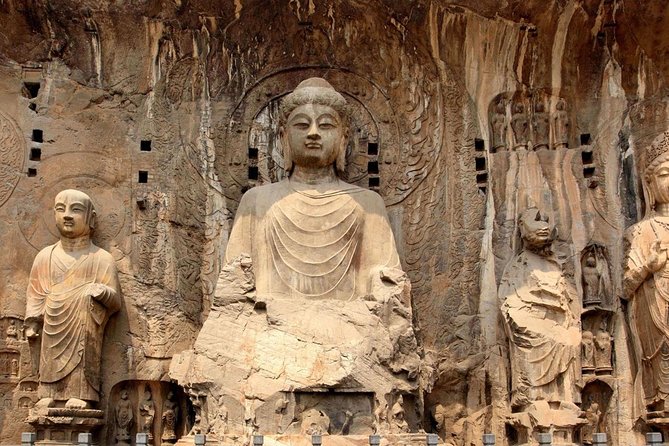
How Reading Dedicatory Names, Dates, and Titles Reveals Donors
Identifying who funded the Longmen Grottoes carvings involves a systematic approach to reading the dedicatory inscriptions. This process allows visitors to move beyond general appreciation and engage with the specific individuals who commissioned these works. Many inscriptions, though weathered, still retain enough detail to provide significant information. Here is a step-by-step procedure to help you uncover the donors behind individual cave commissions:
Step-by-Step Procedure for Identifying Donors
- Locating Inscriptions:
- How: Look closely at the base of statues, around the edges of niches, and on the surrounding cave walls. Inscriptions are often carved vertically in columns.
- Key Checkpoint: Many are at eye level or slightly below, often in recessed areas that offered some protection from erosion.
- Common Failure Reason: Overlooking smaller, less prominent inscriptions, or assuming all text is illegible due to weathering. Bring a small flashlight to enhance visibility in shaded areas.
- Identifying Key Text Elements:
- How: Focus on patterns. Chinese inscriptions generally read from right to left, top to bottom. Look for common characters associated with names (e.g., family names like Li, Wang), official titles (e.g., 太尉 taiwei – Grand Commandant), and dates (e.g., 年 nian – year, 月 yue – month).
- Key Checkpoint: Recognize that while full comprehension requires linguistic expertise, identifying these key categories of information is achievable.
- Common Failure Reason: Getting overwhelmed by the unfamiliar script. Focus on recognizing structural elements rather than individual character meanings initially.
- Understanding Dynastic Context:
- How: Note the artistic style of the nearby sculpture. Northern Wei carvings (late 5th to early 6th century) often feature elongated figures with “smile of contentment,” while Tang dynasty (7th to 9th century) figures are generally more robust and naturalistic. This helps narrow down the period of the inscription.
- Key Checkpoint: Early inscriptions tend to be simpler, while later ones can be more elaborate, reflecting changing societal structures and literacy rates.
- Common Failure Reason: Assuming all inscriptions are contemporary with the most prominent statues. Smaller niches were often added later.
- Interpreting the Dedication:
- How: Once names and dates are tentatively identified, consider the context. Donor inscriptions nearly always state the purpose of the carving. Common phrases include “為亡父母” (wei wang fumu – for deceased parents) or “為皇帝” (wei huangdi – for the emperor).
- Key Checkpoint: These phrases reveal the primary motivation: filial piety, political loyalty, or general merit for all beings.
- Common Failure Reason: Disconnecting the inscription from the sculpture it accompanies. The text and image are intrinsically linked.
Common Mistakes When Interpreting Longmen Donor Records
- Underestimating Weathering: Many inscriptions are severely eroded. Not every text will be fully legible. Patience and keen observation are crucial.
- Lack of Context: Without understanding the historical periods (Northern Wei, Tang) and their respective cultural norms, the significance of titles or specific dedications can be lost.
- Expecting Uniformity: Inscriptions vary greatly in length, style, and content. Some are short and simple; others are lengthy prose.
- Ignoring Specialist Resources: While on-site observation is valuable, scholarly publications and detailed guidebooks often contain transcriptions and translations of key inscriptions, providing invaluable assistance.
By diligently following these steps, you can begin to identify donor names, understand their motivations, and appreciate the rich patronage history of the Longmen Grottoes. This active engagement transforms passive viewing into an interactive historical exploration.
Distinguishing Northern Wei and Tang Buddhist Patrons Through Inscriptions
The Luoyang Longmen Grottoes bear witness to two distinct peaks of patronage: the Northern Wei dynasty (late 5th to early 6th century) and the Tang dynasty (7th to 9th century). The Longmen Grottoes inscriptions from these periods reflect different societal structures, religious emphases, and donor profiles. Recognizing these distinctions enhances our understanding of the site’s evolution.
Comparison of Northern Wei and Tang Dynasty Inscription Characteristics
| Characteristic | Northern Wei Dynasty (c. 493-534 CE) | Tang Dynasty (c. 618-907 CE) |
|---|---|---|
| Dominant Patronage Type | Primarily imperial family, aristocratic clans, high-ranking officials, and Buddhist monks/nuns. Emphasis on collective family merit. | Broader base, including imperial family, wealthy merchants, local gentry, and military officials. Greater emphasis on individual merit and specific personal prayers. |
| Inscription Style | Often characterized by a vigorous, angular calligraphic style known as “Wei Bei” (Wei stele script). Texts can be quite formal and concise. | Generally smoother, more rounded calligraphic styles (e.g., Regular Script – 楷書 kaishu). Texts tend to be longer, more descriptive, and sometimes poetic. |
| Common Dedicatory Phrases | “為皇帝陛下” (for His Majesty the Emperor), “為亡父/母” (for deceased father/mother), “願一切眾生” (may all sentient beings…). Strong focus on filial piety and imperial legitimacy. | “願一切眾生” (may all sentient beings…), “為七世父母” (for parents of seven generations), “願國泰民安” (may the nation be prosperous and the people peaceful). Broader scope of blessings. |
| Depiction of Donors | Donor figures, if depicted, are often elongated, slender, and stylized, dressed in distinctive Northern Wei gowns. | Donor figures are more naturalistic, robust, and sometimes show specific clothing details reflecting Tang fashion. |
| Social Status Revealed | Inscriptions frequently list multiple generations of a family, emphasizing lineage and collective identity. | While family is still important, individual achievements and official positions are often highlighted, reflecting a more complex bureaucratic society. |
These differences are not absolute but represent general trends. By paying attention to these details, you can more accurately identify Longmen donor records and understand the motivations of these Northern Wei inscriptions and Tang Buddhist patrons.
Practical Tips for Interpreting Longmen Donor Records On-Site
Engaging with the luoyang longmen grottoes inscriptions requires a prepared mindset and a few practical considerations. While you might not become a sinologist overnight, you can significantly enhance your observational skills and appreciation for these historical documents.
Visitor’s Checklist for Inscription Exploration
- Quality Guidebook: Invest in a guidebook that specifically discusses the inscriptions, ideally with maps indicating where significant texts are located or even providing transcriptions/translations.
- Magnifying Lens: A small, portable magnifying glass can be invaluable for discerning faint or weathered characters, especially in areas with poor lighting.
- Notepad and Pencil: Sketching the general layout of an inscription or noting down patterns you observe can aid memory and later research.
- Camera with Zoom: Take close-up photos of inscriptions you find intriguing. These can be examined later with greater detail and compared to scholarly resources.
- Patience and Time: Do not rush. Dedicate specific time in each cave or section to actively seek out and observe inscriptions. They are not always immediately obvious.
- Respect for the Site: While observing, avoid touching the rock carvings or inscriptions. The cumulative effect of physical contact contributes to their erosion.
It is important to acknowledge the limits of on-site interpretation. Not every inscription will be perfectly preserved, nor will every visitor possess the linguistic skills to fully translate ancient Chinese. However, the process of active observation itself deepens your connection to the site. Recognizing the general form of a date, a name, or a dedicatory phrase can be profoundly rewarding, even without a full translation. The act of seeking out these hidden narratives transforms a visit into a personal discovery of the rich history encapsulated within the Luoyang Longmen Grottoes.
For more detailed information or to discuss specific historical contexts related to these remarkable sites, please reach out to our technical team.
