
 By
By Which Longmen Grottoes Caves Reveal Imperial Patronage?
For any researcher or serious visitor, understanding the patronage behind a work of art is crucial. At a site as vast as the Longmen Grottoes, distinguishing between a cave sponsored by an emperor’s decree and one funded by a local official or devout family can be challenging. The key is not just in the grand scale, but in a combination of location, artistic program, and the specific language used in donative inscriptions. Identifying these clues reveals the political and religious motivations that shaped this monumental landscape.
The most significant periods of imperial sponsorship occurred during the Northern Wei and Tang dynasties, with powerful rulers using Buddhist art to legitimize their authority and project immense power. These imperial commissions stand apart from the thousands of smaller niches funded by other social strata, each telling a different story of faith and ambition.
The Signature of an Emperor: Key Imperial Caves and Their Features
While many caves at the Longmen Grottoes are impressive, a few stand out as undeniable examples of imperial projects. These caves were not merely acts of devotion; they were political statements carved in stone, intended to be seen and understood as direct extensions of the throne’s power. They share several defining characteristics that set them apart from private commissions.
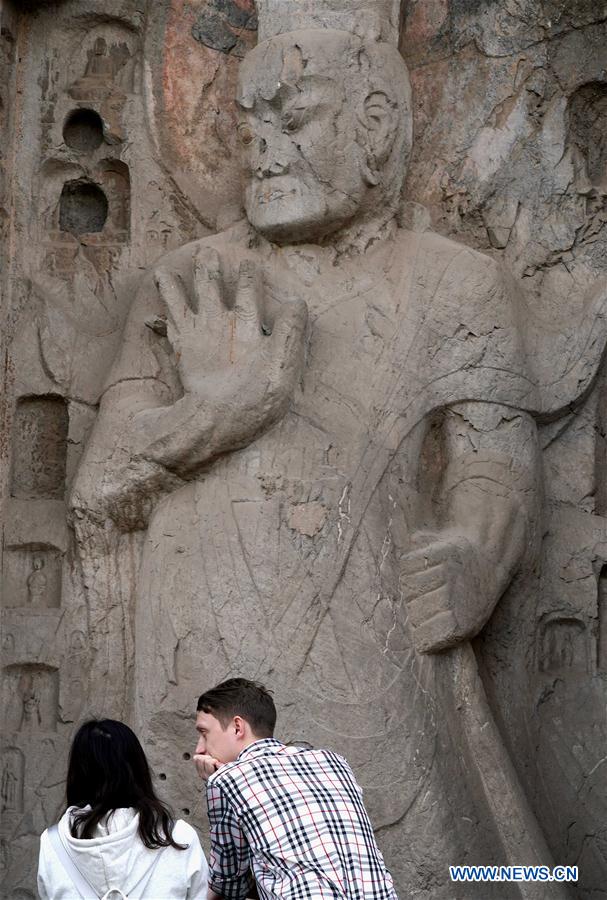
The most famous example is the Fengxian Temple (Ancestor Worshipping Temple), commissioned under the Tang dynasty. Dominated by the colossal Vairocana Buddha, its face is widely believed to be modeled on Empress Wu Zetian, the project’s primary patron. This direct association between the divine and the ruler is a hallmark of imperial art. The project’s immense scale and the sophisticated, unified sculptural style required resources only the state could command.
Similarly, the Three Binyang Caves (North, Middle, and South) are quintessential Northern Wei imperial works. Emperor Xuanwu initiated their construction in honor of his parents. Although only the Middle Binyang Cave was completed during the Northern Wei, its formal procession scenes (now in museums) and grand, symmetrical layout clearly reflect the imperial court’s rigid hierarchy and artistic standards. These caves were strategically located near the entrance of the West Hill, ensuring they were the first major monuments a visitor would encounter.
Buyer’s Checklist: Identifying Imperial Sponsorship
When evaluating a cave for signs of imperial patronage, look for a combination of the following factors. While one feature alone may be inconclusive, the presence of several is a strong indicator.
- Monumental Scale: Are the main figures significantly larger than life? Does the cave’s overall size and complexity suggest a massive mobilization of labor and resources far beyond the means of a private individual or family?
- Prime Location: Is the cave situated in a central, highly visible area, such as near the main entrance (like Binyang) or on a major escarpment (like Fengxian)? Imperial projects were meant to be seen.
- Unified Artistic Program: Do the sculptures exhibit a consistent, high-quality style? Imperial workshops employed the best artisans working under a single artistic direction, resulting in stylistic uniformity, unlike the varied quality often seen in privately funded niche collections.
- State-Themed Inscriptions: Do any accompanying inscriptions dedicate the work to the “prosperity of the state,” the “longevity of the emperor,” or use formal imperial titles? This language contrasts sharply with private dedications for family members.
- Specific Iconography: Does the choice of deities reflect imperial ambitions? The Vairocana Buddha, representing the cosmic, all-encompassing Buddha from which all others emanate, was a powerful symbol for a ruler like Wu Zetian, who sought to present her reign as universal and absolute.
Imperial vs. Private Patronage: Reading the Signs in Stone
The clearest way to differentiate between imperial and non-imperial works at the Longmen Grottoes is to understand the different motivations and resources of the patrons. An emperor sponsored a cave to secure spiritual merit for the state and solidify their divine right to rule. A court official, monk, or merchant family sponsored a niche to gain merit for themselves or their deceased relatives. These divergent goals left distinct fingerprints on the art and inscriptions they funded.
This distinction is not always absolute. For example, Guyang Cave, one of the earliest, contains carvings sponsored by Northern Wei Emperor Xiaowen and members of the aristocracy. However, by comparing the defining characteristics of purely imperial projects with those of clearly private ones, a clear pattern emerges.
The following table clarifies the key differences between works of imperial sponsorship and those funded by officials, clergy, or private citizens.
| Feature | Imperial Patronage (e.g., Fengxian Temple, Binyang Caves) | Private / Official Patronage (e.g., most smaller niches) |
|---|---|---|
| Scale & Scope | Massive, often an entire man-made temple complex. Involves terraforming the cliff face. Figures are colossal. | Typically a small niche or medium-sized cave. Figures are life-sized or smaller. Scope is limited by personal wealth. |
| Location | Prominent, central, and highly visible locations on the main cliff faces of the West or East Hills. | Often fills the spaces between larger caves, located on upper, less accessible tiers, or in secondary areas. |
| Inscription Content | Dedications are for the benefit of the state, the empire, and the ruling family. Uses formal, honorific imperial titles. | Dedications are for the health, salvation, or posthumous well-being of specific family members (parents, children). Lists donor’s name and official rank. |
| Artistic Quality & Style | Extremely high quality, stylistically consistent, and uniform. Reflects the official court style of the period. Executed by the best master artisans. | Highly variable quality, from crude to very fine. Style can be eclectic, reflecting regional influences or the skill of the available artisan rather than a court standard. |
| Resource Mobilization | Indicates state-level organization of labor, materials, and financing over many years. | Represents the financial capacity of a single individual, family, or a small group (like a religious society). |
Beyond the Emperors: Recognizing Non-Imperial Contributions
Focusing solely on imperial caves provides an incomplete picture of the Longmen Grottoes. The vast majority of the over 100,000 statues at the site were not funded by emperors. These thousands of smaller niches were sponsored by a diverse cross-section of society, including:
- High-Ranking Officials and Aristocracy: Many nobles and court officials commissioned caves to demonstrate their piety and loyalty, often mimicking imperial styles on a smaller scale. Their inscriptions are valuable historical records, often stating their name, title, and the date of the dedication.
- Monks and Nuns: The clergy were significant patrons. Monks, nuns, and entire monastic communities pooled resources to carve images and caves, with inscriptions often expressing complex Buddhist doctrines.
- Commoners and Merchant Guilds: Though smaller and often simpler in execution, the thousands of tiny niches carved by commoners are a powerful testament to the widespread nature of Buddhist belief. Inscriptions from these patrons are deeply personal, praying for the health of a parent or a better rebirth.
These non-imperial works are what make the cliffs of Longmen a true tapestry of Chinese society over several centuries. They fill the spaces between the grand imperial projects, creating a dense, layered historical document that records the faith of an entire population, not just its rulers.
Common Misinterpretations in Analyzing Longmen’s Patronage
When trying to determine the source of a cave’s funding, it is easy to fall into common traps. Avoiding these missteps is essential for an accurate understanding of the site’s complex history.
- Mistake: Assuming all large caves are imperial. While imperial caves are large, not all large caves are imperial. Some wealthy aristocratic families or powerful monastic groups had the resources to fund substantial projects. The key differentiator is often the inscription’s content and the uniformity of the artistic style, not just size alone.
- Mistake: Relying on a single inscription. A cave may have inscriptions from many different periods. A later, private dedication in a large cave does not negate the possibility of an earlier, imperial origin. It is crucial to analyze the primary, original inscriptions and sculptural style to determine the initial patronage.
- Mistake: Equating artistic quality with patronage level. While imperial projects consistently display high quality, some privately funded niches are also artistic masterpieces. A wealthy official could afford a top-tier artisan. Conversely, a rushed or late-period imperial project might show a decline in quality. Style and iconography are often more reliable indicators than perceived quality.
- Mistake: Ignoring the context of surrounding niches. A cave’s patronage can sometimes be understood by looking at the cluster of niches around it. A group of modest niches all dedicated by members of the same family or guild tells a different story than a monumental cave surrounded by later, smaller additions. The spatial relationship between carvings is part of the narrative.
By carefully considering factors like scale, location, artistic program, and inscriptional evidence, one can confidently distinguish the grand political and religious statements of the Northern Wei and Tang emperors from the more personal devotions of their subjects at the Longmen Grottoes.
For detailed analysis or planning a research-focused visit, contact our specialists to discuss your requirements.
