
 By
By Longmen Caves AP Art History: Exam Study Guide
Longmen Caves AP Art History preparation calls for more than memorizing a place and date. To write a strong response, connect Buddhist iconography, imperial patronage, limestone carving, cultural exchange, and visual form to the conditions of medieval China. This guide organizes the site into the evidence-based categories that matter most on the AP Art History exam.
Longmen Caves: Essential Identification Facts
The Longmen Caves, also known as the Longmen Grottoes, are an extensive complex of Buddhist cave temples and cliff carvings near Luoyang in Henan Province, China. Artists carved sculptures into limestone cliffs lining the Yi River. Work began in the late fifth century under the Northern Wei dynasty and continued for several centuries, with major additions during the Tang dynasty.
For an exam response, identify the site with a compact set of facts:
- Culture: Chinese Buddhist art, shaped by imperial and elite patronage.
- Location: The cliffs beside the Yi River near Luoyang.
- Materials: Limestone, pigment, and architectural spaces cut directly into the rock.
- Dates: Construction began around 493 CE and continued through later dynasties.
- Religious subject: Mahayana Buddhist figures, including Buddhas, bodhisattvas, guardians, and worshippers.
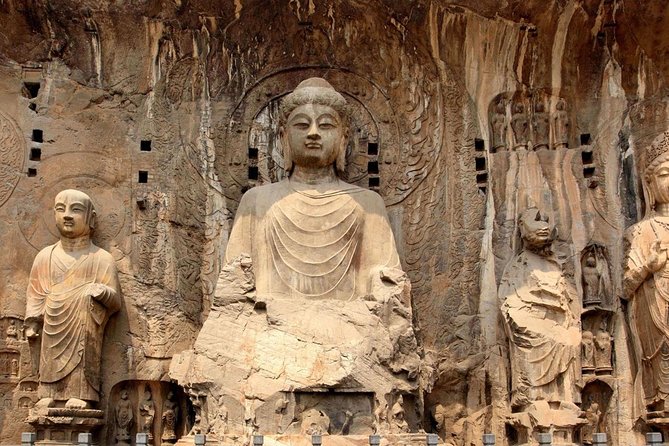
- Major example: The Fengxian Temple complex, especially its colossal Vairocana Buddha, completed in 675 CE during the Tang dynasty.
Do not assume that “cave” means a small or secluded chamber. At Longmen, some spaces function as monumental cliff sanctuaries. The site brings together architecture, sculpture, inscriptions, ritual practice, and landscape. That combination matters because AP Art History questions often ask how an artwork operated within its wider cultural setting.
Historical Context: Buddhism, Empire, and Cultural Exchange
From India through Central Asia to China
Buddhism originated in South Asia and reached China through trade, pilgrimage, translation, and diplomatic networks. As Buddhist ideas and images moved through Central Asia, architectural forms and visual conventions traveled with them. Chinese artists did not merely reproduce foreign models. They adapted Buddhist beliefs and imagery to local political structures, available materials, and Chinese ideas about rulership.
This is a central point for AP Art History Buddhist art. The Longmen sculptures show how a religious tradition became rooted in Chinese society. Their iconography reflects Buddhist belief, while their scale and placement also advertise the power of the patrons who financed them.
Royal and elite patronage
The Northern Wei court moved its capital to Luoyang in 493 CE, helping turn the region into a major center of Buddhist construction. Court-sponsored cave temples presented the dynasty as a legitimate Buddhist power and a protector of the faith. Later, Tang rulers and high-ranking officials continued to support ambitious carving campaigns.
Patronage helps explain why Longmen is more than a collection of devotional images. It is also a political statement carved into the landscape. A ruler or official who commissioned a colossal Buddha could demonstrate piety, wealth, administrative control, and concern for the spiritual welfare of the state. In an AP response, connect the donor’s role to the sculpture’s public scale and prominent setting.
The Fengxian Temple is especially effective evidence for this argument. Its central Vairocana Buddha is not simply a religious image. The immense figure dominates the carved sanctuary, creating a commanding presence for anyone who approaches it. Its grandeur suggests how Buddhist devotion and imperial authority could support one another.
Longmen Grottoes Art Analysis: Materials and Process
Artists worked directly in living limestone cliffs rather than producing freestanding sculptures in a separate workshop. That decision shaped both the carving process and the viewer’s experience. Carvers removed stone from the cliff face, blocked out the major forms, and then refined facial features, robes, jewelry, and hand gestures. Many sculptures were originally painted, though much of the pigment has since disappeared.
Carving into a cliff creates an immediate relationship between image and site. The Buddha is not merely installed inside a cave; the figure seems to emerge from the mountain itself. The rock gives the sculpture permanence and visual authority, while the surrounding carved architecture directs how visitors approach, view, and move through the sanctuary.
Material can distinguish a precise answer from a generic one. Rather than saying that the sculptures are simply “large and detailed,” explain that limestone allowed artists to integrate sacred images with the cliff face. The carved environment supported ritual viewing and made Buddhist imagery part of a lasting sacred landscape.
Iconography: How to Read the Buddhist Images
Longmen includes a broad range of Buddhist figures. One of the most useful identification skills is recognizing how visual features communicate a figure’s identity and role.
Vairocana Buddha
The central figure at Fengxian Temple is generally identified as Vairocana, the cosmic Buddha associated with the Mahayana idea of universal illumination. The sculpture is enormous, frontal, and visually dominant. Its scale creates an encounter that feels both devotional and political.
When describing the image, begin with observable evidence. Discuss the frontal pose, calm expression, symmetrical arrangement, large head, stylized hair, and monumental scale. Then connect those features to meaning: the figure’s authority, transcendence, and cosmic importance.
Bodhisattvas
Bodhisattvas are enlightened beings who delay final release in order to assist others. They can often be recognized by elaborate crowns, jewelry, patterned garments, and graceful poses. Unlike the comparatively austere Buddha, a bodhisattva may appear richly adorned and more immediately engaged with the viewer.
That contrast is useful in a visual comparison. The Buddha can represent perfected enlightenment, while the bodhisattva’s ornament and compassionate role make the figure feel more accessible to worshippers. Still, avoid claiming that every decorated figure is a bodhisattva without considering its attributes, placement, and context.
Mudras, halos, and attendants
Hand gestures, or mudras, carry religious meaning. A gesture may signal teaching, meditation, reassurance, or another aspect of Buddhist practice. Halos mark sacred status and distinguish divine figures from ordinary human participants. Attendant figures reinforce the hierarchy surrounding the main Buddha.
Read the arrangement as a system. A central figure encircled by smaller attendants establishes a clear visual hierarchy. Size, position, and proximity direct the viewer toward the most important being. In a timed response, that hierarchy can provide some of your strongest visual evidence.
Longmen Caves Visual Analysis: A Reliable Exam Method
Use the following sequence when a prompt asks you to analyze the site or a related image.
1. Identify the visible subject
Start with what is visible: a monumental seated Buddha, surrounding bodhisattvas, a cliff-cut sanctuary, inscriptions, or groups of smaller figures. Name the subject only when the visual evidence supports the identification.
2. Describe formal qualities
Discuss scale, pose, symmetry, line, surface, space, and composition. For example, the central Buddha’s frontal orientation and immense size create stability and authority. Repeated figures and symmetrical placement organize the viewer’s attention.
3. Explain function
Ask what the space was designed to do. The caves served Buddhist devotional and ritual purposes. Worshippers could approach sacred images, make offerings, pray, and take part in acts believed to generate spiritual merit. Inscriptions and donor images could record personal, family, or political devotion.
4. Connect form to meaning
This is where an answer becomes more persuasive. Do not stop at “the Buddha is large.” Explain that monumental scale makes the sacred figure physically overwhelming and communicates cosmic or political authority. Do not merely mention the cave, either. Explain how the carved cliff unites religion, architecture, sculpture, and landscape.
5. Add historical context
Relate the work to the spread of Buddhism, the Northern Wei capital at Luoyang, Tang imperial patronage, and cultural exchange along routes connecting China with South and Central Asia. Context should sharpen your analysis of the artwork, not replace it.
Exam Themes to Remember
Patronage and power
Ask who commissioned the work, who paid for it, and what the patron hoped to communicate. Imperial sponsorship could express religious devotion while strengthening the public image of the state. Private donors could seek merit, protection, remembrance, or social prestige.
Religion and ritual
The sculptures were not created solely for visual appreciation. They belonged to active religious environments. Images helped worshippers visualize Buddhist teachings and engage with the sacred through prayer, offerings, and ritual movement.
Cultural exchange
The Longmen Caves reveal the movement of ideas across Asia. Buddhist imagery entered China from outside the region, but Chinese artists reshaped it through local styles, political needs, and carving traditions. Cultural exchange is not passive copying; it involves selection, transformation, and the creation of new meanings.
Site and environment
The cliffs beside the Yi River shaped the experience of the artwork. Natural rock, carved architecture, and sculpture operate together. This site-specific quality can support an argument about how location affects meaning.
Common Mistakes in Longmen Caves AP Art History Answers
- Confusing the Longmen Caves with other cave sites: Do not substitute details from Ajanta, Dunhuang, or Yungang without checking the location and historical period.
- Calling every figure Buddha: Distinguish Buddhas, bodhisattvas, guardians, donors, and attendants when the evidence allows.
- Ignoring patronage: Monumental scale and labor-intensive carving point to powerful sponsors.
- Describing without analyzing: Turn observations into claims about religious meaning, hierarchy, or authority.
- Using vague cultural exchange language: Name the movement of Buddhism through South Asia, Central Asia, and China, then explain how Chinese artists adapted it.
- Forgetting material: Limestone carving into a cliff is central to the site’s identity.
How to Analyze the Longmen Caves for AP Art History
For a short-answer response, use a clear claim-evidence-meaning structure. A sample answer might read: “The central Vairocana Buddha’s colossal scale and frontal pose establish visual authority within the Fengxian Temple. Carved directly into the limestone cliff, the figure becomes part of a permanent sacred landscape. The Tang imperial context links Buddhist devotion to political power and demonstrates how rulers used religious patronage to reinforce legitimacy.”
That response works because it identifies a formal feature, cites material and site, and explains historical significance. It does not rely on decorative description alone.
FAQ: Longmen Caves AP Art History
What makes the Longmen Caves important in AP Art History?
The site brings together Buddhist religious practice, Chinese imperial patronage, cultural exchange, monumental sculpture, and site-specific architecture. It demonstrates how imported religious ideas were transformed within a Chinese historical and political context.
Which Buddhist features appear in Longmen Caves art?
Common features include Buddhas, bodhisattvas, halos, mudras, lotus imagery, attendants, guardians, donor figures, and hierarchical groupings. Elaborate jewelry often helps identify bodhisattvas, while a central monumental figure may establish the primary sacred focus.
How should I analyze the Longmen Caves for AP Art History?
Identify the subject and location, describe formal qualities, explain the function of the cave sanctuary, connect visual evidence to Buddhist meaning, and place the site within Northern Wei and Tang history. Include material—especially limestone carving—and discuss patronage.
Why is the Fengxian Temple important?
The Fengxian Temple contains the colossal Vairocana Buddha completed in 675 CE. Its scale, central position, and commanding presence demonstrate how Tang-period Buddhist sculpture could express both spiritual power and imperial authority.
How does material affect the meaning of the sculptures?
Because the images were carved into limestone cliffs, they appear permanently connected to the landscape. The material also enabled monumental scale and gave the sanctuary a stable, ancient, and authoritative character. Originally painted surfaces would have added visual impact, even though much of that pigment has faded.
Conclusion: Build a Stronger AP Art History Review
The Longmen Caves are best remembered as a meeting point of religion, politics, material, and place. Identify the Buddhist figures, explain the limestone carving, analyze the visual hierarchy, and connect the site to Northern Wei and Tang patronage. This method gives you flexible evidence for identification questions, contextualization prompts, and visual-analysis essays. Explore our study-ready educational products to support your next AP Art History review session.
